

In a 3PL warehouse, small delays can quickly turn into missed SLAs, inventory errors, billing issues, and unhappy clients. That is why many logistics providers use 3PL software to manage warehouse tasks, client inventory, orders, returns, and fulfillment workflows in one system.
What Is 3PL Warehouse Management Software?
A 3PL WMS manages inventory and warehouse execution for multiple clients. Depending on the platform, it also supports client-specific fulfillment rules, activity-based billing, reporting, integrations, and controlled client access.
Key 3PL WMS Features to Look for in 2026
A 3PL warehouse management system should do more than store inventory data. For third-party logistics providers, the right platform needs to support multi-client operations, order accuracy, warehouse visibility, carrier coordination, returns, billing, reporting, and system integrations.
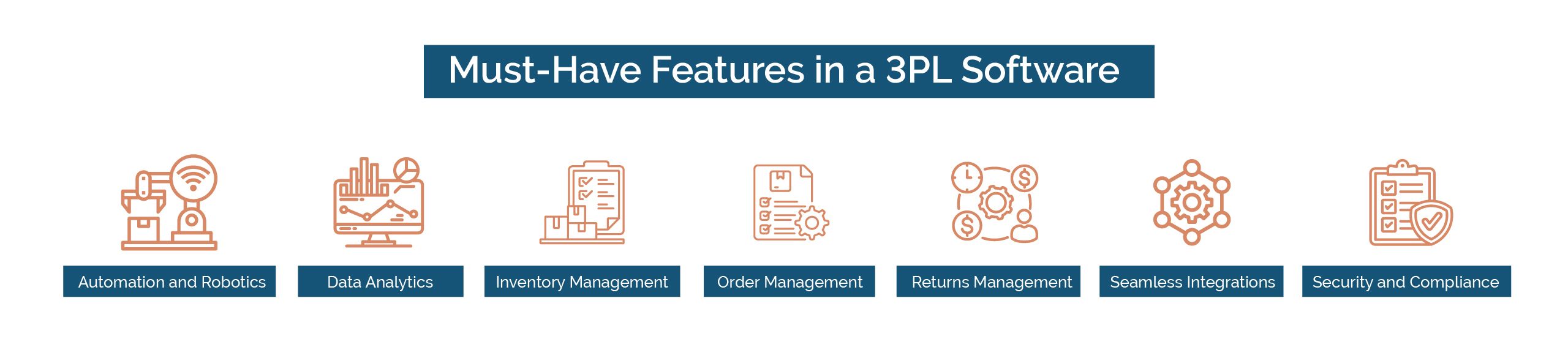
Here are the 3PL WMS features that matter most when choosing warehouse software in 2026:
Multi-Client Inventory and Access Control
Every inventory record, order, return, and warehouse transaction should remain linked to the correct client. Check how the system handles identical SKU codes across accounts, client-specific workflows, and permissions that restrict each customer to its own information.
Activity-Based 3PL Billing
A 3PL WMS should capture chargeable warehouse services against the correct client and agreed rate card. Evaluate storage calculations, receiving charges, picking fees, returns, kitting, minimum charges, and billing exceptions.
Ask the vendor to demonstrate how a recorded warehouse activity becomes a charge that your team can review before invoicing. Learn more about 3PL billing automation.
Warehouse Automation
Automation is one of the most useful features in a modern 3PL WMS. It reduces manual work across receiving, putaway, picking, packing, shipping, and stock movement.
For growing 3PL warehouses, automation does not always mean robotics from day one. Many teams first need scan-based workflows, automated task assignment, barcode validation, picklist generation, shipping rules, and exception alerts.
These features help reduce picking errors, speed up order processing, and make warehouse work easier to control during busy periods.
Inventory Visibility
Inventory management is a core part of any warehouse management system, but 3PL operations need more than basic stock tracking.
A 3PL WMS should give warehouse teams and clients real-time inventory visibility into stock levels, SKU movement, bin locations, receiving status, reserved inventory, damaged goods, and available inventory.
This helps reduce stock mismatches, overstocking, understocking, and client disputes. It also makes it easier to manage inventory across multiple warehouses, sales channels, and fulfillment accounts.
Order Management
Order management helps 3PL teams receive, process, prioritize, pick, pack, and ship customer orders through defined workflows, with exceptions routed for review.
A strong order management feature should support order filtering, status tracking, fulfillment rules, bulk actions, warehouse assignment, shipping updates, and exception handling.
For 3PL providers, this is especially important because every client may have different order rules, shipping methods, packaging needs, and SLA requirements.
Returns Processing
Poor returns tracking can create inventory confusion. A 3PL WMS should connect returned items with the correct client and original order, record inspection results, and support restocking, quarantine, or other disposition decisions. Only stock approved as sellable should become available for fulfillment again.
Good returns workflows give both the warehouse and the client a clear view of what came back, what condition it is in, and what should happen next.
This is important for ecommerce fulfillment, marketplace orders, D2C brands, and high-volume 3PL operations where return volume can quickly affect available stock.
Data Analytics and Reporting
A 3PL WMS should turn warehouse activity into useful operational data. Instead of guessing where delays happen, managers should be able to track order volume, picking accuracy, fulfillment speed, inventory movement, shipping performance, return rates, and client-level activity.
Client reporting is also important for communication and account management. 3PL providers need clear dashboards and reports that show performance, inventory status, order progress, and billing-related activity.
The best systems make it easier to spot bottlenecks before they turn into missed SLAs or client complaints.
Ecommerce and Carrier Integrations
Integrations connect the warehouse with the tools clients already use. A 3PL WMS should integrate with ecommerce platforms, marketplaces, shopping carts, ERPs, shipping carriers, and accounting tools.
Useful integrations may include Shopify, WooCommerce, BigCommerce, Amazon, eBay, Walmart, FedEx, UPS, DHL, and USPS.
These connections reduce duplicate data entry, speed up order import, sync tracking updates, improve inventory accuracy, and keep fulfillment data consistent across different systems.
Confirm whether each required connection is prebuilt, provided through a third party, or requires custom development. Check the supported data, update frequency, failure alerts, and maintenance responsibilities.
Security and Audit Controls
3PL providers handle sensitive client data, customer details, order records, inventory information, and billing data. That makes security an important part of any warehouse software decision.
A reliable 3PL WMS should include role-based access, client-level permissions, user permissions, audit logs, data encryption, secure login controls, and activity tracking.
These features help protect warehouse data, reduce internal mistakes, and support better accountability across teams, clients, and locations.
What Makes a WMS Suitable for 3PL Operations?
WMS capabilities vary by platform. For a 3PL, suitability depends on how the system handles client ownership, account-specific workflows, service billing, reporting, and controlled access.
| Requirement | What to Verify |
|---|---|
| Client inventory | Stock remains separated by owner, location, and status. |
| Billing | Warehouse activities connect to client-specific rate cards. |
| Reporting | Each client can access its own operational records. |
| Integrations | Connections support each client’s required systems. |
| Workflows | Client rules can differ without disrupting other accounts. |
When Should a 3PL Move From Spreadsheets to a WMS?
Consider a WMS when manual tracking repeatedly causes inventory discrepancies, delayed orders, missed service charges, or slow client reporting. Document those problems and test whether the proposed system can address them before committing to implementation.
Final Thoughts
Choosing the right 3PL warehouse management system can make daily warehouse operations easier to control. From inventory visibility and order accuracy to returns, integrations, reporting, and client communication, a 3PL WMS gives logistics providers the structure they need to manage growth without depending on manual processes.
For third-party logistics companies, the goal is not just faster fulfillment. It is fewer errors, clearer workflows, better client visibility, and more reliable warehouse performance across every order.
Schedule a Free Demo to see how Fulfillor can support your 3PL warehouse operations.