
Warehousing is changing quickly. Ecommerce growth, rising labor costs, customer expectations, and pressure for faster fulfillment are pushing warehouses to become more accurate, automated, connected, and data-driven.
For 3PLs, ecommerce fulfillment teams, distributors, and warehouse operators, the important question in 2026 is not whether warehouse technology will become more important. It is which technologies can solve measurable operational problems.
The U.S. warehouse management system market was valued at USD 783.0 million in 2023 and is projected to grow at a CAGR of 20.0% from 2024 to 2030, according to Grand View Research. The research identifies warehouse automation and the need to reduce operating costs as important drivers of WMS adoption.
Many of the warehousing trends shaping 2026 depend on the same foundation: accurate operational data and connected warehouse workflows. A modern warehouse management system can provide that foundation by connecting inventory, orders, locations, picking, packing, shipping, and reporting.
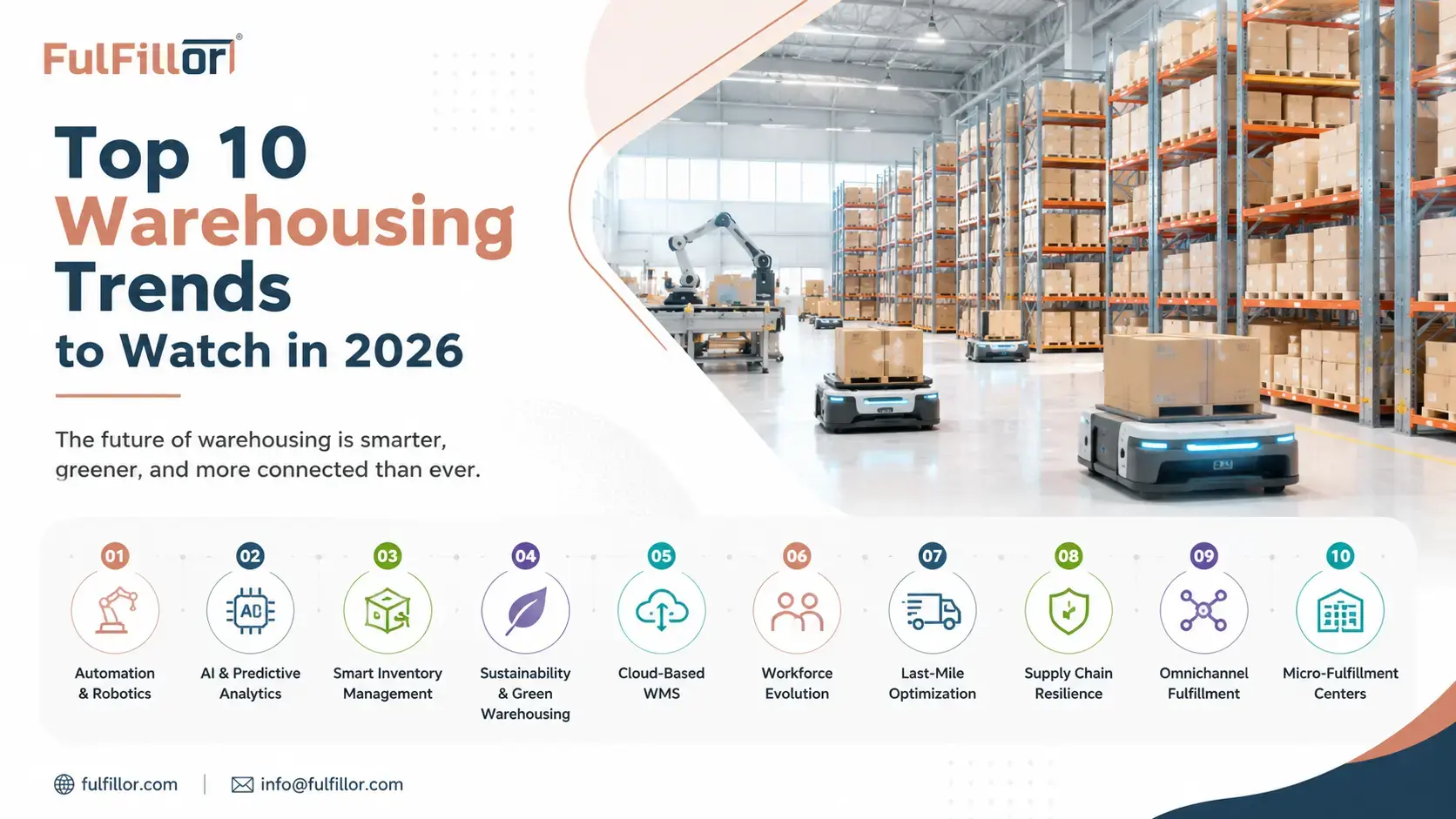
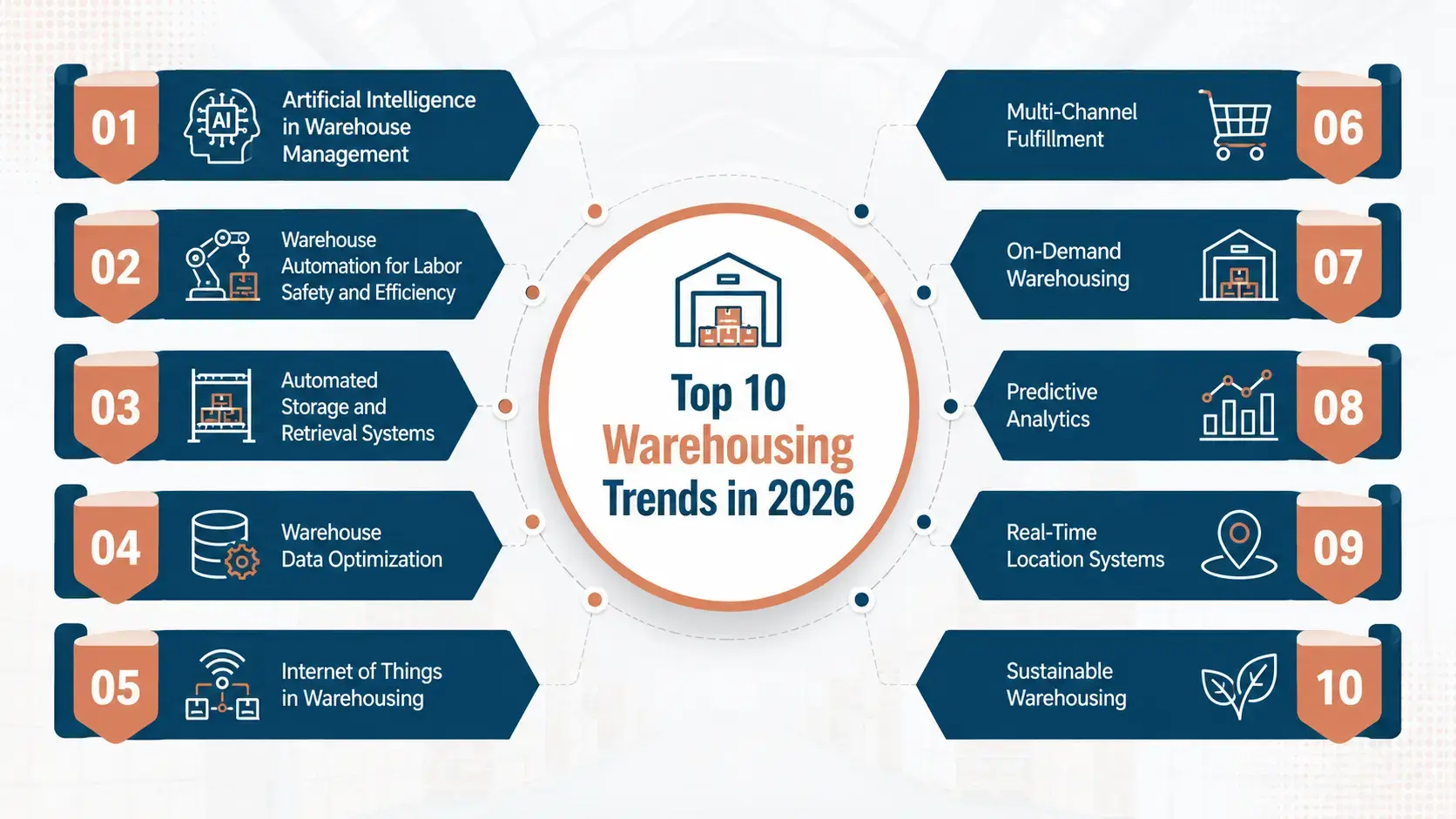
Here are 10 warehousing trends worth watching in 2026 and where each can make the biggest operational difference.
Top 10 Warehousing Trends Transforming Fulfillment in 2026
The most important warehouse trends in 2026 center on practical automation, AI-assisted decision-making, real-time visibility, flexible infrastructure, better use of space, and stronger system resilience.
1. AI for Warehouse Decision Support
Artificial intelligence is moving beyond general discussion and into specific warehouse decisions.
Rather than replacing warehouse managers, AI can help analyze large volumes of operational data and identify patterns that would be difficult to monitor manually across thousands of SKUs, orders, locations, and warehouse events.
Practical applications include:
- Forecasting changes in order and workload volume
- Identifying fast-moving or slow-moving inventory
- Supporting slotting and storage recommendations
- Estimating labor requirements
- Detecting unusual inventory or fulfillment activity
For example, a warehouse preparing for a seasonal promotion can analyze historical order patterns to identify which SKUs are likely to move fastest. Teams can then review replenishment, labor, and storage decisions before order volume increases.
For a deeper explanation of these applications, see our guide to artificial intelligence in warehouse management.
AI still depends on reliable warehouse data. If inventory movements are poorly recorded, locations are inaccurate, or workflows are inconsistent, more sophisticated analysis will not fix the underlying problem.
2. AMRs and Modular Warehouse Automation
Warehouse automation does not always require rebuilding an entire facility around fixed robotics.
One of the more practical trends is modular automation that can be introduced around specific warehouse bottlenecks. Autonomous mobile robots, or AMRs, automated guided vehicles, conveyors, barcode-driven workflows, packing automation, and software-based task automation can each address different forms of repetitive work.
For example, if pickers spend a large part of each shift walking between distant locations, mobile robots or goods-to-person systems may reduce travel. If packing teams repeatedly enter shipment information manually, software automation may provide a faster return than expensive physical equipment.
The most useful question is therefore not:
How much of the warehouse can we automate?
It is:
Which repetitive process is creating the most labor, delay, or errors?
This allows warehouse operators to introduce automation around measurable operational problems instead of treating automation as a technology project by itself.
3. AS/RS and High-Density Storage
Automated storage and retrieval systems, or AS/RS, are becoming more relevant where warehouse space and product retrieval time limit throughput.
Instead of requiring workers to repeatedly travel to storage locations, AS/RS equipment can automatically store or retrieve products for picking and replenishment.
The technology is most relevant when a warehouse has:
- High order or retrieval volume
- Limited or expensive warehouse space
- High SKU density
- Repetitive storage and retrieval activity
The value is not simply automation. AS/RS can allow warehouses to use vertical and high-density storage more effectively while reducing the distance workers travel during normal fulfillment activity.
It is not automatically the right investment for every operation. Warehouses with lower volumes or simpler inventory flows may gain more from improved slotting, barcode workflows, or better picking processes before investing in capital-intensive storage systems.
4. Real-Time Warehouse Visibility and Unified Data
Warehouses already generate large amounts of data. The challenge is turning that information into something operations teams can act on.
Inventory movements, receiving activity, picking rates, order cycle times, returns, labor activity, storage usage, and client performance can all provide useful signals. When those records exist across spreadsheets and disconnected systems, however, managers spend too much time assembling information after problems have already happened.
Real-time warehouse visibility focuses on creating a shared operational view of what is happening now.
Useful metrics can include:
| Metric | What It Can Reveal |
|---|---|
| Inventory accuracy | Whether system quantities match physical stock |
| Order cycle time | How long orders take to move through fulfillment |
| Picking accuracy | How consistently the correct SKU and quantity are picked |
| Storage utilization | How effectively warehouse capacity is being used |
| Client SLA performance | Whether a 3PL is meeting agreed fulfillment requirements |
For 3PL operators, visibility also needs to work at the client level so inventory ownership, order status, warehouse performance, and service levels remain clear across multiple accounts.
The goal is not to create more dashboards. It is to make operational exceptions easier to identify before they become larger fulfillment problems.
5. IoT, RFID, and Real-Time Asset Tracking
The Internet of Things connects physical warehouse events with digital systems.
Warehouse IoT can include RFID tags, scanners, environmental sensors, connected equipment, and real-time location technologies used to track inventory, pallets, containers, equipment, or facility conditions.
The strongest use cases usually begin with a specific visibility problem.
A cold-storage warehouse may need continuous temperature monitoring. A facility handling valuable inventory may need better asset tracking. A large distribution center may need to know where pallets, carts, or equipment are located without relying on manual searches.
Typical applications include:
- RFID-based inventory visibility
- Pallet and container tracking
- Environmental monitoring
- Equipment monitoring
- Real-time asset location
- Alerts when inventory enters or leaves defined zones
Collecting more sensor data is not useful by itself. The operational value appears when a recorded event can trigger a warehouse action, alert, or exception workflow.
6. Unified Multichannel Fulfillment
Multichannel fulfillment has become a normal requirement for ecommerce brands and 3PL providers.
A warehouse may receive orders from Shopify, WooCommerce, Amazon, Walmart, eBay, wholesale systems, retail channels, and direct sales at the same time.
The challenge is not simply importing those orders. Inventory, allocation, order priority, fulfillment status, and shipping information need to remain synchronized while different channels use the same warehouse network.
A connected multichannel workflow can help warehouses:
- Bring orders into a shared operational system
- Maintain synchronized inventory availability
- Allocate stock against active orders
- Reduce repeated manual data entry
- Coordinate fulfillment and shipping activity
- Return order and shipment updates to connected channels
For 3PLs, this becomes more complex because different clients may use different sales channels, inventory rules, carriers, and service requirements.
Our guide to multichannel inventory management for 3PLs explains the inventory synchronization and allocation side of this problem in more detail.
The broader trend in 2026 is toward one reliable operational view across connected sales and fulfillment systems rather than adding isolated marketplace integrations.
7. Flexible and On-Demand Warehouse Capacity
Not every business wants to commit to additional permanent warehouse space because demand might increase.
Flexible and on-demand warehousing allows businesses to add storage or fulfillment capacity without immediately making the same long-term infrastructure commitment required by opening another dedicated facility.
This can be useful when a business is:
- Preparing for seasonal inventory
- Entering a new geographic market
- Testing regional demand
- Managing a temporary order surge
- Moving inventory closer to customers
For example, a brand entering another region may want to position inventory closer to customers without immediately opening and staffing its own warehouse.
The same model can create opportunities for 3PLs that have available capacity and can support additional client volume.
The operational challenge is maintaining visibility as inventory becomes distributed across more facilities. Warehouse teams still need to know where stock is available, which facility should fulfill an order, and whether each location is meeting service requirements.
Flexible capacity works best when additional locations remain part of the same connected inventory and fulfillment environment.
8. Digital Twins and Warehouse Simulation
Digital twins are emerging as a way to test warehouse decisions before changing the physical operation.
A warehouse digital twin creates a virtual representation of warehouse processes, resources, layouts, or material flows using operational data.
Instead of moving storage areas, adding equipment, or changing workflows and then waiting to see what happens, teams can use simulation to evaluate possible outcomes first.
Digital twins and simulation can support questions such as:
- What happens if order volume increases significantly?
- Will a proposed layout create new congestion?
- Where might a new automation system create bottlenecks?
- How would adding another packing station affect throughput?
- What happens to travel time if fast-moving inventory is relocated?
- How much additional capacity can the current operation support?
This is particularly useful when physical warehouse changes are expensive or difficult to reverse.
The value of simulation depends on the quality of the underlying data. A warehouse model built on inaccurate inventory, travel-time, or process data can produce a very sophisticated representation of the wrong operation, which would be an impressively expensive way to remain confused.
9. Warehouse Cybersecurity and System Resilience
As warehouses become more connected, cybersecurity becomes an operational issue rather than only an IT concern.
Modern warehouse operations may depend on cloud WMS platforms, APIs, ecommerce integrations, mobile scanners, carrier systems, automation equipment, IoT devices, and client portals.
A security incident affecting those systems can disrupt inventory visibility, order processing, picking, shipping, or client access even if nothing physical has happened inside the warehouse.
Warehouse system resilience increasingly requires attention to:
- Role-based access and user permissions
- Secure integrations and APIs
- Mobile and handheld device access
- Vendor and third-party system access
- Data backup and recovery
- Monitoring unusual system activity
- Business continuity when a connected service fails
The goal is not only to prevent unauthorized access. Warehouses also need to understand how fulfillment continues when an important system or integration becomes unavailable.
As software and automation become more deeply connected to physical operations, cybersecurity and operational continuity become part of warehouse planning.
10. Sustainable and Energy-Efficient Warehousing
Sustainable warehousing is often discussed as an environmental goal, but many sustainability improvements also reduce operating waste.
Poor slotting creates unnecessary travel. Inventory mistakes cause extra handling and reshipping. Excess packaging consumes materials. Paper-heavy workflows create administrative work. Poor use of warehouse space increases the facility capacity required to support the same volume.
Practical improvements can include:
- Moving paper-based processes into digital workflows
- Reducing unnecessary picker and equipment travel
- Improving packaging decisions
- Using warehouse space more efficiently
- Reducing unnecessary inventory movement
- Improving inventory accuracy to reduce avoidable reshipping
- Using energy-efficient lighting and warehouse equipment
The useful approach is to make sustainability part of normal warehouse decisions rather than separating it from operational efficiency.
For many warehouses, reducing wasted movement, materials, energy, and rework can support both sustainability goals and lower operating costs.
Which Warehousing Trends Should You Prioritize First?
A warehouse does not need to adopt every technology on this list.
The right trend to prioritize depends on the operational bottleneck the warehouse is already experiencing.
| If Your Main Problem Is... | Prioritize |
|---|---|
| Frequent inventory discrepancies | Barcode workflows, real-time visibility, and stronger WMS controls |
| High picking travel or repetitive movement | AMRs, slotting improvements, or AS/RS |
| Limited or expensive storage space | AS/RS and high-density storage |
| Seasonal or unpredictable workload | AI-supported forecasting and flexible capacity |
| Orders coming from many sales channels | Unified multichannel fulfillment |
| Misplaced pallets, assets, or equipment | IoT, RFID, and real-time asset tracking |
| Poor warehouse visibility | Unified warehouse data and real-time reporting |
| Need to test major layout or automation changes | Digital twins and warehouse simulation |
| Increasing dependence on connected warehouse systems | Cybersecurity and system resilience |
| High operating waste | Sustainable and energy-efficient warehouse processes |
For a 3PL, priorities can differ from those of a single-brand warehouse.
A multi-client operation may first need to solve inventory ownership, integration reliability, client reporting, order routing, billing accuracy, or workflow consistency before investing in advanced automation.
If basic operational data is unreliable, AI, analytics, or simulation will simply analyze unreliable information more efficiently.
The best starting point is the process creating the largest combination of cost, delays, errors, or client complaints.
Why a Modern WMS Still Matters
Many of the technologies shaping warehousing in 2026 either create operational data or depend on it.
Robotics needs accurate information about inventory, tasks, and locations. Multichannel fulfillment depends on synchronized orders and available inventory. AI and digital twins require trustworthy warehouse events. IoT and RFID become more useful when physical events can be connected to warehouse workflows.
A WMS provides the operational layer connecting those activities.
A modern WMS can manage:
- Inventory and warehouse locations
- Order allocation and fulfillment
- Picking and packing workflows
- Receiving and putaway
- Shipping and tracking
- Returns
- Warehouse activity and reporting
For a 3PL, the system also needs to separate inventory, workflows, reporting, and operational activity across multiple client accounts.
This makes interoperability more important than simply collecting more warehouse technologies. New systems should strengthen the operational flow rather than creating another isolated source of data.
Final Thoughts
The strongest warehouse technology investments in 2026 are the ones tied to measurable operational problems.
For one warehouse, that may mean AMRs or AS/RS to reduce travel and storage constraints. For another, the priority may be better inventory visibility, multichannel synchronization, cybersecurity, or improved use of operational data.
For 3PLs, ecommerce brands, distributors, and fulfillment teams, the foundation remains reliable information across inventory, orders, warehouse locations, and fulfillment workflows.
A connected WMS can provide that operational foundation while allowing automation, AI, IoT, multichannel systems, and other technologies to work from more consistent warehouse data.
Explore Fulfillor's warehouse management software to see how inventory, orders, fulfillment, shipping, reporting, and multi-client warehouse workflows can be managed from one connected system.