
Order fulfillment doesn’t usually break all at once. It starts with small issues like delayed updates, inventory mismatches, or slower processing times. As order volume grows and sales channels increase, these problems become harder to manage.
What are often called “trends” in fulfillment are usually responses to these operational challenges.
The goal is to reduce processing delays, improve inventory accuracy, and give both warehouse teams and customers better visibility into order status.
What is Order Fulfillment?
Order fulfillment refers to the process from when a customer places an order to when it is delivered. It includes receiving inventory, storing products, picking and packing orders, shipping, and handling returns.
In practice, this process becomes more complex as order volume increases or when orders are managed across multiple sales channels.
What’s Changing in Order Fulfillment Operations
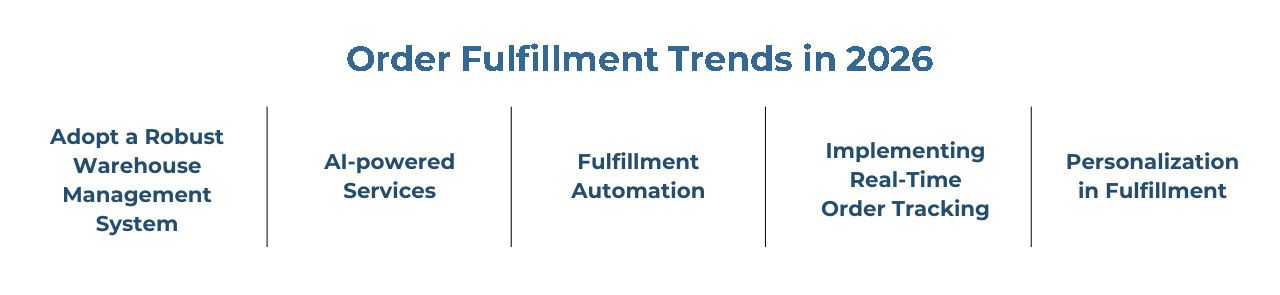
As these challenges grow, businesses adopt different approaches to improve consistency, speed, and coordination across workflows.
Some of the key shifts seen in fulfillment operations include:
- Adoption of warehouse management systems (WMS)
- Use of AI-driven forecasting and decision-making
- Increased reliance on fulfillment automation
- Real-time order tracking and visibility
- Personalization in fulfillment workflows
Adopt a Robust Warehouse Management System (WMS)
A warehouse management system connects inventory records, order processing, picking, packing, and warehouse tasks in one environment. Barcode-based workflows and real-time updates help teams maintain stock accuracy across channels and locations.
In multi-client operations, a configurable WMS can also separate workflows, inventory ownership, user access, and reporting requirements for each account.
AI-Driven Decision Making in Fulfillment
As order volume and demand variability increase, manual decision-making becomes harder to manage. This often leads to issues like stockouts, overstocking, or inefficient order processing.
AI-based systems help analyze order patterns, predict demand, and adjust inventory levels based on changing conditions. This can support replenishment planning, inventory allocation, and demand-based staffing decisions without relying entirely on manual calculations.
AI recommendations are only as reliable as the order, inventory, supplier, and lead-time data used to generate them.
Fulfillment Automation
Fulfillment automation can include conveyors, automated guided vehicles, robotic picking systems, and automated storage and retrieval systems. These technologies reduce repetitive movement and support higher throughput, but they require accurate inventory data, stable workflows, and enough order volume to justify the investment.
Implementing Real-Time Order Tracking
Real-time order tracking combines warehouse status updates, carrier scan events, shipping integrations, and customer notifications to show where an order is within the fulfillment and delivery process.
Better visibility also helps warehouse and customer-service teams identify delayed orders, failed delivery attempts, and carrier exceptions before they lead to repeated customer inquiries.
Personalization in Fulfillment
Fulfillment personalization often appears through client-specific packing rules, branded packaging, product inserts, kitting, subscription-box assembly, and delivery preferences. These services can improve the customer experience, but they also require accurate order data and clearly defined warehouse workflows.
How to Decide Which Fulfillment Changes Matter
Not every business needs advanced robotics, AI forecasting, or extensive automation. Before investing in new fulfillment technology, identify the operational constraint creating the greatest cost, delay, or error rate.
Businesses should first identify whether the main problem is inventory accuracy, picking speed, order visibility, multi-channel synchronization, labor dependency, or client-specific workflow complexity. Technology should address a documented operational problem rather than being adopted simply because it is described as a trend.
If you’re evaluating how to manage multi-channel fulfillment, inventory, and shipping workflows more effectively:
Explore how Fulfillor supports 3PL and warehouse operations in the US Schedule a emo with us!
Fulfillor is a cloud-based WMS and fulfillment platform built for mid-size 3PLs and growing warehouse operations that need flexible, multi-client workflows without enterprise complexity.