Most ecommerce businesses don’t think about an order management system early on. Orders are manageable, inventory is simple, and everything runs through a single platform.
The problems usually start later - when sales increase across multiple channels, inventory stops syncing properly, and order fulfillment becomes inconsistent. That’s when businesses begin looking for an OMS, often after operations have already become difficult to manage.
What Is an Order Management System (OMS) and Why Ecommerce Businesses Need One
An Order Management System (OMS) is typically introduced when managing orders manually or through a single platform starts becoming difficult.
As ecommerce businesses expand across multiple channels, inventory, order tracking, and fulfillment workflows often become harder to manage in sync. An OMS helps centralize these processes, ensuring orders are processed accurately and inventory stays consistent across channels.
Key Features and Components of an Order Management System (OMS)
The components of an order management system are as follows -
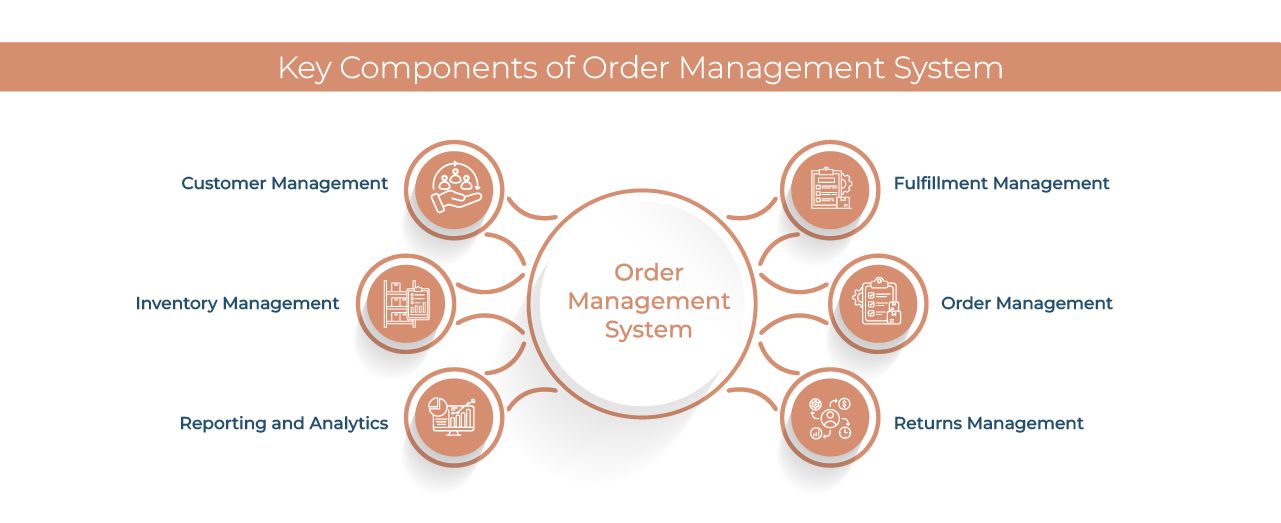
- Customer Management
- Fulfillment Management
- Inventory Management
- Order Management
- Reporting and Analytics
- Returns Management
1. Customer Management
It helps manage every aspect of the customer data like their name, contact number, address, order details, and other important information which helps provide personalized services to the customers like custom offers, coupons, etc. It also facilitates automated updates about the order status with real-time order tracking and visibility, while ensuring transparency.
2. Fulfillment Management
This feature helps direct orders to the relevant warehouses based on the location, stock availability, and other important aspects like order fulfillment time and costs. It also helps manage the delivery times alongside generating automated labels, thus streamlining the other processes like picking, packing, and shipping.
3. Inventory Management
As the name suggests, it helps manage the stock levels of products across different locations and warehouses from a centralized system alongside streamlining the goods restocking process. It helps eliminate the risks associated with the inventory like overstocking and understocking, thus leading to reduced losses and increased efficiency.
4. Order Management
It handles and automates the entire order processing approach with features like validating orders, tracking orders, and more, thus facilitating an enhanced customer experience alongside ensuring on-time delivery of the products.
5. Reporting and Analytics
This helps in providing detailed insights and reports on business performance based on various metrics like sales trends, order fulfillment rates, inventory levels, and other aspects. It also helps predict future market demands by using historical data, thus ensuring optimized stock levels to fulfill future customer needs.
6. Returns Management
Returns are an essential part of the order fulfillment process and this feature facilitates seamless and easy returns management. It involves the process of return by picking goods from the customer to their source with features like tracking returned items, processing refunds, exchanges, and more.
When You Actually Need an OMS
Most ecommerce businesses don’t need an OMS early on. It becomes necessary when orders come from multiple channels, inventory starts desynchronizing, and fulfillment delays begin affecting customer experience.
Top 5 Order Management Systems for Ecommerce in 2026
Moving forward, here are the top five order management solutions businesses should consider in 2026:
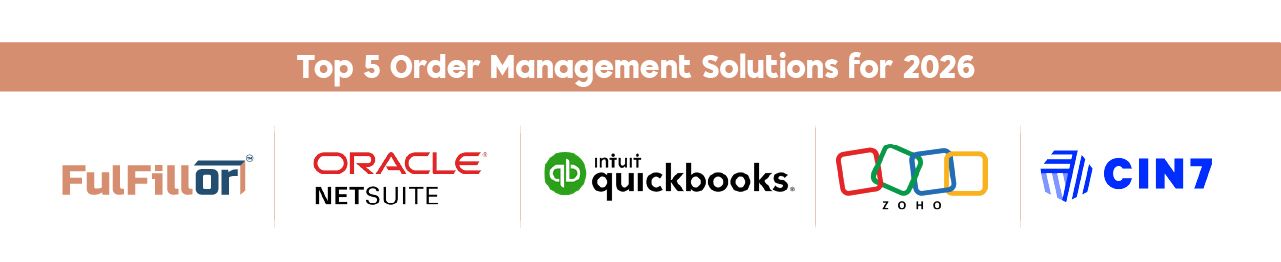
- Fulfillor – Order & Warehouse Management System
- NetSuite – Cloud-Based ERP with Order Management
- QuickBooks Commerce – Inventory and Order Management Solution
- Zoho Inventory – Order and Inventory Management Software
- Cin7 – Omnichannel Inventory and Order Management Platform
1. FulFillor - A 3PL WMS Software
Developed by NOI Technologies LLC, Fulfillor combines order management and warehouse operations into a single system, which becomes especially useful for businesses managing multi-client fulfillment or high order volumes.
Key features of Fulfillor 3PL WMS include: -
Connects with ecommerce platforms like Amazon, Shopify, and Walmart, which helps centralize orders coming from multiple channels without manual syncing.
Allows workflows to be adjusted based on how different clients or operations are structured, which is often required in 3PL environments.
It also facilitates advanced shipping integrations like FedEx, DHL, UPS, and more for streamlined shipping.
Fulfillor offers detailed insights and reports based on different metrics to make data-driven decisions for enhanced efficiency and customer satisfaction.
It also facilitates order routing, batch tracking, automated label generation,
Benefits of Fulfillor’s Order Management Software:
-
keeps inventory and order status aligned across channels to avoid stock mismatches
-
reduces manual coordination between inventory, orders, and fulfillment processes
-
helps teams manage higher order volumes without increasing operational complexity
-
Best for: 3PL providers and ecommerce businesses managing multi-client inventory, fulfillment workflows, and billing.
2. NetSuite
NetSuite, developed by Oracle, is a cloud-based Order Management System and ERP platform designed for small to mid-sized businesses. It helps organizations manage orders, inventory, financials, and customer data within a unified system, enabling better visibility and control across the entire order-to-cash lifecycle.
Key features of NetSuite include:
It helps in customizing workflows which further helps in seamless order processing to meet the unique business needs.
It facilitates real-time visibility of the entire business processes to ensure precision in tasks.
It also helps centralize the order fulfillment and management process, which in turn helps improve the efficiency of the workflows alongside increased productivity.
Key benefits of NetSuite include:
It provides the flexibility to adapt to changing business requirements. It also helps enhance the decision-making process by analyzing real-time data, thus ensuring accuracy. Works well for businesses needing ERP-level control, but can be complex and expensive for smaller ecommerce operations.
3. Quickbooks
QuickBooks, developed by Intuit, is a widely used accounting software that also offers basic order and inventory management capabilities. Licensed as proprietary software, it is commonly preferred by small businesses looking to manage accounting, invoicing, and order tracking within a single platform.
Key features include -
It facilitates seamless order processing with automated invoicing and billing. It provides real-time inventory management, which helps avoid overstocking and understocking alongside automated reordering as the inventory levels get low.
It also enables you to easily sync orders from other e-commerce channels like Shopify, Amazon, WooCommerce, and more.
The benefits of Quickbooks are -
It enables you to manage your finances, orders, inventory, etc from a unified platform.
It helps save time with automation alongside minimized errors and ensuring precision in tasks for enhanced customer satisfaction. Suitable for basic order tracking, but not ideal for multi-warehouse or high-volume fulfillment setups.
4. Zoho Corporation
Zoho Inventory, developed by Zoho Corporation, is a cloud-based Order Management System designed to help small and medium-sized businesses streamline order processing, inventory tracking, and fulfillment operations across multiple sales channels.
Its features include the following -
It facilitates seamless order tracking, starting from order placement till delivery, thus ensuring transparency. It also helps manage stock levels easily, across multiple locations and warehouses with ease.
Key benefits of Zoho’s Order Management Software include:
It is a cost-effective solution for small to medium-sized businesses. It is also scalable, which implies it easily accommodates the requirements as the business grows.
Works well for smaller operations but may be limited for complex multi-warehouse workflows.
5. Cin7
It is a cloud-based order management system that is accessible to businesses of every scale and seamlessly integrates with a wide range of e-commerce channels, marketplaces, accounting software, and more.
The features of Cin7 are as follows -
It helps automate the entire order fulfillment process which helps reduce errors and saves time, effort, and money. It synchronizes real-time data which further helps ensure accuracy in workflows alongside enabling you to plan inventory accordingly.
The benefits include the following -
It helps reduce costs with guided walk paths, wave-based picking capabilities, and more. It also helps improve employees' productivity with automation, thus enabling them to focus more on strategic processes.
Suitable for growing ecommerce brands, but can become complex as operations scale.
Which Order Management System Is Right for Your Business?
Not all OMS platforms are designed for the same type of operations. The right choice usually depends on how your business is structured.
- Small ecommerce businesses (single channel): Tools like QuickBooks or Zoho are often sufficient in early stages.
- Multi-channel ecommerce brands: Platforms like Cin7 help manage inventory and orders across multiple sales channels.
- ERP-driven businesses: NetSuite works well when financials and operations need to be tightly integrated.
- 3PL and warehouse-heavy operations: Systems like Fulfillor are better suited for managing multi-client workflows, fulfillment, and billing together.
Choosing the right OMS depends less on features and more on how your operations scale over time.
Choosing the Right Order Management System for Your Ecommerce Business
Choosing an OMS depends less on features and more on how your operations are structured. Businesses managing multiple channels, warehouses, or clients typically benefit from centralized systems, while smaller setups may not need that level of complexity early on.
Connect and Schedule a Demo with us now. Fulfillor's is one of the top order management solutions in the United States of America and is the need of the hour. Exemplify your business services with top-notch features and solutions customized to your unique business needs at business-friendly pricing.