

Managing a 3PL warehouse means coordinating inventory, orders, picking, packing, shipping, returns, and client requirements at the same time. As order volume and client accounts grow, spreadsheets and disconnected systems make it harder to maintain accuracy and visibility across daily warehouse operations.
A cloud-based 3PL WMS brings these processes into one connected platform that teams can access across warehouses and supported devices. Warehouse teams can separate stock by client, record every movement, and prevent one customer’s inventory from being allocated to another customer’s order, monitor warehouse activity, and scale operations without maintaining complex on-premise software infrastructure.
What Is a Cloud-Based 3PL WMS?
A cloud-based 3PL WMS is warehouse management software hosted by the provider and accessed through the internet. Unlike an on-premise system, it does not require the 3PL company to maintain local application servers or manage every software update internally.
The system helps third-party logistics providers manage inventory, orders, receiving, putaway, picking, packing, shipping, returns, and client reporting from one connected platform. It is designed for multi-client warehousing, where each customer may have different inventory rules, sales channels, carriers, fulfillment requirements, and reporting needs.
Warehouse teams can review inventory, orders, and fulfillment activity across locations. Client access can also be restricted by account, so each customer only sees its own inventory and orders.
Common capabilities include:
- Multi-client inventory management: Separate stock, orders, permissions, and reports by client.
- Remote access: Review warehouse activity and operational data from supported locations.
- System integrations: Connect with e-commerce platforms, marketplaces, carriers, and accounting tools.
- Provider-managed updates: Receive software improvements without manually installing updates on local servers.
- Scalable operations: Add users, clients, warehouses, and order volume as the business grows.
How a Cloud-Based WMS Addresses Common 3PL Warehousing Challenges
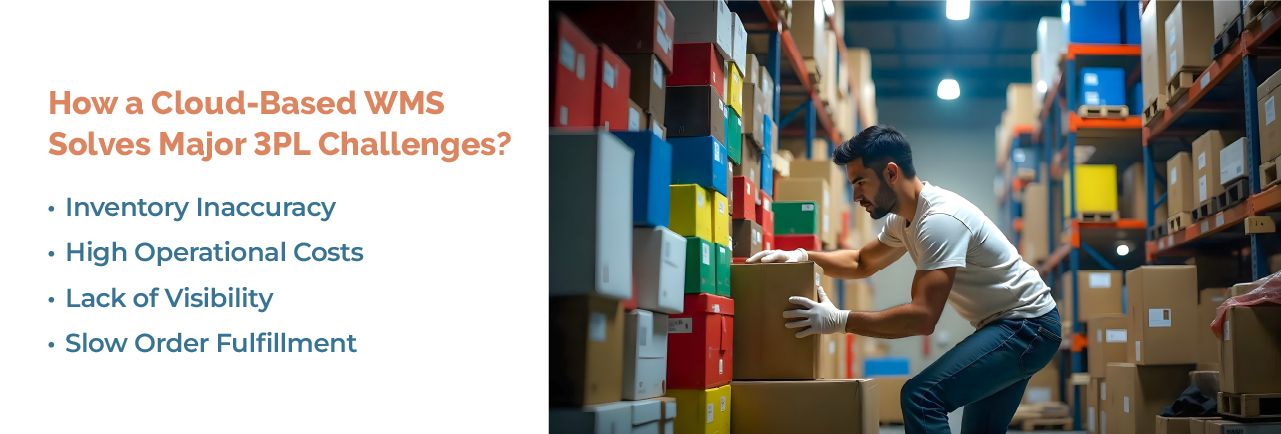
1. Inventory Inaccuracy
Managing inventory for multiple clients increases the risk of stock mismatches, misplaced items, and incorrect quantity records. A cloud-based WMS helps warehouse teams track receiving, putaway, transfers, picking, and adjustments through one centralized system.
Barcode scanning, inventory history, and cycle counting can also make it easier to identify and correct discrepancies before they affect customer orders.
Consider a 3PL receiving the same SKU for two different clients. The stock may be placed in the correct warehouse location but assigned to the wrong account. That error might remain hidden until an order is allocated or the client checks the available quantity. Client-level inventory records and scan validation help catch the mistake during receiving rather than after shipment.
2. High Warehouse Operating Costs
Manual processes, disconnected systems, and repeated data entry increase labor costs and slow down warehouse operations. A cloud-based WMS can reduce unnecessary administrative work by connecting inventory, order processing, fulfillment, and shipping workflows.
It can also reduce the need to maintain local application servers, although businesses should still consider subscription, implementation, device, training, and integration costs.
3. Limited Warehouse Visibility
Spreadsheets and separate warehouse systems make it difficult to see current inventory levels, order progress, and fulfillment issues across clients or locations.
Warehouse managers should not have to call three supervisors to find out why an order has not shipped. A connected WMS brings inventory changes, picking progress, packed orders, shipment status, and returns into the same system. Client access can also be limited by account, giving customers useful visibility without exposing another company’s inventory or orders.
4. Slow Order Fulfillment
Slow fulfillment often results from inefficient picking routes, manual order handling, poor inventory visibility, and disconnected carrier systems.
When orders move between separate spreadsheets, carrier portals, and warehouse tools, employees spend more time checking information than processing shipments. A connected WMS reduces those handoffs by assigning tasks, validating scans, and sending shipment data directly to integrated carriers.
Benefits of Cloud-Based 3PL WMS for Modern Warehousing

1. Scalable Warehouse Operations
A cloud-based 3PL WMS can support additional clients, users, warehouse locations, SKUs, and order volume as the business grows. This makes it easier for 3PL providers to expand operations without rebuilding their software environment for every new client or facility.
Scalability should still be evaluated carefully. Businesses should confirm how the system performs during seasonal peaks, large order imports, and multi-warehouse operations.
2. Better Warehouse Performance Insights
A 3PL WMS can help warehouse managers track operational metrics such as inventory accuracy, order cycle time, picking performance, storage use, returns, and client service levels.
The reports matter when they lead to a warehouse decision. A manager might use pick-time data to change product placement, compare error rates between shifts, or identify a client whose handling requirements consume more labor than expected.
3. Easier Access Across Warehouses
Cloud access can help regional managers review inventory, order progress, and warehouse issues across several facilities without logging into separate local systems.
4. Reduced Internal Software Maintenance
With a cloud-based WMS, the provider generally manages application hosting, platform maintenance, backups, and software releases. This can reduce the technical workload associated with maintaining an on-premise warehouse system.
3PL companies should still ask how updates are tested, communicated, and scheduled. A poorly timed release can disrupt warehouse activity even when the provider manages the underlying platform.
What to Look for in a Cloud-Based WMS for Your 3PL Company
Cloud-based 3PL software is not one-size-fits-all. The right system should support your current warehouse workflows while giving you enough flexibility to add clients, locations, users, and integrations as operations grow.
Before making the switch, evaluate these areas:
- Multi-client management: Can the system separate inventory, orders, users, workflows, reports, and permissions by client?
- Warehouse operations: Does it support receiving, putaway, picking, packing, cycle counting, shipping, and returns?
- Integration capabilities: Can it connect with your e-commerce platforms, marketplaces, shipping carriers, accounting tools, APIs, and webhooks?
- Scalability: Can the platform handle more clients, warehouses, SKUs, users, and order volume without significant performance issues?
- 3PL billing: Can it capture storage, receiving, handling, fulfillment, packaging, shipping, and value-added service charges?
- Security and privacy: What access controls, encryption methods, backup practices, audit logs, privacy measures, and certifications can the provider document?
- Ease of use: Can warehouse employees complete common tasks efficiently with minimal unnecessary steps?
- Implementation support: Who manages data migration, workflow configuration, integration testing, staff training, and launch support?
- Customer support: What support channels, service hours, response targets, and escalation procedures are available?
- Pricing structure: Are costs based on users, warehouses, orders, clients, integrations, modules, implementation, or support?
Conclusion
Cloud delivery is useful, but it should not be the only reason to choose a WMS. A 3PL should evaluate how well the system handles client separation, daily warehouse workflows, billing, integrations, and implementation. The right platform is the one that fits how the warehouse actually receives, stores, picks, packs, ships, bills, and reports.
Fulfillor 3PL WMS software supports multi-client inventory management, order fulfillment, warehouse operations, integrations, reporting, and client visibility. Schedule a product demonstration to review your warehouse workflows and implementation requirements.
About the Author: Visvendra Singh Rajpoot is the CEO of NOI Technologies & Fulfillor WMS and has more than five years of experience developing technology for warehouse and logistics operations.