

Multi-client warehouses can lose accuracy and control when receiving, inventory control, picking, shipping, returns, and client reporting rely on disconnected processes. These problems become harder to manage as a 3PL adds more clients, SKUs, sales channels, warehouse locations, and account-specific rules.
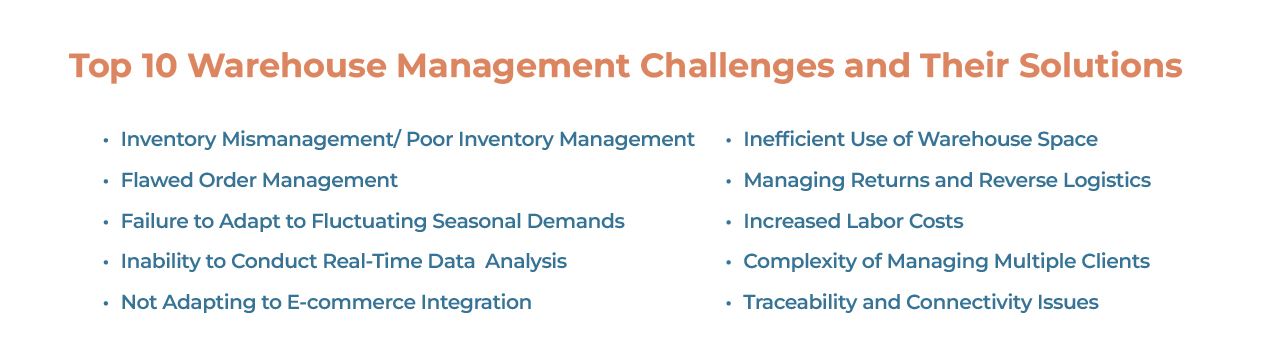
Common 3PL warehouse management challenges include inaccurate inventory, slow order processing, demand spikes, limited visibility, disconnected integrations, poor space utilization, complex returns, labor inefficiencies, client-account mix-ups, and weak traceability. This guide explains the controls that can help address each problem.
Common Warehouse Management Challenges in 3PL Operations
1. Inaccurate Inventory Records
Challenge: Differences between physical stock and system records can spread quickly across multi-client warehouses.
Common causes include receiving errors, missed scans, incorrect putaway, unrecorded stock movements, inconsistent cycle counts, and returns assigned to the wrong inventory status.
These discrepancies can lead to stockouts, overselling, delayed orders, incorrect client reports, and inventory disputes.
Useful indicators include inventory accuracy rate, adjustment frequency, stockout rate, and unresolved receiving discrepancies.
Solution: Barcode scanning, location-level tracking, cycle counting, movement logs, and inventory status controls can help maintain accurate stock records. The WMS should track stock availability, allocation, condition, and holds separately where needed. Returned items should only become available for fulfillment after inspection and approval under the client’s rules.
Accurate inventory also depends on correct product data, clear receiving and putaway procedures, controlled stock adjustments, and consistent scanning by warehouse teams.
2. Inefficient Order Processing
Challenge: Inefficient order processing occurs when warehouse teams lack clear order priorities, inventory-allocation rules, picking methods, packing checks, or exception workflows. Orders may remain unassigned, miss shipping cutoffs, or require repeated supervisor intervention.
Solution: Centralized order workflows can support order synchronization, inventory allocation, prioritization, picking lists, scan-based verification, packing validation, and carrier integration. These controls can shorten order cycle time, reduce missed shipping cutoffs, and prevent orders from reaching packing with unresolved picking errors.
Orders with insufficient stock, invalid addresses, integration errors, or client holds should move into a visible exception queue rather than remaining unassigned.
3. Seasonal Demand and Order Volume Spikes
Challenge: Seasonal demand can create sudden order volume spikes across multiple 3PL clients. During peak periods, warehouses may face labor shortages, limited storage capacity, replenishment delays, inventory shortages, and slower order processing. These pressures can make it harder to meet client service-level agreements, or SLAs, and shipping cutoff times.
Solution: A scalable 3PL WMS can help teams prioritize orders, assign tasks, and monitor inventory during peak periods. Historical order data can support labor and capacity planning, while advanced demand forecasting may require integration with an ERP or planning system.
4. Limited Visibility Into Warehouse Activity
Challenge: Limited real-time warehouse visibility is a common problem for 3PL providers using disconnected systems, spreadsheets, or delayed reporting. Without current information on inventory, orders, shipments, and warehouse tasks, teams may struggle to identify exceptions, resolve delays, and provide accurate updates to clients.
Solution: A 3PL WMS can provide inventory and order visibility based on recorded warehouse transactions and connected-system updates. The freshness of that information depends on scanning discipline, integration timing, and successful data exchange.
5. Disconnected Ecommerce and Marketplace Systems
Challenge: A 3PL may receive orders from several client stores and marketplaces, each with different product data, cancellation rules, fulfillment statuses, and synchronization requirements. Manual data entry and delayed synchronization can cause duplicate orders, inventory mismatches, overselling, missed cancellations, and fulfillment delays.
Solution: Depending on the connector and channel API, integrations can exchange orders, inventory availability, fulfillment status, and tracking information. Cancellation handling and changes to orders already being picked should be tested explicitly.
A useful integration should handle more than order import. It should also support cancellations, partial fulfillment, bundles or kits, inventory updates, shipment confirmation, and tracking information where the channel API allows it.
6. Inefficient Warehouse Space Utilization
Challenge: Inefficient warehouse space utilization is a common issue for 3PL providers managing products with different sizes, storage requirements, and movement rates. Poor slotting, inconsistent putaway, and limited location visibility can waste storage capacity, increase picker travel, and make inventory harder to locate.
Solution: Location tracking, directed putaway, and data-based slotting can help warehouses place inventory according to product dimensions, movement velocity, and picking requirements. These capabilities help improve storage capacity, reduce unnecessary travel, and place frequently picked products in more accessible locations.
Slotting recommendations also depend on accurate product dimensions, storage constraints, and order-history data. A WMS cannot optimize locations reliably when this information is incomplete.
7. Returns and Reverse Logistics Complexity
Challenge: Returns management becomes more complex for 3PL providers handling different return policies, product conditions, restocking rules, and disposition requirements. Returned goods may be misplaced, assigned the wrong status, or remain unavailable for resale when inspection processes are inconsistent.
Solution: Warehouse software can guide returned products through receiving, inspection, disposition, and restocking. Depending on the client’s rules, returned items may be restocked, quarantined, repaired, returned to the vendor, recycled, or written off. Standardized workflows can reduce return cycle time while preserving the correct inventory status for each client.
8. High Labor Costs and Low Productivity
Challenge: Labor costs rise when warehouse teams rely on paper-based processes, repeated data entry, inefficient pick paths, and manual task decisions. These inefficiencies reduce productivity and make it harder to handle higher order volumes without adding staff.
Solution: Scan-guided workflows, task assignment, batch picking, wave picking, and packing validation can reduce unnecessary manual work and standardize daily operations. Robotics may support high-volume facilities, but many 3PLs benefit first from clearer task control and more consistent workflows.
9. Separating Client Accounts, Rules, and Access
Challenge: Managing multiple client accounts becomes difficult when inventory ownership, orders, user permissions, billing rules, service levels, and operating procedures are not clearly separated. This can lead to product mix-ups, inaccurate reports, missed charges, slower responses, and client disputes.
Solution: Multi-client warehouse software can separate inventory, orders, users, reports, billing rules, service levels, and operational workflows by account. Role-based access and dedicated client dashboards also allow customers to view their own activity without exposing data from other businesses.
10. Limited Inventory Traceability
Challenge: Manual processes and disconnected systems make it difficult to follow product movements, order history, lot numbers, serial numbers, expiration dates, and user activity. These gaps can delay recalls, complicate audits, weaken stock investigations, and make inventory reconciliation more difficult.
Solution: A warehouse system should preserve lot, batch, and serial number data, expiration dates, user activity, and transaction history across receiving, putaway, transfers, picking, shipping, and returns. This end-to-end audit trail supports recalls, compliance reviews, stock reconciliation, audits, and internal investigations.
Example: Improving Picking Coordination in a Multi-Client Warehouse
A US-based 3PL was experiencing delayed order processing because warehouse teams relied on inefficient picking routes, disconnected order information, and manual task coordination.
The Fulfillor WMS was integrated with the company’s existing technology environment to centralize order visibility, improve task assignment, and support clearer picking workflows.
Conclusion
Warehouse teams should begin by identifying which problems create the greatest operational cost or client risk. Inventory accuracy, order cycle time, picking errors, return-processing time, labor productivity, missed shipping cutoffs, and reporting delays provide a practical starting point.
A 3PL warehouse management system can help standardize workflows, improve visibility, and support scan-based operations. However, successful implementation also depends on accurate data, clear procedures, employee training, and consistent system use.
Fulfillor supports multi-client inventory, order processing, picking, packing, shipping, returns, warehouse billing, client reporting, and multi-warehouse visibility within a cloud-based platform.
Schedule a call with our team to discuss your warehouse processes and implementation requirements.