
In today’s tech-driven and interconnected supply chain environment, warehouses and fulfillment centers have evolved far beyond basic storage facilities. Warehousing and fulfillment now play a strategic role in inventory control, order processing, operational efficiency, and customer satisfaction by helping businesses store, process, and deliver goods faster and more accurately.
So, if you are part of the supply chain, logistics, eCommerce, or 3PL industry, this guide is for you. Explore the role of warehousing and fulfillment in modern supply chains, including key functions, technologies, challenges, best practices, and future trends shaping shaping warehouse and fulfillment operations.
What Is Warehousing and Fulfillment in Supply Chain Management?
Warehousing and fulfillment in supply chain management refer to the storage, handling, tracking, picking, packing, and shipping of goods as they move from suppliers to end customers. Together, they help businesses maintain inventory accuracy, process orders faster, reduce fulfillment errors, and improve supply chain efficiency.
Traditionally, warehouses were used mainly as storage spaces. Today, they function as strategic supply chain hubs that support real-time inventory visibility, optimized distribution, scalable fulfillment, and smoother coordination across logistics networks.
Warehousing vs Fulfillment: What Is the Difference?
Warehousing focuses on receiving, storing, protecting, and tracking inventory. Fulfillment focuses on processing customer orders, including allocation, picking, packing, and shipping.
The activities overlap: one facility may store inventory and fulfill orders, using the same inventory records and warehouse workflows.
Types of Warehousing in Supply Chain Management
Different types of warehouses support different supply chain needs, from long-term storage to fast-moving fulfillment operations. Choosing the right warehouse model depends on product type, order volume, customer location, storage needs, and fulfillment requirements.
Public Warehouses
Public warehouses are third-party storage facilities that businesses can rent for short-term or long-term inventory storage.
Private Warehouses
Private warehouses are owned and operated by a single company, giving businesses more control over inventory, layout, security, and fulfillment workflows.
Distribution Centers
Distribution centers focus on fast product movement, sorting, cross-docking, and outbound shipping rather than long-term storage.
Fulfillment Centers
Fulfillment centers manage customer orders by picking, packing, shipping, and processing returns for eCommerce, retail, and omnichannel businesses.
Cold Storage Warehouses
Cold storage warehouses maintain controlled temperatures for products such as food, pharmaceuticals, and other temperature-sensitive goods.
Bonded Warehouses
Bonded warehouses store imported goods before customs duties are paid or before the products are cleared for distribution.
Automated Warehouses
Automated warehouses use robotics, conveyor systems, barcode scanning, and warehouse software to improve speed, accuracy, and labor efficiency.
3PL Warehouses
3PL warehouses manage storage, fulfillment, shipping, returns, and client-specific workflows for multiple businesses from one facility.
Key Functions of Warehousing and Fulfillment in Supply Chain Management
Modern warehouses perform several critical functions that help businesses improve supply chain efficiency, inventory accuracy, order fulfillment, and customer satisfaction. These functions go beyond basic storage and support faster, more reliable movement of goods across the supply chain.
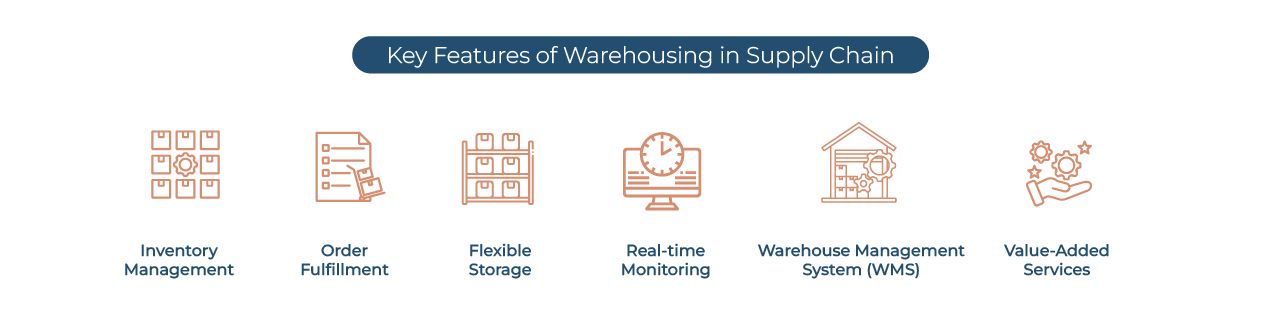
- Inventory management
- Order fulfillment
- Flexible storage
- Real-time monitoring
- Warehouse Management System, or WMS
- Value-added services
Inventory Management
Warehouses do more than store goods. They help businesses manage and track inventory in real time, reducing the risks of overstocking, stockouts, and inventory losses. This improves inventory accuracy and helps businesses meet fluctuating customer demand more efficiently.
Order Fulfillment
Warehouses support the picking, packing, and shipping of customer orders, helping businesses deliver faster and more accurate fulfillment experiences. By using technologies such as barcode scanning, robotics, automated guided vehicles, and a modern WMS, warehouses can speed up order processing while reducing fulfillment errors.
Flexible Storage
Modern warehouses offer flexible storage options based on product type, size, volume, and handling requirements. Adjustable shelving, pallet racks, bulk storage areas, and dedicated zones help businesses manage seasonal inventory, diverse product lines, and changing demand more effectively.
Real-time Monitoring
Real-time monitoring helps warehouses track stock levels, equipment, product movement, and environmental conditions. With IoT sensors and connected systems, businesses can monitor temperature, humidity, and item location to maintain proper storage conditions and reduce product damage or loss.
Warehouse Management System
A robust WMS is essential for streamlining modern warehouse operations. It helps manage inventory, optimize storage space, reduce manual errors, improve compliance and reporting, and support key workflows such as FIFO stock management, batch tracking, serial number tracking, picking, packing, and shipping.
Value-Added Services
Many warehouses also provide value-added services such as kitting, labeling, customization, quality checks, returns processing, security measures, and sustainability initiatives. These services help businesses meet customer requirements, improve operational flexibility, and stay competitive in fast-moving supply chains.
Common Challenges in Warehousing and Fulfillment in Supply Chain Management
Despite being an essential part of the supply chain, warehousing and fulfillment centers face several challenges that can affect efficiency, accuracy, and customer satisfaction.
Labor shortages and skill gaps
Finding skilled warehouse workers remains a challenge for many businesses, especially during peak seasons. Labor shortages can slow down receiving, picking, packing, shipping, and returns processing.
Slow technology adoption
Many warehouses struggle to adopt advanced technologies such as IoT, automation, barcode scanning, and modern WMS platforms due to limited investment, lack of expertise, or outdated systems.
Poor space and resource utilization
Making the best use of available warehouse space, equipment, and labor remains difficult without proper layout planning and warehouse management systems. Inefficient storage and disorganized workflows can lead to delays, errors, and higher operating costs.
Inventory visibility issues
Without real-time inventory tracking, warehouses may face stockouts, overstocking, misplaced items, and inaccurate order fulfillment. This can directly impact customer satisfaction and supply chain performance.
Picking, packing, and shipping errors
Manual processes and disconnected systems can increase the risk of wrong picks, incorrect shipments, delayed deliveries, and costly returns.
The Future of Warehousing and Fulfillment in Supply Chain Management
As warehousing and fulfillment become more important to modern supply chain management, businesses are adopting advanced technologies to improve speed, accuracy, visibility, and scalability. The future of warehousing is being shaped by automation, IoT, robotics, real-time data, and smarter warehouse management systems.
Automation is becoming a major part of modern warehouses and fulfillment centers. Technologies such as automated guided vehicles, robotic picking systems, conveyor systems, and automated sorting tools help reduce manual work, improve efficiency, minimize errors, and speed up order processing.
IoT, or the Internet of Things, is also transforming warehouse operations by enabling real-time inventory tracking, equipment monitoring, and environmental control. IoT sensors can track stock movement, temperature, humidity, and storage conditions, helping businesses reduce losses, improve space utilization, and make faster operational decisions.
Cloud-based WMS platforms and connected fulfillment systems are also becoming essential for growing warehouses, eCommerce businesses, and 3PL providers. These systems help teams manage inventory, orders, shipping, returns, client reporting, and warehouse performance from one centralized platform.
Instead of chasing every emerging technology, warehouses are seeing the most immediate gains from real-time inventory visibility, automation, system integrations, and data-driven warehouse management.
How Fulfillor Supports Modern Warehousing and Fulfillment
For 3PLs and fulfillment teams, the biggest challenge is not only moving orders faster. It is keeping inventory, client requirements, warehouse tasks, shipping data, returns, and billing activity connected as order volume grows.
Fulfillor supports this by giving teams a centralized WMS for day-to-day warehouse execution. Teams can track inventory by client, manage receiving and fulfillment workflows, reduce manual updates, and give customers clearer visibility into stock and order activity.
This helps growing 3PLs move from reactive warehouse management to a more organized, scalable fulfillment operation.
Conclusion
The role of warehousing and fulfillment in supply chain management continues to evolve with the adoption of automation, IoT, real-time inventory visibility, and advanced warehouse management systems. Modern warehouses are no longer just storage facilities. They are essential supply chain hubs that help businesses improve speed, accuracy, cost efficiency, productivity, and customer satisfaction.
As eCommerce, omnichannel commerce, and 3PL operations continue to grow, businesses need scalable fulfillment systems that can support inventory control, order processing, shipping, returns, reporting, and client visibility.
If you are looking to transform your warehouse and fulfillment operations, Fulfillor can help you streamline workflows, improve inventory accuracy, and scale with confidence.
Schedule a free demo to see how Fulfillor can support your warehouse and fulfillment operations.