
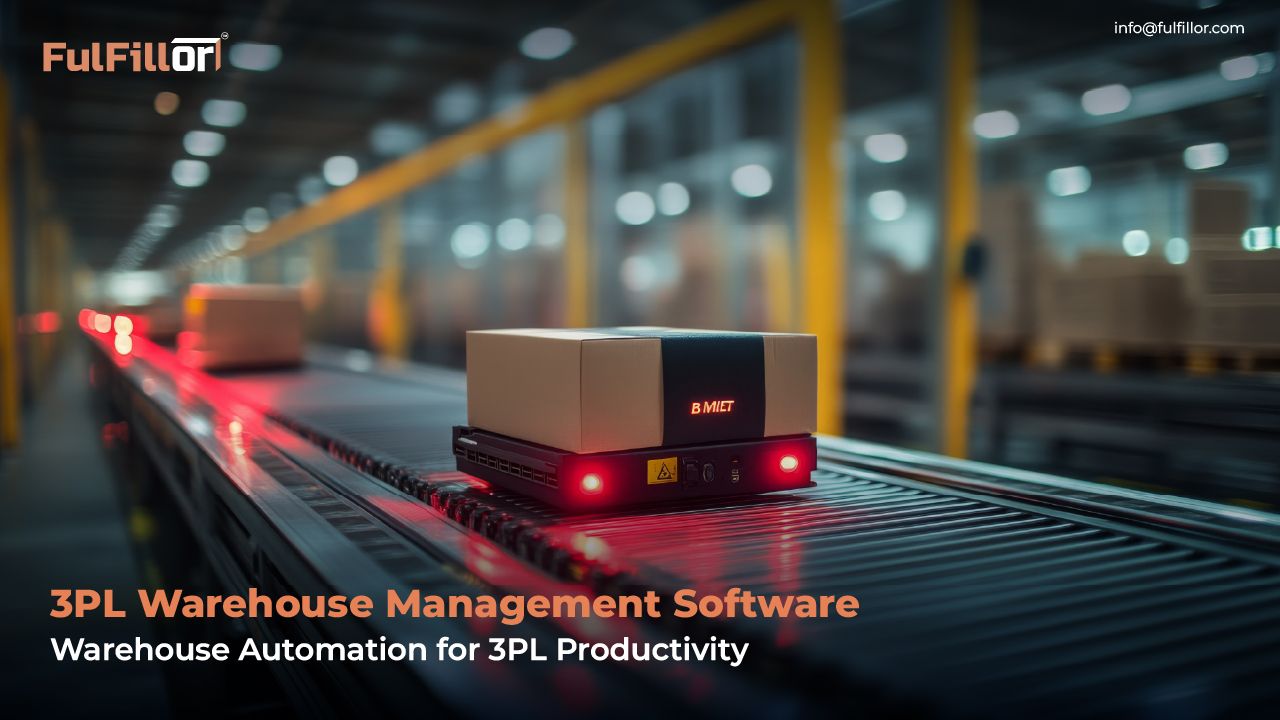
Most fulfillment warehouses do not face serious problems when order volume is low. The pressure starts when more clients, SKUs, sales channels, and seasonal peaks enter the operation.
Warehouse automation is becoming a priority for logistics operations.
Picking takes longer. Stock mismatches become harder to control. Warehouse teams spend more time checking, correcting, and chasing updates instead of moving orders through the fulfillment process.
This is usually when logistics providers move away from spreadsheets, manual task tracking, and disconnected tools. They start looking for a warehouse system that can connect stock control, order processing, picking, packing, shipping, and reporting in one place.
What Is 3PL Warehouse Automation?
3PL warehouse automation is the use of WMS software, barcode scanning, workflow rules, robotics, and connected tools to reduce manual work across inventory, picking, packing, shipping, returns, and reporting.
For most third-party logistics providers, automation starts with a warehouse management system. Robotics and advanced equipment can improve speed in high-volume facilities, but they work best when warehouse data, task rules, and stock movement are already organized.
Where 3PL Warehouse Operations Usually Break
Growth creates pressure inside a 3PL warehouse. More clients, more SKUs, more sales channels, and more daily orders can expose problems that were easy to ignore at lower volume.
The most common operational weaknesses appear in labor planning, space utilization, picking accuracy, and order control.
1. Labor Shortages and Training Gaps
Labor shortages become harder to manage when warehouse teams depend on tribal knowledge, paper lists, or supervisor instructions for every task.
Clear, scan-based workflows reduce dependence on tribal knowledge and make it easier for new employees to complete tasks correctly.
2. Poor Space Utilization
Space becomes a problem when inventory is stored without clear location logic, SKU movement data, or client-level visibility.
A 3PL WMS helps teams understand where stock is stored, how often it moves, and which products should be placed closer to picking areas. This makes it easier to improve slotting, reduce travel time, and avoid unnecessary expansion.
3. Picking and Order Accuracy Problems
Most fulfillment errors do not happen because people are careless. They happen because warehouse processes are unclear or disconnected.
Manual picking, delayed stock updates, missing barcode validation, and unclear packing steps can lead to wrong items, missed quantities, and incorrect shipments.
Automation helps reduce these issues by:
- updating stock as items move
- guiding pickers through the right sequence
- validating picks through barcode scanning
- reducing paper-based checks
- making exceptions easier to identify
Fewer mistakes usually mean fewer returns, fewer client escalations, and less time spent fixing avoidable problems.
How a WMS Automates 3PL Warehouse Operations

A 3PL WMS replaces paper lists, spreadsheets, and repeated supervisor instructions with structured warehouse tasks. As workers receive, store, pick, pack, and ship inventory, barcode scans update stock records and order status in real time. Managers can then monitor priorities, exceptions, and fulfillment progress from one system.
1. Guided Picking and Packing
Guided picking helps warehouse staff follow the correct item, quantity, location, and order sequence. Barcode scanning adds another layer of validation before items move to packing or dispatch.
This is especially important for 3PLs managing multiple clients because similar SKUs, shared storage areas, and high order volume can increase the risk of mistakes.
2. Automated Order Routing
Automated order routing helps assign orders based on warehouse rules, inventory availability, priority, carrier requirements, or fulfillment location.
This reduces manual sorting and helps teams process urgent, high-volume, or channel-specific orders with fewer delays.
3. Real-Time Stock Movement Tracking
Stock visibility is one of the biggest problems in manual warehouse environments. When updates are delayed, teams may pick unavailable items, miss replenishment needs, or give clients inaccurate information.
A WMS tracks stock movement across receiving, storage, picking, packing, shipping, and returns. This helps reduce mismatches and gives teams a clearer view of available inventory.
4. Robotics and Automated Storage Systems
Robotics, conveyors, and automated storage and retrieval systems can reduce travel and manual movement in high-volume facilities. However, these systems depend on accurate inventory records, location logic, and task priorities. Growing 3PLs should usually establish reliable WMS workflows and barcode control before investing in physical automation.
5. AI-Driven Warehouse Decisions
AI can support warehouse planning by helping prioritize orders, identify demand patterns, and surface operational issues.
These insights are more useful when they are connected to live inventory, order, and fulfillment data inside a WMS. This helps managers make faster decisions instead of reacting after problems have already slowed down fulfillment.
Benefits of 3PL Warehouse Automation
Warehouse automation helps 3PLs move from reactive fulfillment to controlled execution. The biggest benefits come from reducing manual decisions, improving inventory visibility, and giving teams a repeatable process for handling higher order volume.
1. Faster Order Fulfillment
When orders are assigned automatically and pickers receive clear instructions, teams can move faster without depending on constant supervisor direction.
Guided picking, scan-based packing, and better order prioritization help reduce delays from order release to dispatch.
2. Lower Operating Costs
Automation can reduce operating costs by cutting down repeated checks, manual coordination, fulfillment errors, return-related fixes, and avoidable labor waste.
Over time, faster task completion and fewer mistakes help warehouses handle more volume without increasing costs at the same pace.
3. Easier Multi-Client Scaling
A multi-client WMS should separate inventory ownership, workflows, user permissions, service levels, billing rules, and reporting for each account.
4. Better Client Visibility and Retention
A client portal can reduce routine status requests by giving each account access to inventory, orders, shipments, returns, and reports.
What to Consider Before Choosing a 3PL Warehouse Automation System
Not every 3PL warehouse needs robotics, AS/RS, or automation equipment from day one. Many growing providers need better control over daily warehouse execution first.
Evaluate automation when rising order volume leads to measurable delays, inventory discrepancies, missed service-level targets, or excessive manual coordination. Identify the workflow causing the problem before deciding whether you need software automation, handling equipment, or both.
Key questions to ask include:
- Can the system manage inventory separately for multiple clients?
- Does it support barcode-based picking and packing?
- Can it track stock movement across receiving, storage, shipping, and returns?
- Does it connect order processing, warehouse tasks, and reporting in one place?
- Can managers see bottlenecks, exceptions, and fulfillment status without manual follow-up?
- Can clients access order, inventory, and reporting data through a portal?
- Can the system scale without forcing the warehouse to rebuild every process later?
Fulfillor is built for 3PL warehouses that need better control over multi-client inventory, order processing, picking, packing, shipping, and client visibility without adding more manual work.
Schedule a demo to see how Fulfillor helps automate warehouse operations from one connected WMS.
Author Bio
Visvendra Singh is a logistics and supply chain professional with over 10 years of experience in warehouse operations and automation. He works closely with 3PL businesses to improve inventory accuracy, streamline workflows, and manage operational complexity as they scale.