
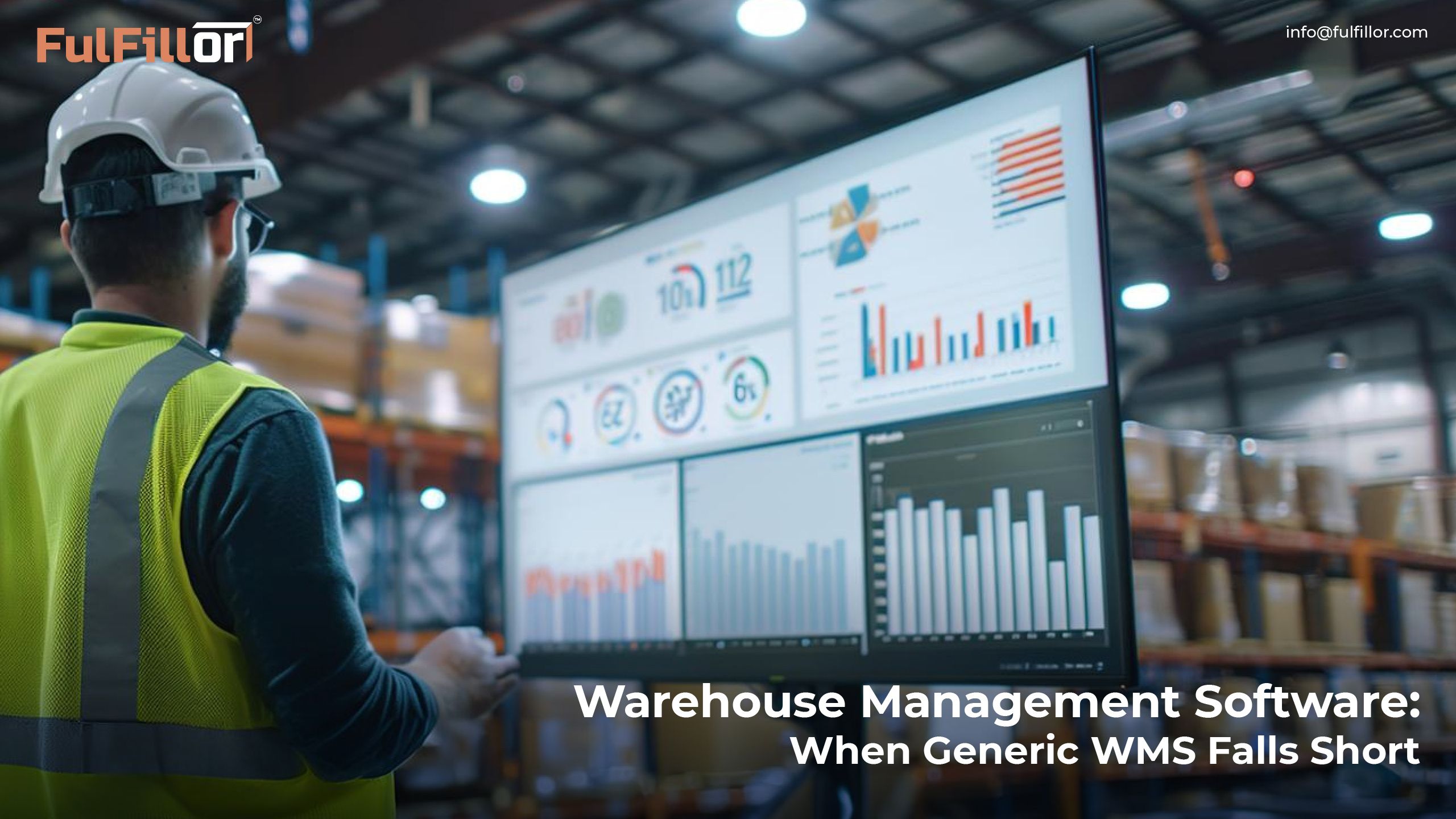
Warehouse management software can look like the right answer when a warehouse first moves away from spreadsheets, paper-based processes, or disconnected tools. It helps manage inventory, receiving, picking, packing, shipping, and stock movement from one system.
For many warehouses, basic WMS software brings structure, visibility, and better control over daily fulfillment. But as operations grow across more sales channels, locations, customers, integrations, reporting needs, or workflow requirements, a generic WMS may start to show its limits.
That does not mean generic WMS software is wrong. It means the system may no longer match the complexity of the operation. This can happen in ecommerce warehouses, distribution centers, retail fulfillment operations, multi-location warehouses, and 3PL businesses.
For 3PL warehouses, the gap often appears faster because the business has to manage multiple clients, 3PL billing, integrations, rules, returns, and reporting expectations within one operation.
What Generic WMS Software Usually Does Well
Generic WMS software is designed to help warehouses control inventory and execution. It helps teams know what stock is available, where products are stored, which orders need to be picked, and how goods move from receiving to shipping. For a single company managing its own warehouse, these capabilities can solve many day-to-day problems.
Generic WMS vs WMS Built for Complex Operations
At a high level, both generic WMS and specialized WMS platforms help manage warehouse operations. The difference is in the complexity each system is built to support.
A generic WMS is usually centered on inventory and warehouse activity. A specialized WMS is designed to support more complex workflows, integrations, reporting, billing activity, and multi-client operations.
| Area | Generic WMS | Specialized WMS |
|---|---|---|
| Inventory | Tracks stock levels, item locations, and basic inventory movement. | Supports advanced inventory rules by client, location, lot, channel, or workflow. |
| Workflows | Handles standard receiving, picking, packing, and shipping processes. | Supports configurable workflows for different operation types, customers, or fulfillment requirements. |
| Billing and activity tracking | Often focuses on internal records or basic operational tracking. | Can support activity-based tracking for storage, picks, returns, kitting, special handling, or client-level billing. |
| Reporting | Provides general warehouse reports for inventory, orders, and fulfillment activity. | Supports role-based, customer-facing, client-facing, location-level, or operation-specific reporting. |
| Integrations | Connects with common ecommerce, ERP, shipping, or accounting systems. | Supports more complex multi-system, multi-channel, or client-specific integration needs. |
| Scaling | Usually scales by SKUs, users, warehouse locations, and order volume. | Scales across channels, clients, workflows, locations, billing rules, exceptions, and operational complexity. |
Capabilities vary by vendor and configuration. In this guide, “generic WMS” refers to a system whose available setup does not fully support the operation’s requirements. Evaluate each platform against your actual workflows rather than relying on its category label.
If the warehouse only needs to manage stock for one company, a generic warehouse management system may be enough. If the warehouse needs to manage many clients with different requirements, a 3PL WMS becomes much more important.
Where Generic WMS Software Starts to Break
The system still processes orders. Pickers still pick. Inventory still moves. Shipments still leave the warehouse. On the surface, operations continue. But behind the scenes, more and more work starts happening outside the WMS. Billing gets exported. Reports get cleaned manually. Client instructions live in documents. Returns need extra handling. Integrations need checking.
Managers ask warehouse staff for updates because the system does not show the full picture. The software is still present, but it is no longer the only source of truth.
That creates a dangerous gap. The warehouse thinks it is running on a system, but parts of the operation are actually running on human memory, side spreadsheets, and informal processes.
The most common breaking point is not basic inventory. Most WMS platforms can track items and locations. The real pressure comes from client-specific operations. A generic WMS may not easily support different workflows, billing logic, permissions, reporting formats, and integration requirements for each client.
Billing Is Where Many Generic WMS Platforms Fall Short
A single-brand warehouse may use a WMS to manage operations and then track costs internally. A 3PL, however, needs to charge clients for the work performed inside the warehouse. That means the system should help connect warehouse activity to billable events.
This is where generic WMS software can become a poor fit. It may manage the movement of goods, but it may not track activity in a way that supports client-level billing. When that happens, the 3PL team has to gather data manually from orders, receiving logs, storage records, shipping activity, return reports, and spreadsheets.
That manual process creates friction. It slows invoicing, increases the chance of missed charges, and makes billing disputes harder to resolve. If a client asks why they were charged for storage, returns, kitting, or special handling, the team needs clean data to support the invoice.
A true 3PL WMS should help track activity that can become billable. That includes common operational events such as receiving, putaway, storage, picking, packing, returns, labeling, kitting, repacking, pallet movement, and custom projects. The exact billing model may vary by client, but the system should help capture the activity clearly enough to support accurate invoicing.
This matters because revenue leakage is not always obvious. A 3PL may lose money not because it lacks clients, but because it fails to capture and bill for the work already being done.
Client Visibility Cannot Be Treated as an Extra
In a 3PL operation, reporting is not only for internal managers. Clients also need visibility.
That changes the role of the WMS. The system is not just helping warehouse employees do their jobs. It is also supporting the relationship between the 3PL and its clients.
Clients want to know what is happening with their inventory, orders, returns, and shipments. They do not want to email the warehouse every time they need an update. They want access to accurate information without waiting for someone to export a report or manually confirm a status.
A generic WMS may offer internal reporting, but that does not always translate into client-facing visibility. A 3PL client portal should allow each client to see the right data while keeping other clients’ information secure. That requires account-level separation, role-based access, and reports designed around client needs.
This is not just a nice feature. It reduces support load and improves trust. When clients can see accurate information on their own, the warehouse team spends less time answering repetitive questions and more time managing actual operations.
WMS Integrations Get More Complicated as Operations Grow
A single warehouse may only need to connect one ecommerce platform, one ERP, one shipping service, and one accounting tool. A 3PL works differently. It may need to support multiple client systems at the same time. One client may use Shopify, another may sell through WooCommerce, and another may rely on Amazon or a marketplace-specific setup. Some clients may also require a custom API, unique shipping rules, or special order settings.
The WMS must support these integrations without mixing up data, inventory, rules, or client-specific information. Each client’s orders, stock updates, shipping details, and reporting data need to stay separate, accurate, and easy to trace.
When integrations are weak or incomplete, warehouse teams often become the workaround. Staff may manually enter data, import files, fix mismatches, and verify updates across systems. That may work for a few clients in the short term, but it becomes painful as the 3PL scales.
Strong WMS integrations help orders, inventory updates, shipping details, and return data move between systems without constant manual checking.
Signs Your Warehouse Has Outgrown Generic WMS Software
A growing warehouse can outgrow a generic WMS before leadership fully realizes it. The team may still be shipping orders, but the system may no longer be supporting the business cleanly. The clearest warning sign is when employees start building side processes around the official software.
Here are common signs that the current WMS may no longer fit a growing 3PL operation:
- Billing or reporting depends on spreadsheets.
- Inventory reports need manual cleanup.
- Staff store workflow instructions outside the WMS.
- New customer, client, or channel onboarding takes too long.
- Managers cannot easily view performance across operations.
- Teams keep checking integrations manually.
- Returns are managed outside the main workflow.
- The system cannot clearly separate users, rules, or reporting needs.
- Reports are exported instead of viewed in real time.
- The warehouse team works around the system instead of through it.
What Should Replace the Manual Workarounds?
A 3PL-focused WMS should be built for client complexity, not just warehouse activity. It should support the way third-party logistics providers actually operate, especially when they serve multiple ecommerce brands, retailers, distributors, or marketplace sellers.
The replacement system should reduce manual work, maintain inventory accuracy, and support new clients without creating new side processes.
- Real-time inventory visibility
- Configurable warehouse workflows
- Billing or activity tracking
- Customer, client, or location-level reporting
- Ecommerce and shipping integrations
- Role-based permissions
- Returns and exception handling
- Multi-location or multi-client support
For the broader capability checklist, see Best WMS Features for 3PL Warehouses and Fulfillment Operations.
How Fulfillor Supports Growing Warehouse Operations
Fulfillor helps growing warehouses and 3PL operations manage inventory, orders, workflows, integrations, reporting, billing activity, and client visibility in one system.
For multi-client operations, Fulfillor supports client-specific workflows, billing activity, role-based visibility, integrations, returns, and multi-location warehouse operations without requiring teams to manage core processes through separate spreadsheets and disconnected tools.
Learn more about Fulfillor's 3PL WMS or schedule a demo.
Final Takeaway
A generic WMS does not become the wrong system simply because a warehouse grows. The problem starts when operational complexity moves outside the system.
If billing, client reporting, integrations, returns, workflow instructions, or inventory controls increasingly depend on spreadsheets and manual processes, the warehouse may have outgrown what its current WMS was designed to support.
The next system should solve those specific operational gaps rather than simply provide another way to process orders.
See how Fulfillor supports multi-client 3PL operations
Written by Visvendra Singh, Founder & CEO of Fulfillor
Visvendra has spent 10+ years building software for 3PL warehouses and works directly with multi-client fulfillment operations across North America.