
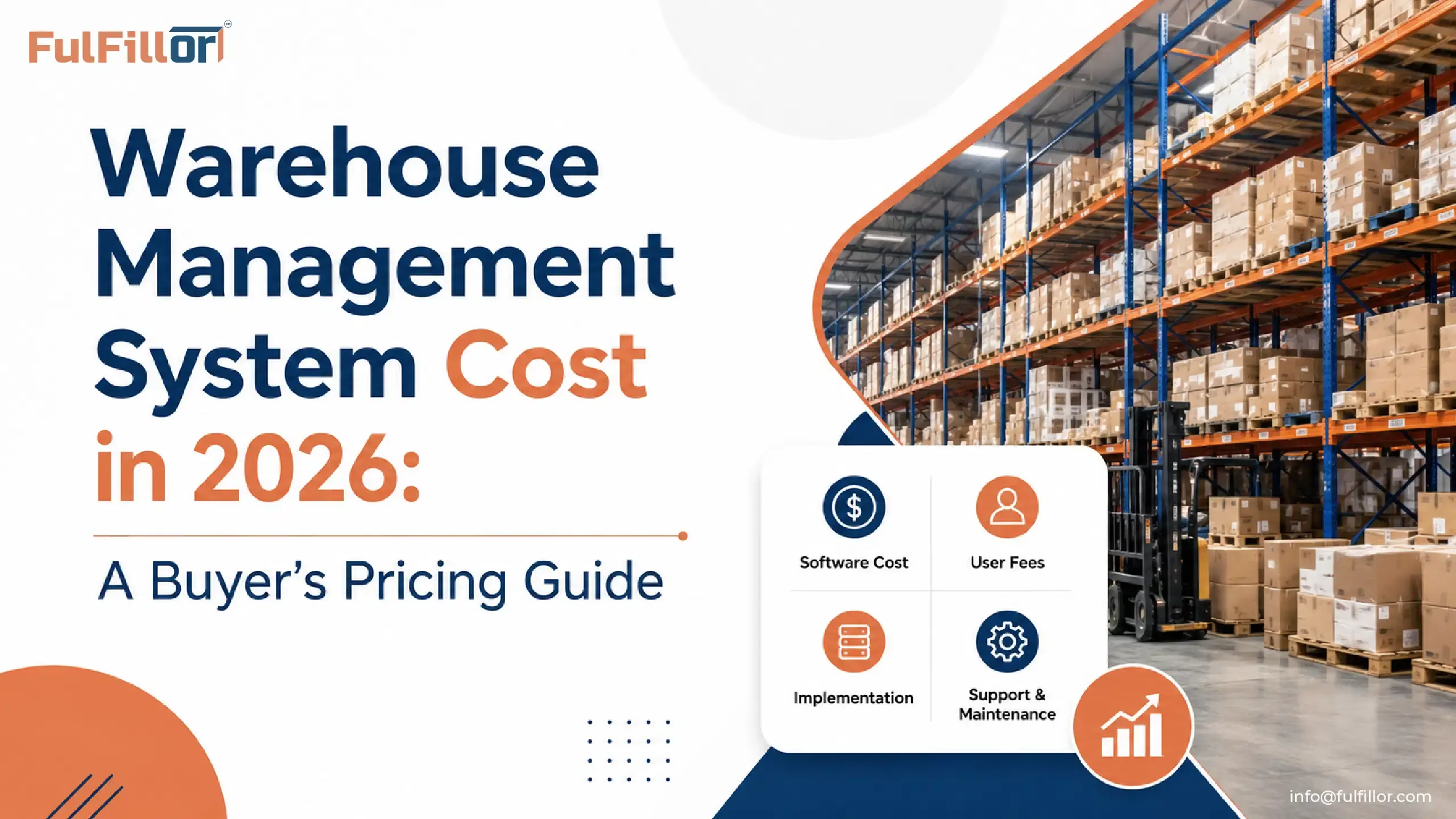
Published WMS pricing can start in the low hundreds of dollars per month, while more advanced and enterprise systems may use higher subscription tiers or custom pricing based on users, locations, integrations, workflows, and implementation requirements.
If you're trying to understand how much a warehouse management system costs, you're not alone. Pricing is one of the most searched and least clearly explained parts of choosing a WMS.
Average WMS Pricing for Different Business Sizes
A WMS is typically priced according to the scale and sophistication of your operation.
-
Small warehouses ($100–$500/month): suitable for basic inventory tracking. Choosing beyond this level may lead to paying for unused features.
-
Mid-sized ($500–$3,000/month): required for multi-client or integration-heavy operations.
In bigger warehouses and the enterprise-level 3PLs, pricing usually starts at $3,000/month but can increase based on customizations, number of warehouses, and operational complexity. Such systems support high-order volume, automation workflows and granular visibility into operations.
Capterra reports that entry-level warehouse management software plans typically cost around $146 per month, while advanced packages commonly start around $868 per month. Enterprise and complex warehouse deployments may require custom quotes.
How Do WMS Pricing Models Work?
WMS vendors may charge through monthly subscriptions, per-user licensing, usage or transaction-based pricing, or custom enterprise agreements. The pricing model matters because costs can change as users, orders, warehouses, or system usage increase.
For a detailed breakdown, see WMS SaaS Pricing: Costs and Models
What Factors Influence the Cost of a WMS?
The subscription price is only one part of WMS cost. Warehouse locations, integrations, users, order volume, customization, automation, implementation, and support can all affect the final budget.
One of the factors is the number of warehouses you operate, multiple locations require more management and coordination from your system. You also need to think about integration requirements because that can impact pricing - if you want integrations such as ecommerce, ERP systems and shipping carriers or EDI.
Customization is another key factor. The more your workflows need automation or processes beyond the norm, the more expensive it gets. In transaction-based models, higher order volumes or inventory complexity directly increase your costs.
Understanding these factors helps you evaluate pricing more realistically instead of focusing only on base subscription costs.
The main factors that impact WMS pricing are:
- Number of warehouses – more locations increase system complexity and cost
- Integrations – ecommerce, ERP, and carrier integrations add to pricing
- Customization and automation – advanced workflows increase development and maintenance costs
What Are the Hidden Costs of a Warehouse Management System?
Most businesses underestimate total WMS cost by ignoring implementation, training, and integration overhead.
One of the most common issues businesses face is underestimating the total cost of a WMS.
Implementation and onboarding often require an upfront investment, which can range from a few hundred to several thousand dollars depending on the system and level of support. Training is another factor that goes unnoticed because warehouse teams need time and support to adapt to the new workflows.
Continuous support and feature improvements might not be included in the pricing plans by default, and advanced support or other modules might incur additional charges from some vendors. If many integrations are involved, maintenance of integration could also lead to a recurring cost.
The fact that these costs are more hidden is not itself a bad thing, but it does mean you need to understand them early on if you want to avoid nasty surprises down the road.
Cloud vs On-Premise WMS: Which Is More Cost-Effective?
Cloud-based WMS platforms can reduce the need to purchase and maintain server infrastructure, but subscriptions, implementation, integrations, and support still contribute to total cost. On-premise systems may involve licensing, hardware, maintenance, and internal IT expenses. Compare both options over the same period and against the same operational requirements.
How to Choose the Right WMS Based on Your Budget
Choosing a WMS is not just about finding the lowest price. It’s about selecting a system that aligns with your operational needs and long-term growth.
If you're evaluating options in more detail, this guide on how to choose a 3PL WMS breaks down the key factors to consider.
Smaller warehouses will benefit most from user-friendliness and core features. Don’t oversimplify your needs, but don’t buy into expensive features you won’t use.
Expanding 3PLs should consider extensibility, integration, and multi-client capacity so that your WMS can grow with you, rather than forcing you to switch WMS.
Large businesses should prioritize automation, performance, and efficiency, the ROI typically outweighs the upfront cost. Remember that if a WMS can eliminate errors, speed up fulfillment and decrease labor spend, it’s likely saving you money elsewhere.
Final Thoughts: What Should You Expect to Pay for a WMS in 2026?
WMS pricing varies by vendor, included capabilities, usage limits, and implementation scope. Compare the subscription alongside onboarding, integrations, training, support, and expansion costs to estimate the total budget for your operation.
Instead of focusing only on monthly pricing, it’s more important to evaluate the overall value a system brings to your operations. The right WMS should improve efficiency, reduce errors, and support your growth without creating unnecessary complexity.
Explore WMS pricing plans to see what fits your warehouse operations.
Author Bio:
Visvendra Singh brings over 12 years of hands-on experience in retail, ecommerce, supply chain, and fulfillment operations. He has helped 3PLs and ecommerce brands evaluate and implement WMS platforms.