

Warehouse management challenges for 3PLs in Saudi Arabia include keeping client inventory separate, maintaining accurate stock records, managing fulfillment priorities, processing returns, and capturing billable services. These challenges become harder to control as order volumes, client requirements, and warehouse locations increase.
A shared warehouse may handle different client inventories, fulfillment rules, billing terms, and reporting requirements. When those records are disconnected, staff can allocate the wrong stock, miss billable activities, or provide outdated order updates.
For Saudi operations handling marketplace orders, cash on delivery (COD), and regional shipments, warehouse records also need to stay aligned with sales channels, carriers, and finance systems. This guide explains the main challenges and the controls a 3PL WMS can support.
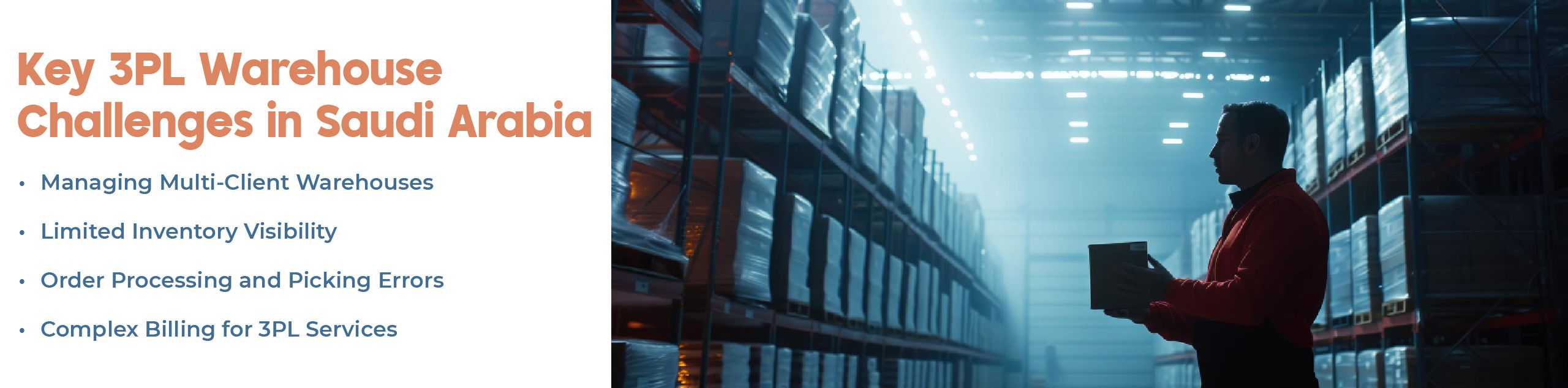
Key 3PL Warehouse Challenges in Saudi Arabia
Managing Multi-Client Inventory in Shared Saudi Warehouses
When clients stock similar products, a product barcode alone may not establish inventory ownership. Receiving, allocation, picking, and reporting should preserve the client account associated with each inventory record.
Without a structured multi-client warehouse management system, inventory can easily become mixed across clients, bins, zones, or picking routes. This creates a higher risk of picking stock from the wrong client, shipping incorrect items, and creating stock discrepancies between the system record and the actual warehouse floor.
In a shared 3PL warehouse, similar products from different clients may be stored close to each other. If pickers rely on memory, printed lists, or manual checks, errors become more likely. System-driven allocation, barcode scanning, and client-level inventory rules help keep stock separated and traceable.
Maintaining Accurate Inventory Visibility Across Warehouse Operations
Saudi warehouse inventory management becomes more difficult when stock moves across receiving, storage, picking, packing, returns, and dispatch without real-time updates. Even a small delay in updating inventory can create problems for ecommerce orders and client reporting.
Poor inventory visibility can lead to stockouts, overselling, delayed fulfillment, and unnecessary overstocking. For 3PL providers managing multiple clients, these issues can also affect client trust because each business expects accurate stock counts and clear visibility into its inventory.
A structured 3PL inventory management system helps warehouse teams track inventory by client, SKU, location, status, and movement history. This makes it easier to separate available, reserved, damaged, returned, and in-transit stock.
Reducing Picking and Packing Errors in High-Volume Fulfillment
Picking errors often increase when Saudi warehouses process higher order volumes without standardized workflows. In busy 3PL environments, teams may handle orders from online stores, marketplaces, wholesale clients, and regional shipping channels at the same time.
Without barcode validation or system-guided picking, warehouse staff may select the wrong SKU, quantity, batch, carton, or client inventory. These errors lead to incorrect shipments, customer complaints, higher return rates, and extra operational cost.
Using barcode picking for warehouse teams helps confirm the item, bin location, quantity, and order before packing. This gives warehouse teams a more reliable way to reduce manual picking mistakes.
Managing COD Orders, Returns, and Marketplace Fulfillment
Saudi ecommerce fulfillment often includes COD orders, marketplace sales, customer returns, and fast delivery expectations. These workflows add extra pressure for 3PL warehouses because every order may require accurate payment status, shipping updates, return inspection, and client-level reporting.
Returns can also create inventory confusion if items are not inspected, graded, restocked, quarantined, or marked as damaged correctly. When these steps are handled manually, returned stock can disappear from visibility or be made available for resale before it is ready.
For 3PL warehouses serving ecommerce clients, a WMS helps connect order status, inventory movement, return records, and warehouse tasks so teams do not have to manage these processes across spreadsheets, messages, and separate courier portals.
A COD order marked as delivered does not, by itself, confirm that the carrier has remitted the payment. Where connected systems support these records, teams should track fulfillment status, carrier collection, and settlement separately.
For refused or undelivered shipments, returned goods should remain unavailable for sale until receiving and inspection are completed.
Handling Client-Specific 3PL Billing Without Manual Errors
3PL providers charge clients for storage, receiving, picking, packing, shipping, returns, special handling, and value-added services. When these activities are tracked manually, billing can become inconsistent and difficult to verify.
Manual billing often leads to missed charges, revenue leakage, invoice disputes, and reporting delays. The process becomes even more complex when each client has different pricing rules, storage terms, order volumes, or service agreements.
With 3PL billing automation, warehouse operators can capture billable activities more consistently and reduce the manual work required to prepare client invoices.
For Saudi 3PL providers, warehouse billing data may also need to connect with a ZATCA-compliant accounting or e-invoicing system. The WMS records billable warehouse activities and client charges, while the connected invoicing solution handles invoice generation and the applicable FATOORA clearance or reporting process.
This connection reduces duplicate data entry, improves billing reconciliation, and helps finance teams maintain accurate customer, VAT, service, and transaction details.
Connecting Warehouse Teams, Carriers, and Client Updates
As 3PL operations grow, warehouse work does not happen in isolation. Orders may come from ecommerce platforms, marketplaces, ERP systems, or client portals, while shipping updates may need to flow through regional and international carriers.
When systems are disconnected, teams spend more time checking order status, confirming stock, updating clients, and tracking shipments manually. This slows down fulfillment and increases the chance of missed updates.
Before relying on a connection, confirm which records it exchanges, how often updates arrive, and how failed transactions are handled. Duplicate orders, missing tracking updates, and failed cancellations need clear alerts and an assigned owner for resolution.
Example: Handling a COD Order and Return in a Shared 3PL Warehouse
Consider a hypothetical Saudi 3PL serving two ecommerce clients that stock similar products.
When an order arrives, warehouse staff need to confirm the client account, payment method, required item, and shipping details. Allocation should use the correct client’s available inventory, while picking checks confirm the assigned product and location.
If the recipient refuses delivery, the carrier’s update should be recorded separately from the physical return. Warehouse staff receive and inspect the item before deciding whether it can be restocked, quarantined, or recorded as damaged.
Any return-handling charge should follow the client’s agreed billing rules. Finance then reconciles the relevant carrier charges and COD records through the connected systems.
The example shows why client ownership, fulfillment status, return inspection, and financial records need to remain connected without being treated as the same event.
What Saudi 3PLs Should Look for in Warehouse Management Software
Saudi 3PL providers should look for warehouse management software that supports multi-client operations, real-time inventory visibility, barcode scanning, order fulfillment, returns handling, and automated billing.
For Saudi Arabia, it is also useful to consider features that support local and regional fulfillment needs, such as COD order handling, marketplace fulfillment, Arabic and English order data, GCC shipping workflows, and integration with ecommerce platforms and carriers.
- Client inventory separation when products have similar identifiers.
- Arabic and English text handling in the screens, documents, and exports your team uses.
- COD and prepaid order workflows, including failed delivery and returns.
- The exact data exchanged with your required marketplaces and carriers.
- Activity-based charges using different client rate agreements.
- How warehouse billing records reach the accounting or invoicing system.
- Inventory transfers between locations, including dispatch, in-transit status, and receipt.
- Alerts, retries, and responsibilities when an integration fails.
Confirm which capabilities are available as standard, require configuration, or need additional development.
Improving Control Across Saudi 3PL Warehouse Operations
As client requirements and order volumes increase, warehouse teams need clear inventory ownership, reliable picking checks, controlled returns, and traceable billing records. Carrier and finance updates should remain aligned with warehouse activity while preserving their separate responsibilities.
Fulfillor helps 3PL providers manage multi-client inventory, barcode picking, order fulfillment, returns, billing, and client visibility.
Schedule a demo to discuss your Saudi 3PL warehouse workflows and required integrations.