
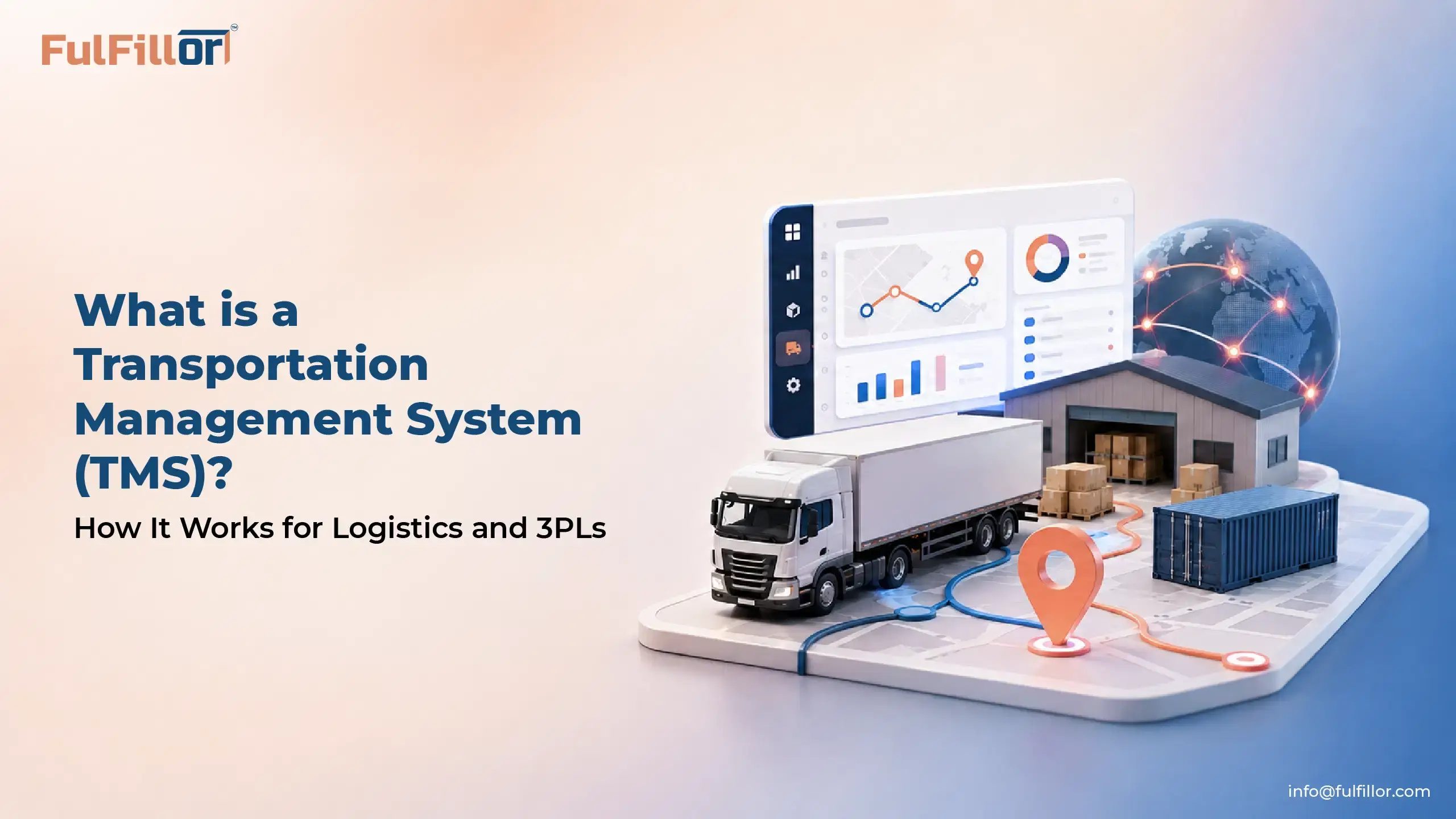
A transportation management system (TMS) helps businesses manage how orders move from a warehouse or shipping location to their destination. Even when an order is completely picked and packed, decisions still need to be made about the carrier, service level, delivery commitment, shipping documents, and what happens after the parcel leaves the facility.
When these activities are spread across carrier portals, spreadsheets, emails, and separate systems, transportation becomes harder to manage as order volume grows. A transportation management system brings transportation planning, carrier selection, shipment execution, tracking, and delivery exceptions into a more structured workflow.
What Is a Transportation Management System (TMS) in Logistics?
A transportation management system is software used to plan, execute, track, and optimize the movement of goods between locations.
Once a business knows what needs to be shipped, where it is going, and when it needs to arrive, the TMS helps determine how that shipment should move. In parcel fulfillment, this can include selecting a carrier, comparing available services, creating the shipment, generating a label, and receiving tracking updates.
For fulfillment operations, transportation management software helps coordinate the decisions and shipment information required between packing, dispatch, and final delivery.
How Does a Transportation Management System Work?
A TMS receives shipment information from systems such as a WMS, ERP, ecommerce platform, order management system, or client system. This lets transportation decisions use existing information instead of requiring employees to recreate the order manually.
A typical transportation process looks like this:

Transportation Planning and Carrier Selection
Transportation planning begins with the details that determine how a shipment should move. These can include the destination, delivery commitment, warehouse location, package weight and dimensions, available carrier services, shipping method, and client-specific rules.
The cheapest option is not always the correct one. A lower-cost service is of little value if it cannot meet the promised delivery date or is not allowed for that client.
Transportation management software helps apply carrier, service, and delivery rules consistently without asking warehouse teams to interpret them manually for every order.
Shipment Execution
Once the carrier and service have been selected, the shipment needs to be created.
Depending on the carrier integration, this can include label generation, tracking number creation, shipping documentation, shipment confirmation, and dispatch information.
Keeping shipment information tied to the original order reduces repeated data entry between the WMS and carrier systems.
Tracking and Exception Management
Carrier events can show whether the parcel has been collected, moved through the network, reached the destination area, gone out for delivery, or been delivered.
This becomes especially important when transportation performance is connected with a client's 3PL SLA management.
An order dispatched before the agreed cutoff but delayed by the carrier should be treated differently from one that remained inside the facility after the dispatch deadline. A clear event history helps identify where the service failure actually occurred.
TMS vs WMS: What Is the Difference and How Do They Work Together?
A WMS manages inventory and physical work inside the warehouse, while a TMS manages how shipments move between locations.
There can be some overlap. Modern WMS platforms may already provide shipping management software capabilities such as carrier selection, rate comparison, label generation, tracking, and dispatch workflows. The main question is whether the operation needs transportation capabilities beyond what its existing WMS already provides.
Consider an ecommerce order moving through a warehouse. The WMS allocates inventory, creates picking work, confirms the products, and manages packing. Once the carton is ready, the system already has information such as its weight, dimensions, destination, warehouse location, client account, and delivery requirements.
That shipment data can then be used for carrier and service selection without recreating the order. After the shipment is created, the label and tracking number can return to the same order while later carrier events update its delivery status.
These WMS integrations allow order and shipment data to move between warehouse systems, carriers, ecommerce platforms, and other operational systems without rebuilding the same transaction manually.
Why Is Transportation Management More Complex for 3PLs?

A retailer usually works with one set of transportation rules. The complexity increases when the same warehouse serves multiple clients, each with its own carrier accounts, service levels, and delivery requirements.
Client A wants the lowest-cost service that can arrive within three days. Client B requires a specific carrier under its own account. Client C promises next-day delivery and only allows services that can meet that commitment.
The parcels may look almost identical at the packing station, but the transportation decision is different for each one.
In 3PL transportation management, the main challenge is applying the correct client-specific carrier, service, and delivery rules to each order.
This becomes especially important in a multi-client 3PL WMS, where warehouse activity, shipping rules, and order history need to remain associated with the correct client.
How Does TMS Support Multi-Carrier Shipping?
Multi-carrier shipping becomes difficult when warehouse staff have to move between separate carrier portals for every order.
Without a connected shipping workflow, staff may compare rates in separate carrier portals, re-enter shipment details, and manually move labels or tracking numbers back into the WMS. Delivery exceptions often send them back to those same portals later.
A centralized multi-carrier process allows carrier options to be evaluated using predefined rules, so warehouse employees do not need to repeat the same rate comparison and service checks for every shipment.
Fulfillor brings these carrier connections into the warehouse process through its courier and multi-carrier integrations, so shipping data can move without relying on separate carrier portals.
Does Every Business Need a Standalone TMS?
No.
A business handling straightforward ecommerce or parcel fulfillment may already have enough transportation functionality inside its WMS or shipping platform without introducing separate transportation management software.
If the main requirements are carrier selection, rate comparison, label generation, tracking, delivery updates, and client-specific shipping rules, introducing another platform may increase system complexity without solving an important operational problem.
When Does a 3PL Need Better Transportation Management?
A 3PL may need better transportation management when staff regularly leave the WMS to compare services, maintain shipping information separately, or investigate delivery issues manually. As client volume grows, these disconnected steps become harder to control consistently.
These shipping requirements should therefore be defined during 3PL client onboarding, alongside warehouse workflows, integrations, cutoffs, billing rules, and other client-specific requirements.
TMS vs Shipping Software: Are They the Same?
Not necessarily. Shipping software generally focuses on activities such as carrier rate comparison, label generation, shipment creation, and tracking. A full transportation management system may also support routing, load planning, freight tendering, transportation contracts, audit and settlement, carrier performance, and broader transportation optimization.
For parcel-focused fulfillment operations, the capabilities can overlap considerably, which is why some 3PLs can manage their transportation requirements through an integrated WMS and multi-carrier shipping workflow rather than implementing a separate TMS.
How Fulfillor Supports 3PL Shipping Workflows
Fulfillor connects multi-client warehouse execution with shipping workflows for 3PL and fulfillment operations. The right TMS software should match the transportation complexity of the operation rather than add another system for tasks already handled well inside the WMS.
Contact the Fulfillor team to discuss how your warehouse, carrier, and client shipping workflows can be managed within a connected 3PL WMS.