
3PL Warehouse Management Software for UK Fulfilment Providers
Multi-Client 3PL Warehouse Management
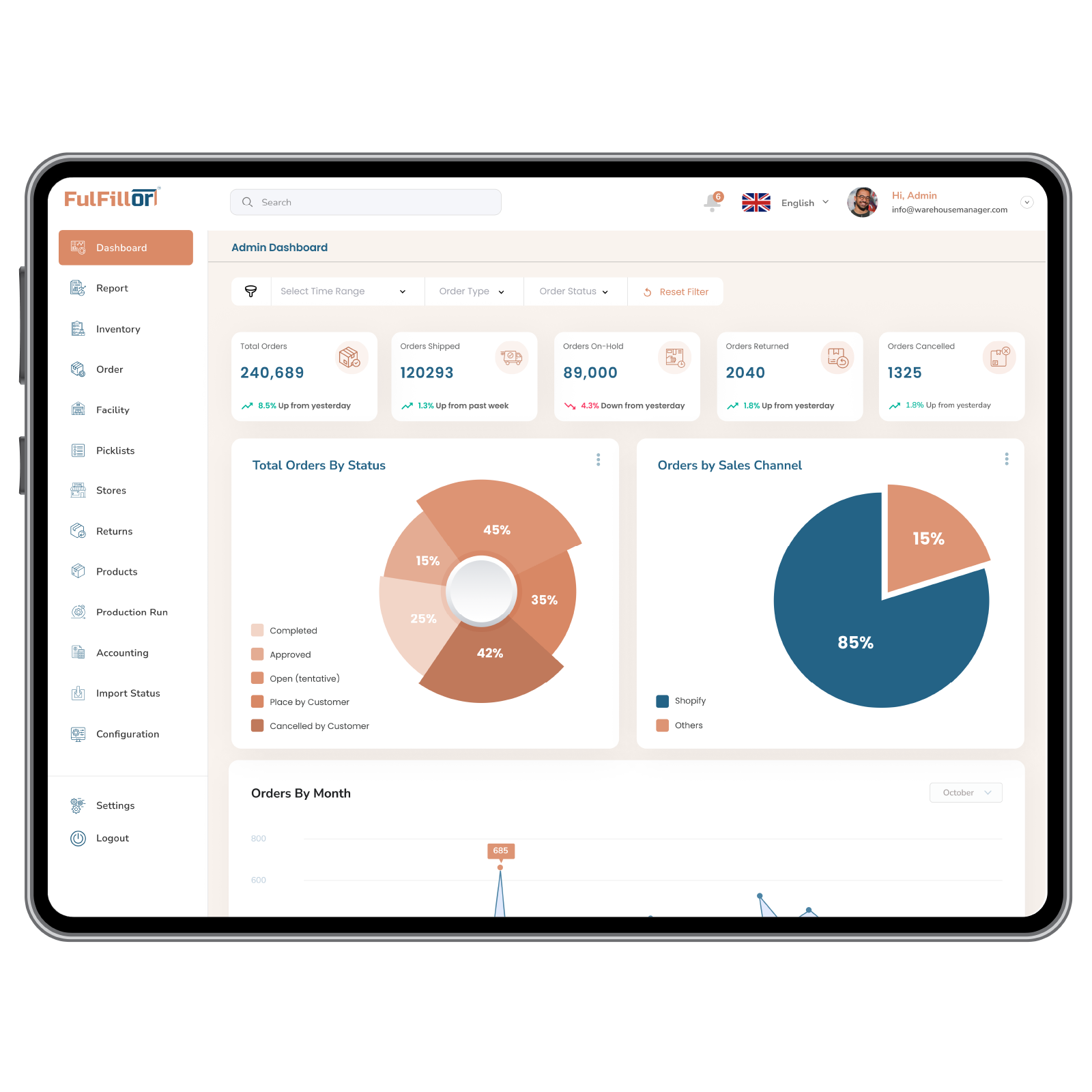
Fulfillor is a cloud-based 3PL warehouse management system for UK fulfilment providers managing multiple clients, sales channels, warehouse locations, and carrier workflows. It helps teams separate inventory and orders by client, automate warehouse activities, calculate service charges, and give customers controlled access to operational data.
The system supports receiving, storage, picking, packing, shipping, returns, reporting, and client billing from one connected platform.
Why UK 3PLs Need Dedicated Fulfilment Software
The UK is one of the most advanced and fast-moving logistics markets in Europe, driven by high-volume ecommerce, rapid delivery expectations, and strong competition across fulfilment providers.
3PLs and fulfilment houses need a scalable, automation-driven WMS that keeps pace with increasing order volumes, strict SLAs, multi-client complexity, and next-day delivery standards.
Fulfillor WMS enables UK operators to centralise operations, reduce errors, automate fulfilment tasks, and maintain high performance across warehouse hubs nationwide.
Core Advantages for UK Operations
- Centralise inventory, orders, and workflows across multiple clients.
- Reduce fulfilment errors with guided picking and smart warehouse processes.
- Automate shipping and courier routing for domestic carriers.
- Improve efficiency with barcode scanning and mobile picking.
- Provide clients with complete visibility through a branded customer portal.
- Scale operations across all regions and warehouse hubs.
UK Ecommerce and Marketplace Integrations for 3PL Fulfilment
Supports Royal Mail, Evri, and Yodel carrier integrations alongside Xero and Sage for accounting, plus Shopify, WooCommerce, Amazon UK, eBay UK, OnBuy, Linnworks, and Brightpearl for ecommerce and marketplace operations.
















3PL WMS Capabilities for UK Fulfilment Operations

Multi-Client 3PL Management

Client-Level Inventory Control

Multichannel Order Automation

Picking, Packing, and Dispatch

UK Carrier and Shipping Connections

Client-Specific Returns Processing

Multi-Warehouse Operations

3PL Billing and Invoicing
Cross-Border Fulfilment Data for UK 3PL Warehouses
Fulfillor helps 3PL teams organise the product, order, destination, carrier, return, and customs-related data used in cross-border fulfilment. Warehouse teams can maintain structured records for shipments involving Great Britain, Northern Ireland, the EU, and other international destinations.
Fulfillor organises operational warehouse and shipment data. It does not determine commodity codes, submit customs declarations, file VAT returns, or replace advice from tax professionals or customs brokers.
Access and Data Controls for UK 3PL Operations
Fulfillor provides account and access controls for multi-client warehouse operations. Teams can separate client records, restrict access by role, provide controlled portal visibility, and review supported user and operational activity.
Privacy compliance depends on how each organisation configures and uses the platform, its contracts, retention policies, internal procedures, and legal responsibilities.
Implementation and Support for UK 3PL Teams
Fulfillor's onboarding process covers warehouse setup, client accounts, inventory migration, billing rules, and required integrations. Our team works with you to test receiving, picking, packing, dispatch, and returns before go-live. Training helps warehouse staff and client users get familiar with their daily tasks.
Ready to streamline your UK fulfilment operations?
Frequently Asked Questions About 3PL WMS in the UK
A UK 3PL warehouse management system should support multi-client inventory, barcode warehouse operations, ecommerce order processing, carrier connections, returns, reporting, and activity-based billing. It should also keep each client's inventory, users, workflows, service rules, and reports separate within the same warehouse operation.
Yes. Fulfillor allows UK fulfilment providers to manage multiple clients, brands, or merchants from one platform. Inventory, orders, users, warehouse rules, reports, and billing records can be separated by client account, reducing the risk of mixing operational data.
Fulfillor can connect with supported carriers, shipping platforms, ecommerce systems, and marketplaces used by UK fulfilment providers. Available workflows may include order import, label generation, tracking updates, manifests, delivery status synchronisation, and returns.
Yes. Fulfillor can calculate client-specific charges for receiving, storage, pick and pack, packaging, returns, kitting, courier services, and other warehouse activities. Billing records can be generated from completed operational transactions, helping reduce manual calculations and missed charges.
Fulfillor can store and export supported product, destination, carrier, commodity code, customs value, commercial invoice, shipment, and return information. These records help warehouse teams organise the operational data required by carriers, finance teams, and customs specialists. Fulfillor does not submit customs declarations, file VAT returns, or replace advice from a tax professional or customs broker.
Yes. Our team can help plan the move, review your existing data, and configure your warehouse workflows in Fulfillor. The migration scope depends on your current system, data quality, client accounts, and integrations. Testing and training form part of the transition before go-live.
Implementation time depends on the number of warehouses, clients, integrations, billing rules, workflows, and records being migrated. The process may include operational discovery, system configuration, data migration, integration setup, workflow testing, user training, and go-live support.
Fulfillor stores WMS data for UK customers on dedicated servers in the UK. This includes the inventory, order, and customer records managed through the platform. If you have specific data hosting requirements, our team can discuss them with you before onboarding.