
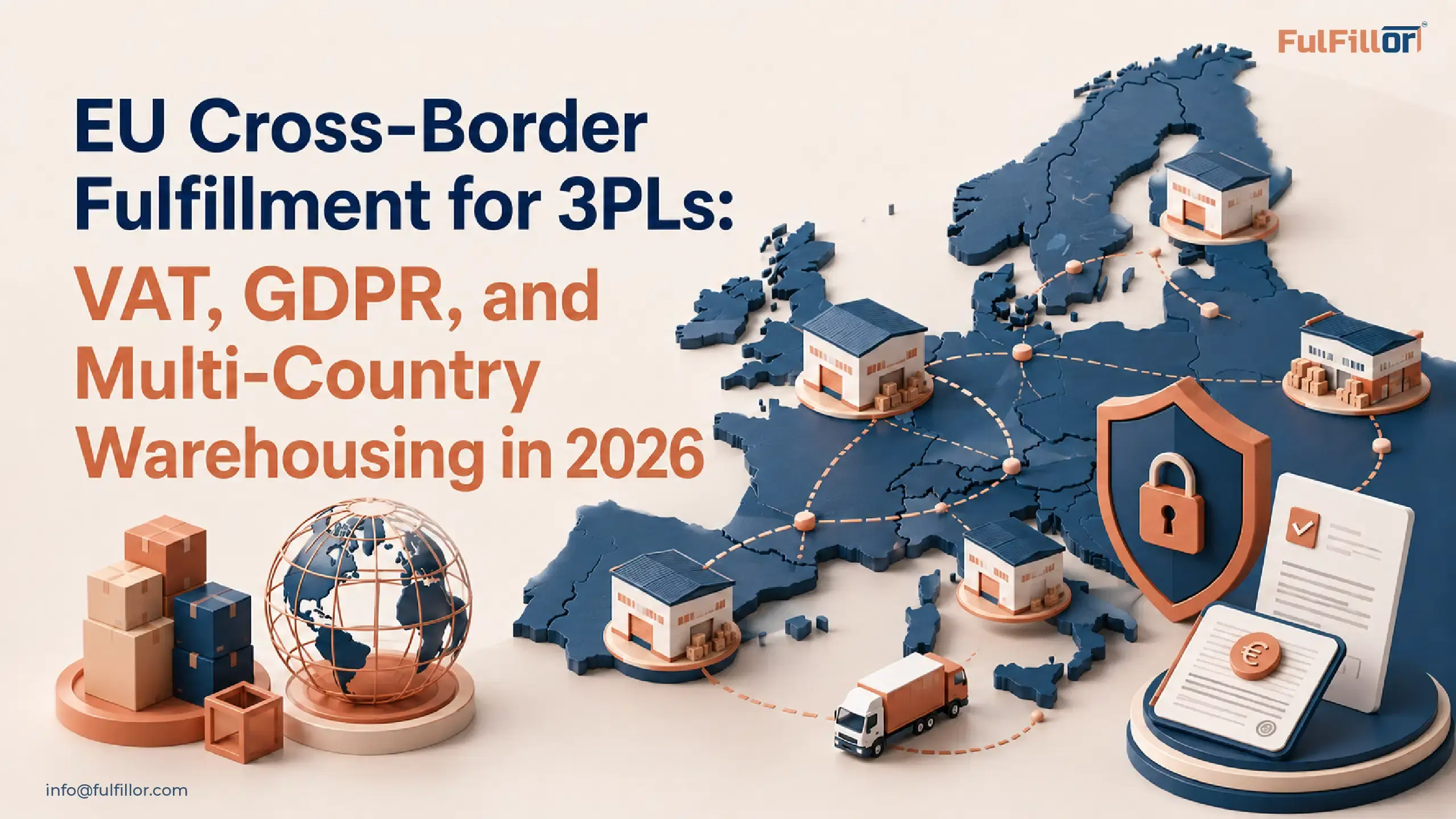
EU cross-border fulfillment is the process of storing, processing, shipping, and managing orders across multiple European Union markets. For a 3PL, it can involve one or several warehouses serving clients across different EU countries while keeping inventory, orders, shipping, returns, and client data connected.
The operational challenge grows when stock is distributed between facilities, clients use different sales channels and carriers, and orders must remain traceable across country-specific workflows. In 2025, 78% of EU internet users aged 16 to 74 bought or ordered goods or services online, up from 62% in 2015, according to Eurostat.
What Does EU Cross-Border Fulfillment Mean for a 3PL?

For a 3PL, the complexity begins when inventory, orders, clients, warehouses, destinations, and service requirements have to remain connected across several EU markets. Stock may be stored in multiple countries, clients may sell through different channels, carrier options can vary by warehouse, and returns may enter through a different facility from the one that originally shipped the order.
A 3PL WMS should help keep those workflows connected without forcing teams to build a separate manual process for every country.
| Operational area | Cross-border challenge | What the warehouse needs to control |
|---|---|---|
| Inventory | Stock spread across clients and facilities | Client, warehouse, location, lot, and availability |
| Orders | Multiple channels and destination countries | Routing, allocation, status, and exceptions |
| Shipping | Different carriers and service rules | Labels, carrier selection, tracking, and dispatch |
| VAT-related records | Transaction and destination information | Consistent order, shipment, return, and billing records |
| Customer data | Personal data across fulfillment workflows | Access controls and client-level separation |
| Returns | Products coming back through different markets | Identification, inspection, and inventory disposition |
| Reporting | Clients operating across several facilities | Consolidated operational and client visibility |
Keep Multi-Country Inventory Visible Without Mixing Client Stock
A total inventory figure becomes less useful once stock is distributed across multiple warehouses. If a client holds 12,000 units across Europe, the operations team still needs to know how many are available in Germany, how many are in the Netherlands, what has already been allocated to orders, and whether any stock is currently in transit. This becomes more relevant for multi-client 3PLs because physical location is not the only dimension of inventory ownership.
The WMS needs to maintain the link between the SKU, client, warehouse, storage location, lot or serial if relevant, available quantity, allocated quantity, and status.
A connected inventory view should quickly show where stock is available, what has already been allocated, whether replenishment or transfers are needed, and which facility ultimately fulfilled the order.
For EU cross-border fulfillment, 3PL inventory management software can give teams a connected view of stock across facilities and help prevent a distributed network from becoming a collection of isolated warehouses.
Order Routing Across Multiple EU Warehouses
Multi-country inventory only creates value when incoming orders can reach the correct fulfillment location. A 3PL client may sell through several ecommerce stores, marketplaces, or other channels while its inventory is distributed across multiple European warehouses.
When an order enters the warehouse environment, the operation needs reliable SKU, client, destination, inventory, shipping, and service information. Routing rules may come from the ecommerce platform, client configuration, WMS, or another routing system, but the warehouse still needs a dependable record of where the order was sent, which stock it consumed, and how fulfillment progressed.
Reliable 3PL order management software can keep allocation, routing, order status, and warehouse execution connected as orders move between sales channels and fulfillment locations.
EU VAT, OSS/IOSS, and ViDA: What 3PLs Need to Track
VAT is one area where warehouse execution intersects with wider ecommerce, accounting, and tax processes. A WMS does not replace VAT determination, tax registrations, accounting systems, or professional tax advice. Its role is to maintain accurate operational records that those systems and teams can use.
For qualifying cross-border B2C transactions, the OSS framework can simplify how eligible businesses report VAT through one Member State, while IOSS applies to certain distance sales involving imported goods. From a warehouse perspective, the priority is maintaining reliable records for order destinations, inventory locations, shipments, ownership, returns, adjustments, and billing so that downstream ecommerce, accounting, and tax systems receive consistent operational data.
The EU adopted the VAT in the Digital Age, or ViDA, package on March 11, 2025, with changes being introduced gradually through 2035. Certain legislative clarifications affecting OSS and IOSS users take effect from January 1, 2027. Broader Single VAT Registration reforms begin from July 1, 2028, while new digital reporting requirements for cross-border B2B transactions begin from July 1, 2030.
For 3PL operations, the practical takeaway is the growing importance of structured fulfillment data. Inventory movements, orders, shipments, returns, and transaction records should be able to move between warehouse, ecommerce, accounting, and reporting systems without repeated manual reconstruction.
Multi-Country Warehousing vs. Cross-Border Shipping
Selling into another EU country and physically storing inventory there are different operational models.
The operation might choose to keep inventory in one location and ship into other EU Member States, or distribute stock across facilities in markets such as Germany, the Netherlands, Poland, and France.
Once inventory is distributed across facilities, the 3PL needs to know where stock was received and stored, whether it moved between warehouses, which facility fulfilled the order, and where returned inventory entered the network.
The WMS does not determine VAT treatment, but it can record the physical and operational information that VAT teams and connected business systems may need to determine that treatment.
GDPR Matters Inside the Warehouse Too
Cross-border fulfillment moves more than stock. Warehouse software routinely processes customer names, shipping addresses, contact details, order information, shipment records, and return data, much of which may involve personal information.
An organization can be a controller, processor, or, in certain cases, a joint controller under the GDPR, depending on the purposes and means by which data is processed. When processing is carried out on behalf of another organization, responsibilities need to be clearly allocated. The GDPR requires organizations to implement appropriate technical and organizational measures to protect personal data.
For a third-party warehouse managing multiple clients, warehouse software can support these responsibilities through role-based access, client-level data separation, activity visibility, and restrictions that prevent employees from accessing information they do not need for their work.
A picker fulfilling orders for client A does not need access to the customer list for client B. A client portal should restrict each client to its own orders, shipping information, inventory data, returns, and relevant reports.
Keep Shipping Connected Across Different EU Markets
Shipping requirements rarely remain identical as a 3PL expands across Europe. A warehouse in Germany may use a different carrier mix from one in Spain or the Netherlands, while clients can have different service levels, delivery promises, cutoff times, and routing rules.
What should remain consistent is the connection between the original order and the shipping workflow. The warehouse needs the right destination data, selected service, labels, shipment status, tracking information, and exception history to remain attached to the correct client and order.
This becomes more important as EU cross-border fulfillment volume grows. Small manual inconsistencies become harder to trace as more facilities and carriers participate in the fulfillment process.
A connected shipping management workflow can keep warehouse execution and shipment information aligned while specialist carrier, customs, tax, or other systems handle responsibilities outside the WMS.
Build Returns Into the Cross-Border Design
Returns should be planned at the same time as outbound fulfillment, especially when inventory is distributed across several European facilities.
A customer in Belgium might return an order originally fulfilled from the Netherlands. A German client may want sellable returns routed back into one facility while damaged goods follow a different path. Another account may require inspection or approval before inventory becomes available again.
Without predefined rules, returned products can easily become unidentified stock sitting in a receiving area while employees search through emails, carrier records, or ecommerce systems for context.
A structured returns management process should connect the returned item with the original client, order, product, receiving location, inspection decision, and resulting inventory status.
Give Clients Visibility Across the Warehouse Network
Operating several warehouses does not mean clients should have to contact each location separately to understand their business.
A client using fulfillment facilities in Germany and the Netherlands may want one view of inventory, orders, shipments, returns, and operational performance even though physical execution is distributed between locations.
A 3PL client portal can help maintain that client-specific view while warehouse teams continue operating from the appropriate facilities.

What About UK and EU Fulfillment?
The United Kingdom is not an EU Member State. Fulfillment between Great Britain and the EU involves customs and VAT requirements that differ from movements within the EU. Northern Ireland has distinct arrangements for goods, so 3PLs should confirm the requirements for each route and configure their warehouse and shipping workflows accordingly.
What Should a 3PL Test Before Expanding Into Another EU Market?
Before routing live volume through a new country or warehouse, test the entire workflow rather than validating isolated functions.
Start with realistic orders for several clients and destination countries. Confirm that the intended inventory is allocated from the correct facility, follow the order through picking and packing, verify the shipping workflow, and make sure tracking and order updates return to the systems that depend on them.
Then test the situations that expose operational gaps. Transfer inventory between facilities, cancel an allocated order, receive a return into a different warehouse, change the shipping service, restrict a user's permissions, and verify that the accounting or reporting records still contain the information they require.
Pay particular attention to moments where staff leave the WMS to reconstruct information in a spreadsheet or email. That usually indicates that the official workflow and the workflow employees actually use are not the same.
How a 3PL WMS Supports EU Cross-Border Fulfillment
A 3PL WMS can connect inventory, orders, warehouse locations, picking, packing, shipping, returns, client access, billing, and reporting across multi-client fulfillment. In a multi-country operation, it also needs to preserve local and client-level differences while maintaining consistent visibility across the wider warehouse network.
Fulfillor is built for multi-client 3PL warehouse operations and supports connected inventory, order, shipping, returns, billing, and client-visibility workflows across multiple warehouse locations.
Explore the Fulfillor 3PL WMS for the broader multi-client warehouse workflow.