

Warehouse slotting optimization is the process of deciding where to store each stock-keeping unit (SKU) so warehouse teams can pick, replenish, and handle inventory with less wasted movement. Sales volume alone rarely determines the best location. Order-line frequency, dimensions, weight, pick-face capacity, SKU affinity, replenishment demand, and storage restrictions all influence the decision.
For 3PL warehouses, several clients may share the same building while following different storage rules and fulfillment workflows. Slotting has to improve flow without compromising client separation.
What Is Warehouse Slotting Optimization?
Warehouse slotting optimization assigns SKUs to storage and picking locations using real warehouse activity and physical constraints.
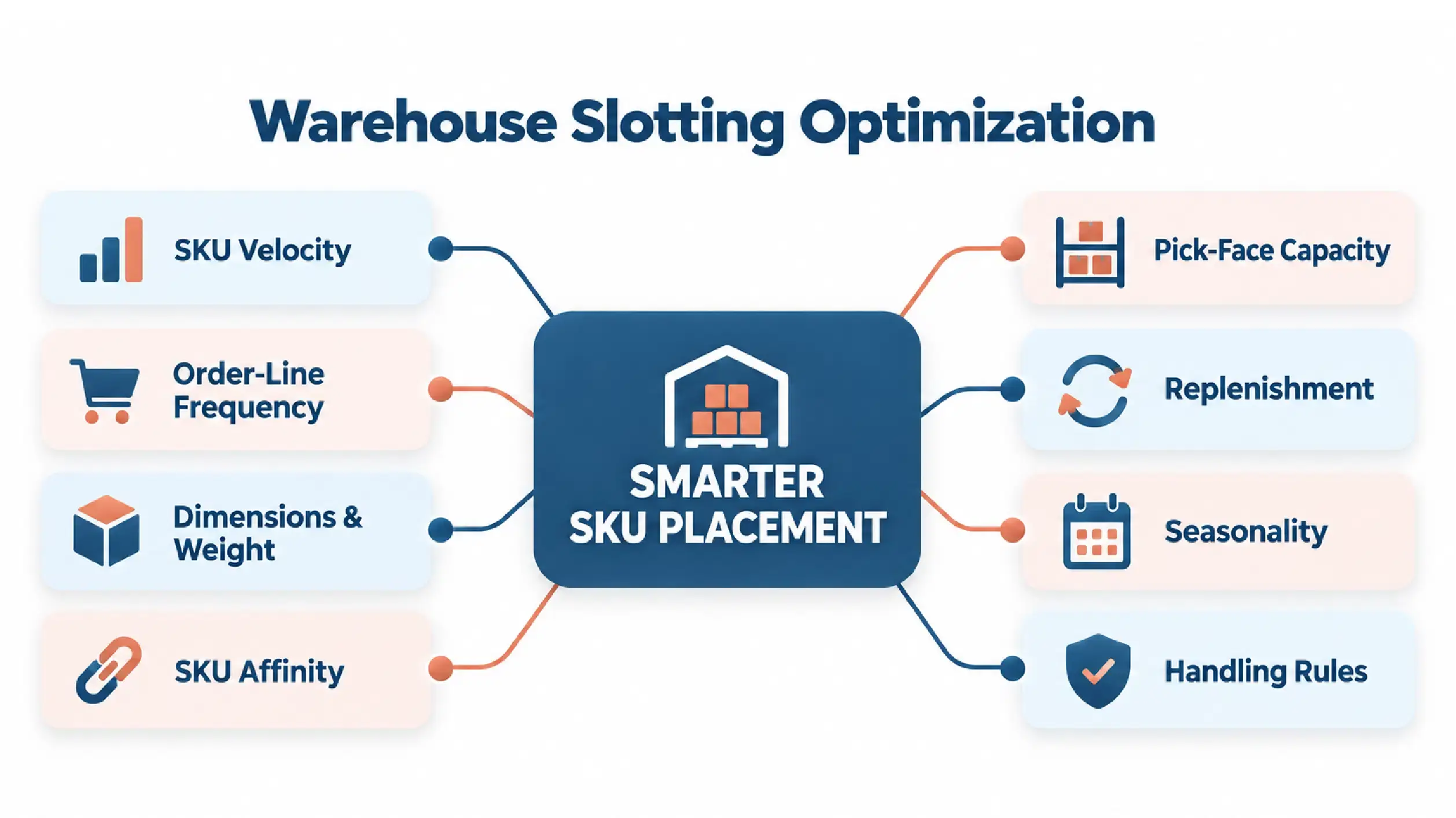
A high-velocity item may deserve an accessible location, but the slot also needs enough capacity for daily demand. A tiny pick face can create repeated replenishment, while a heavy case-pick SKU stored too high can slow handling. Research on manual order picking helps explain why location matters. A 2022 study in Logistics noted that travel can account for about 50% of total picking time in manual operations.
What Determines the Best SKU Location?
Start with movement data, then apply the building's realities.
| Slotting Factor | What It Tells You |
|---|---|
| SKU velocity | How frequently inventory moves |
| Order-line frequency | How often the SKU appears in orders |
| Dimensions and weight | Which positions can safely hold the item |
| SKU affinity | Which products are commonly picked together |
| Pick-face capacity | How much working stock the location can hold |
| Replenishment frequency | How often reserve stock must move forward |
| Seasonality | Whether demand changes during specific periods |
| Handling rules | Whether inventory needs special storage or separation |
Accurate inventory records across SKUs, bins, zones, warehouses, and client accounts provide the location-level data needed for a slotting review.
Macro Slotting vs. Micro Slotting
Macro slotting determines which warehouse zones should hold different inventory groups. It considers decisions such as whether fast-moving each-pick inventory should be positioned near packing, where pallet storage should be located, and which products require temperature-controlled or restricted areas.
Micro slotting determines the exact location of an SKU within its assigned zone, including the aisle, rack, shelf, bin, and picking height.
A warehouse may have the right product in the right zone but still lose time because the SKU occupies an unsuitable shelf position or undersized pick face. Effective warehouse slotting optimization therefore requires both zone-level and location-level decisions.
Picking Speed and Replenishment Have to Work Together
A warehouse can shorten pick paths and still add labor elsewhere.
If a fast-moving SKU is moved close to packing but its new pick face holds only a few hours of demand, reserve stock may need to be brought forward repeatedly. Picker travel falls, while replenishment work and aisle traffic increase.
Slot size matters alongside slot location. High-activity products need enough accessible capacity for a sensible working period, while slower items can tolerate less convenient positions.
This is where warehouse slotting becomes more useful than simply ranking products by popularity. The location needs to work for the complete movement of the SKU, not only the moment when a picker reaches for it.
These factors become the inputs for the slotting methods below, where velocity, affinity, dimensions, and capacity are applied in different ways depending on the warehouse.
Four Warehouse Slotting Strategies Worth Using
ABC Slotting
Among common warehouse slotting strategies, ABC analysis identifies which inventory generates the most activity. A-class SKUs receive priority, B-class items sit in the middle, and C-class inventory moves less often.
It is a starting point, not a complete assignment rule. A small each-pick item and a pallet-sized case-pick item can both be "A" products while needing completely different locations.
Velocity-Based Slotting
Review several weeks of order lines and high-velocity SKUs quickly stand out. These products are usually stronger candidates for convenient pick positions because workers touch them repeatedly.
Use a review period that reflects the demand pattern being planned for, especially around seasonal items, promotions, and launches.
SKU Affinity Slotting
Products that frequently appear on the same orders may benefit from being stored within a practical picking area. This can reduce backtracking, provided size, storage rules, congestion, and client ownership allow it. Affinity becomes especially useful when recurring order combinations appear across a large volume of daily picks.
Cube-Based Slotting
Cube-based slotting matches product dimensions with storage capacity. Small items occupying oversized pick faces waste space, while bulky products forced into undersized locations create handling and replenishment problems.
This approach is particularly useful when forward-pick space is limited or SKU dimensions vary significantly across the catalog.
How Picking Methods Affect Slotting Decisions
The best slotting arrangement also depends on how orders are picked. Discrete picking may prioritize shorter routes for individual orders, while batch and cluster picking can benefit from grouping frequently ordered SKUs within compact picking zones.
Zone picking requires inventory to be positioned around zone capacity and workload. Case picking and pallet picking also need different access, equipment, and slot dimensions than each picking.
Warehouse slotting should therefore reflect the operation’s actual picking method rather than treating product placement as a separate layout decision.
Slotting and pick path optimization address different decisions. Slotting determines where products are stored; pick path optimization determines the route workers follow between locations during a picking task. The two should work together to reduce unnecessary travel.
Fixed vs. Dynamic Warehouse Slotting
Fixed slotting gives a SKU an established location that changes infrequently. It works well when demand and assortment stay reasonably stable.
Dynamic slotting changes locations as inventory activity or operating priorities shift. It can suit seasonal catalogs and rapidly changing demand, but every relocation consumes labor and requires accurate system updates.
Many warehouses use selective re-slotting instead. Stable products stay in place while high-impact SKUs move when the reduction in travel, congestion, or replenishment justifies the effort.
How to Optimize Warehouse Slotting Step by Step
Begin with recent order and inventory activity. Identify the SKUs responsible for the most picks, replenishments, and travel. Then check dimensions, weight, handling rules, current pick-face capacity, and products frequently ordered together.
Remove locations that are physically unsuitable because of rack limits, equipment access, product size, or storage restrictions.
For the remaining options, compare expected picker travel, replenishment workload, available capacity, and likely congestion. A location that shortens walking but doubles replenishment work has simply moved the inefficiency somewhere else.
A full warehouse reset is rarely necessary. Start with the SKUs creating the largest operational burden, move a manageable group, and compare results before expanding the changes.
Warehouse Slotting for Multi-Client 3PL Operations
A 3PL cannot treat every SKU in the building as part of one shared catalog.
Client ownership, service-level agreements, lot or serial requirements, billing arrangements, storage rules, and picking workflows can limit where inventory should be placed. Two similar products may have comparable velocity but require different treatment because they belong to different clients.
Client growth changes the space equation too. A growing account may need more pick-face capacity, while an off-season client may no longer need prime locations.
Fulfillor's 3PL WMS keeps client inventory, locations, orders, workflows, and reporting separated inside the same warehouse environment. That client-level visibility matters when warehouse slotting optimization has to improve flow without blurring inventory ownership or operating rules.
When Should Inventory Be Re-Slotted?
Re-slotting should follow a change in warehouse behavior, not an arbitrary date.
Warning signs include rising replenishment frequency, longer pick travel, congestion around popular aisles, seasonal demand shifts, new client onboarding, packaging changes, SKU growth, or a change in picking method.
In a Concordia University warehouse study, a re-slotting approach reduced picker travel distance by up to 29% in the facility studied compared with its existing mostly random slotting arrangement.
That result should not be treated as a universal warehouse benchmark. The useful lesson is narrower: when poor placement is producing measurable travel and congestion, targeted storage reassignment can create substantial operational gains.
How to Measure Whether Slotting Improved the Operation
Track picker travel, average pick time, picks per labor hour, replenishment frequency, congestion, and storage utilization before and after changes.
Do not read those metrics in isolation. If pick time improves while replenishment trips climb sharply, the new location may be convenient but too small for the SKU's working demand.
Warehouse reporting should make that tradeoff visible. Reporting and analytics capabilities help warehouse teams review inventory activity and operational performance after slotting changes.
How a WMS Supports Warehouse Slotting Optimization
A WMS provides the records needed to make slotting decisions from actual warehouse activity rather than memory. Fulfillor connects SKU and bin data with inventory movement, orders, warehouse locations, client records, and reporting. For multi-client 3PLs, teams can review facility activity while keeping client inventory and workflows separated.
Warehouse management software also connects the surrounding activities that affect slotting decisions, including receiving, putaway, picking, packing, shipping, and location-level inventory movement.
Warehouse operators still have to account for equipment, access, safety, storage restrictions, and labor flow. Software makes the activity visible; the warehouse team determines how that information should change the floor.
A Practical Slotting Decision Check
Before moving a SKU, check six things:
- How often is it picked?
- How much working stock should the pick face hold?
- How often will the location need replenishment?
- Do the item's dimensions, weight, and handling rules fit the slot?
- Are there client-specific storage or workflow constraints?
- Will the move reduce total work without creating congestion elsewhere?
If the only argument is that "this SKU sells a lot," the analysis is incomplete.
Make Slotting a Measured Warehouse Decision
Start with the SKUs generating the most travel, replenishment, or congestion. Check whether their current locations still fit the way they move, make targeted changes, and measure the result.
When location decisions are tied to real order, inventory, and client activity, warehouse slotting optimization becomes a repeatable operating practice rather than a one-time layout exercise.