
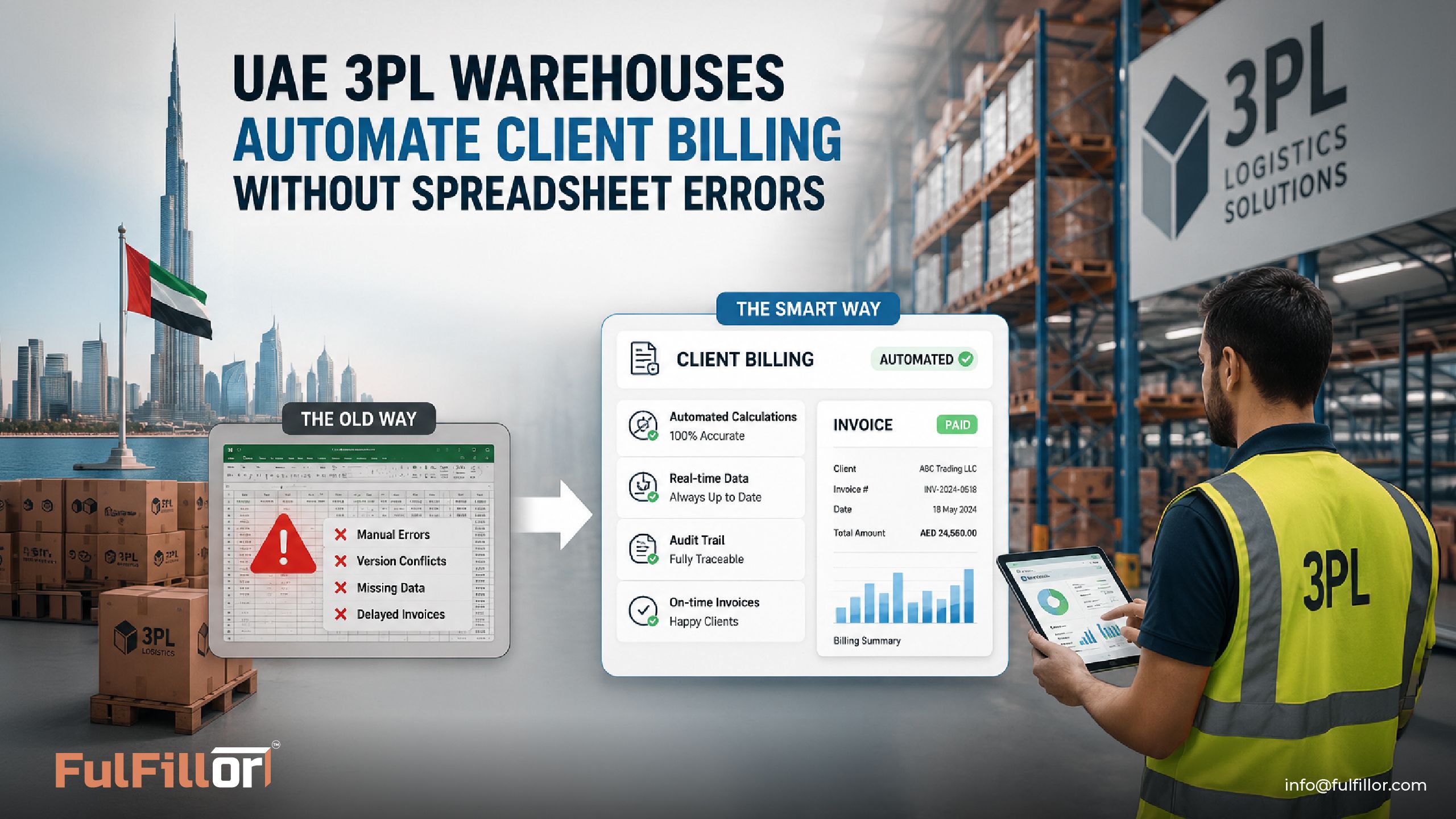
Billing is one of the biggest operational challenges facing growing 3PL warehouses in the UAE.
Most logistics providers start with spreadsheets. When there are only a few clients and a limited number of monthly transactions, manually calculating storage charges, fulfillment fees, and shipping costs seems manageable.
As the warehouse grows, however, billing becomes far more complicated.
New clients bring different pricing structures. Ecommerce brands generate thousands of orders. Returns processing increases. Additional services such as labeling, kitting, repackaging, and quality inspections become common.
Before long, warehouse teams are spending days collecting data from multiple systems just to prepare monthly invoices.
For many 3PL companies in the UAE, billing is no longer an accounting task. It becomes a warehouse operations challenge.
This is where connected warehouse billing becomes important. When receiving, storage, picking, packing, returns, shipping, and value-added services are captured inside the warehouse workflow, invoices become easier to verify and harder to dispute.
Cross-border GCC fulfillment adds another layer of complexity. A warehouse may fulfill orders destined for Saudi Arabia, Kuwait, Bahrain, Qatar, or Oman while applying different shipping costs and service agreements for each client.
Why Billing Becomes Difficult in a Growing 3PL Warehouse
Unlike traditional warehouses, 3PL operations rarely follow a single pricing model.
One client may pay for pallet storage, while another pays by bin location. Ecommerce customers may be charged per order, per pick, or per shipment.
Some clients require special handling, while others need value-added services such as labeling, bundling, or product inspections.
Every warehouse activity can potentially become a billable event.
Receiving inventory, storing products, picking orders, packing shipments, processing returns, and preparing outbound deliveries all create operational costs. The challenge is ensuring those activities are captured accurately and linked to the correct customer.
Without a structured system, warehouse teams often rely on spreadsheets, manual reports, and end-of-month reconciliations to calculate charges. This approach becomes increasingly difficult as order volumes and client requirements grow.
The Hidden Cost of Spreadsheet Billing
Most warehouses do not move away from spreadsheets because they dislike them. They move away because spreadsheets become difficult to maintain as billing complexity increases. They move away because spreadsheets become difficult to maintain as billing complexity increases.
A missed receiving charge, an unbilled return, or an incorrect client rate may not seem serious at first. Over several months, however, these small mistakes can add up.
But those issues add up over time.
Revenue leakage is one of the most common problems in manual billing. Warehouses learn at the same time as finance teams that services were performed but never billed, while finance teams spend hours each week auditing calculations, correcting formulas, and talking to clients.
All of this results in slower billing, slower cash flow, and little control over what is happening in the warehouse.
Why Dubai 3PL Warehouses Are Moving Toward Billing Automation
Dubai has become one of the busiest logistics and fulfillment hubs in the Middle East. A modern 3PL warehouse in Dubai may handle B2B distribution, ecommerce fulfillment, marketplace orders, GCC shipments, and returns processing from the same facility. That creates a billing challenge because each workflow can create different charges for storage, picking, packing, shipping, returns, and value-added services.
The complexity grows when different clients use different sales channels and delivery partners. One client may send Shopify or WooCommerce orders, another may use Salla or Pancake, while others may sell through Amazon UAE, Noon, Zid, Lazada, or Shopee.
On the shipping side, warehouse teams may work with parcel and last-mile providers such as Aramex, DHL, FedEx, iMile, Zajel, Porter, J&T Express, and Ninja Van. For regional freight and cross-border maritime shipments, they may also coordinate with logistics providers such as Asyad Shipping. Each order, return, shipment, delivery fee, and service request can affect what the 3PL needs to invoice.
When these systems are not connected, finance and operations teams spend too much time reconciling data from ecommerce platforms, courier portals, warehouse reports, and spreadsheets. As order volumes increase, this manual process becomes slower and more error-prone. Missed receiving fees, incorrect storage charges, unbilled returns, and unclear courier pass-through costs can all reduce profitability.
This is why growing 3PL warehouses in the UAE need a more connected billing process. Instead of calculating invoices manually at the end of the month, warehouse activity should be captured as it happens and linked to the correct client, service, and rate card. That makes invoicing faster, clearer, and easier to scale across multiple clients.
How a 3PL Billing System Automates Client Invoicing

A connected 3PL billing system reduces manual invoicing by recording warehouse activity as it happens. When inventory is received, the system can capture receiving activity against the right client. When products are stored, it can calculate charges based on pallet, bin, carton, or agreed storage rules.
When orders are picked, packed, and dispatched, those fulfillment activities can be connected to the client’s rate card.
This means the warehouse does not need to rebuild the entire month from spreadsheets and reports. Billing data is already connected to real warehouse transactions, which makes invoices easier to review and less likely to contain missed charges or incorrect calculations.
For finance teams, this changes the month-end process. Instead of chasing operational data, checking formulas, and correcting spreadsheet errors, they can review billing records, validate exceptions, and issue invoices with more confidence.
Why Client-Specific Rate Cards Matter
One of the most challenging aspects of 3PL billing is managing different pricing agreements.
Every client has unique requirements. A wholesale distributor may require long-term pallet storage. An ecommerce brand may generate thousands of small orders each month. Another client may need returns processing, relabeling, and custom packaging services.
Trying to manage these variations manually creates unnecessary complexity.
A modern warehouse billing and operations platform allows warehouses to create client-specific rate cards. Storage fees, receiving charges, fulfillment rates, shipping costs, and value-added services can all be configured according to individual agreements.
This ensures billing remains consistent while reducing the risk of pricing errors.
The Connection Between Inventory Accuracy and Billing Accuracy
When most people think about operating a warehouse, they consider billing and inventory management as two entirely different processes. However, the two systems are extremely interdependent. The accuracy of your billing processes is directly tied to the data integrity within your warehouse operations.
Inaccurate data - such as not properly accounting for movements and receiving - will result in inaccurate storage calculations, incorrect pick and pack rates in instances of partially-fulfilled orders, and could even lead to processing charges that go completely unaccounted for in the event of processing a return and not documenting it. This is why warehouse management systems from established players spend a significant amount of attention on their operational visibility capabilities. Accurate inventory reporting leads to more accurate billing.
And billing comes more easily when it's based on accurate warehouse operations.
Better Billing Creates Better Client Relationships
Most clients have no issue being charged for services they can see and appreciate. Issues emerge when billing is obscure. Should a client query a charge, whether that's for storage, fulfillment, or returns, the warehouse must be able to explain precisely how the fee was determined.
When invoices are supported by clear operational records, clients can understand exactly what they are being charged for. Building trust - With this degree of transparency comes greater client confidence, fostering more enduring relationships for logistics providers. In a competitive logistics market, clients increasingly expect accurate reporting and transparent invoicing.
Warehouses that can provide both are often easier to retain and scale alongside their customers.
What to Look for in a 3PL Billing System
For UAE 3PL warehouses, billing software should do more than create invoices. It should connect daily warehouse activity with each client's pricing rules, so receiving, storage, picking, packing, returns, shipping, and value-added services are easier to track and bill accurately.
A good system should also support multi-client operations. Each client may have different rate cards, fulfillment workflows, ecommerce channels, and reporting needs. When those rules are managed inside the warehouse system, teams spend less time checking spreadsheets and more time reviewing accurate billing data.
Integrations are also important for warehouses serving ecommerce brands across the UAE and GCC. Connections with platforms such as Shopify, WooCommerce, Salla, Zid, Amazon UAE, Noon, and shipping providers can help reduce manual order entry, improve inventory accuracy, and make fulfillment activity easier to connect with billing.
For growing multi-client warehouses, the most useful billing setup is one where operational activity, integrations, reporting, and client-specific rate cards are connected. This allows billing to be based on actual warehouse work instead of disconnected spreadsheets or manual month-end calculations.
Final Thoughts
Spreadsheets can work during the early stage of a 3PL operation, but they become harder to manage as the warehouse adds more clients, services, fulfillment channels, and pricing rules. What starts as a simple billing sheet can quickly become a source of missed charges, invoice disputes, delayed payments, and extra administrative work.
For UAE 3PL warehouses, better billing starts with better operational visibility. When receiving, storage, picking, packing, returns, shipping, and value-added services are tracked clearly, invoices become easier to verify and harder to dispute. The goal is not just to replace spreadsheets. It is to make client billing more accurate, transparent, and scalable as the warehouse grows.