
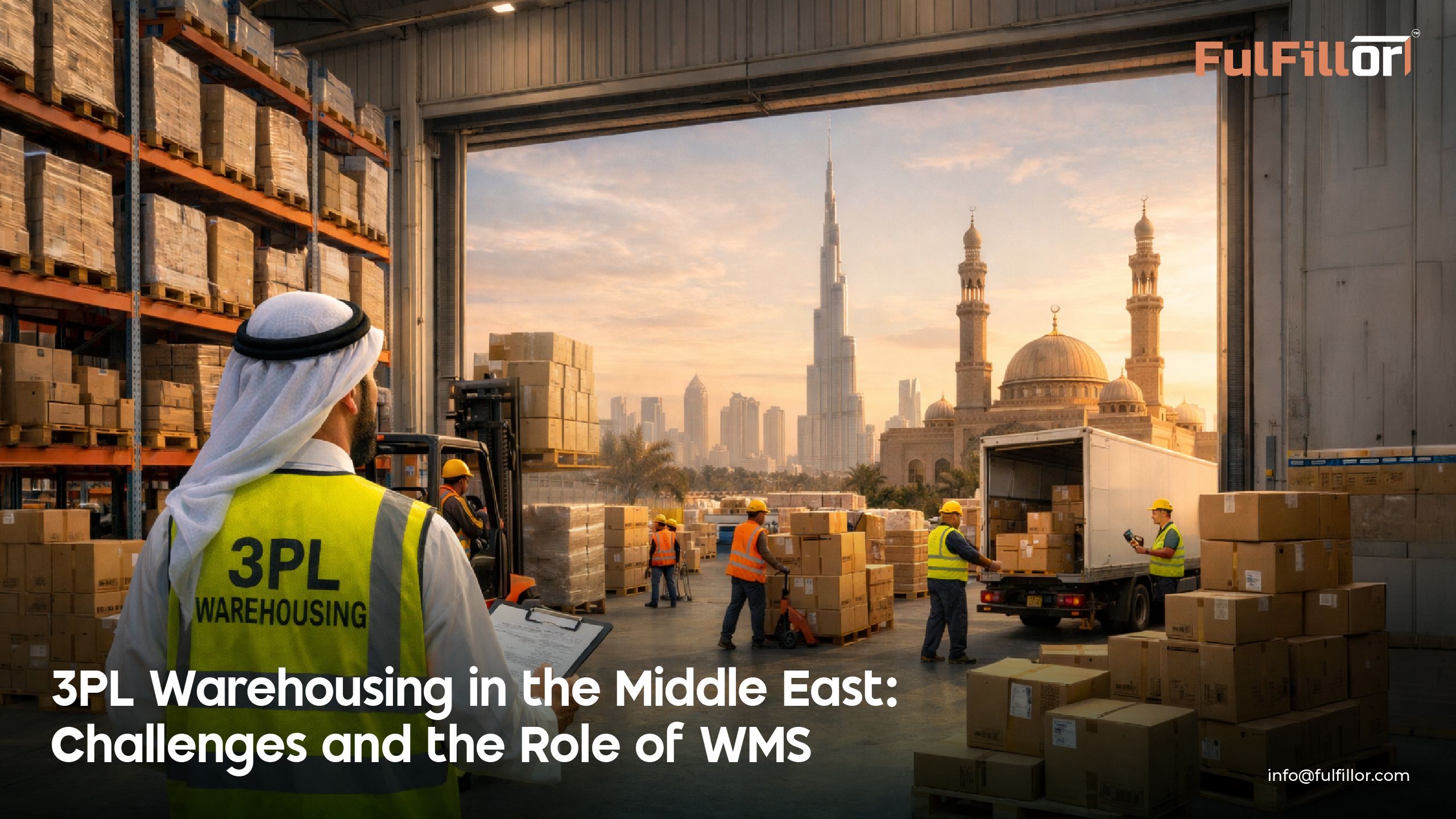
The Middle East has become one of the world's fastest-growing logistics regions. Rapid eCommerce expansion, cross-border trade across GCC markets, and increasing demand for fast fulfillment have pushed warehouse operations to scale quickly.
Countries such as the UAE, Saudi Arabia, Qatar, and Oman are investing heavily in logistics infrastructure, port connectivity, and distribution networks to support regional trade. As order volumes grow and fulfillment expectations accelerate, warehouse operators are under increasing pressure to maintain inventory accuracy, operational visibility, and efficient order processing.
For many third-party logistics providers (3PLs), these demands are difficult to manage using manual processes or disconnected systems. As a result, warehouse management systems (WMS) are becoming essential infrastructure for modern warehouses.
This article explores the growth of 3PL warehousing in the Middle East, the challenges logistics providers face, and how modern WMS platforms improve fulfillment operations.
The Growth of 3PL Warehousing Across the Middle East
Logistics and fulfillment infrastructure have expanded significantly across the Middle East over the last decade. Its strategic position between Asia, Europe, and Africa has turned several Gulf countries into major logistics hubs. Cities such as Dubai, Riyadh, and Doha have developed major logistics and fulfillment infrastructure supporting regional trade and eCommerce distribution.
Some of the major reasons behind this growth include:
- rapid eCommerce adoption across GCC markets
- cross-border trade between Gulf countries
- increasing demand for faster delivery timelines
- expansion of large regional fulfillment centers
According to research from McKinsey, supply chain digitization and data-driven operations are becoming critical for logistics companies aiming to remain competitive in global trade networks.
As warehouse capacity expands across the region, logistics providers are adopting structured warehouse systems to maintain inventory control and operational visibility.
Operational Challenges Facing 3PL Warehouses in the GCC
Rapid logistics growth also introduces operational complexity for warehouse operators.
3PL providers typically manage inventory and fulfillment for multiple clients within the same facility. Without structured systems, maintaining operational accuracy becomes difficult.
Common warehouse challenges across Middle Eastern logistics operations include:
Managing Multi-Client Inventory
3PL warehouses often store inventory for several brands or retailers simultaneously. Maintaining clear separation between client inventories while still optimizing storage space requires precise inventory tracking.
Limited Inventory Visibility
Manual inventory tracking methods or spreadsheet-based systems can lead to discrepancies between recorded stock and actual warehouse inventory. This can result in stockouts, fulfillment delays, or incorrect shipments.
Order Processing Errors
High order volumes increase the risk of picking or packing errors. Even small inaccuracies can create costly returns or impact service-level agreements with clients.
Billing Complexity for 3PL Operations
Many 3PL providers charge clients for storage, picking, packing, shipping, and value-added services. Tracking these activities manually can lead to billing inconsistencies and revenue leakage.
These operational challenges are one of the main reasons warehouse operators increasingly adopt dedicated warehouse management systems.
Why Traditional Warehouse Processes Struggle at Scale
In early-stage warehouse operations, manual processes may appear manageable. However, as order volume and client accounts increase, operational complexity grows rapidly.
Some common limitations of traditional warehouse workflows include:
- manual order allocation
- disconnected inventory systems
- limited operational reporting
- difficulty managing multiple warehouses
Without structured systems, warehouse teams spend significant time resolving operational issues rather than focusing on efficiency improvements.
For growing 3PL providers, these limitations eventually make scaling operations extremely difficult.
The Role of Warehouse Management Systems in Modern Logistics
A modern WMS offers the infrastructure required to manage inventory, picking, and shipping operations in a structured environment.
Key warehouse management system functionalities include the following:
- real-time inventory tracking across warehouse locations
- barcode-based picking and packing operations
- order allocation based on available inventory
- client-specific inventory separation
- operational reporting and performance analytics
For 3PL providers, a WMS enables structured tracking of warehouse activities used for billing, reporting, and operational analysis.
By centralizing warehouse operations within a single platform, logistics teams gain improved visibility and operational control.
How 3PL Warehouses in the Middle East Use Modern WMS Platforms
Across the GCC region, warehouse operators are increasingly adopting digital warehouse systems to effectively manage order fulfillment operations Modern warehouse management platforms such as Fulfillor help 3PL operators coordinate inventory, order processing, and warehouse workflows within a single system.
Many warehouses integrate with regional eCommerce platforms such as Salla and Noon, along with logistics providers like Aramex and DHL, to streamline order processing and shipping operations.
Common WMS use cases include:
- Managing multi-client inventory within shared warehouses
- Managing order fulfillment across multiple warehouse locations
- Reducing picking inaccuracies using barcode-based picking processes
- Automating billing for storage and warehouse services
In countries like the UAE, Saudi Arabia, and Oman, modern warehouse management systems for 3PL warehouses are required to manage multi-location fulfillment and cross-border logistics operations.
Solutions designed specifically for 3PL operations can help warehouse teams manage these complexities more efficiently.
Regional Perspective from 3PL Operators
Warehouse operations in the Middle East region are increasingly focusing on operational visibility and warehouse workflow organization.
Several logistics providers in the region highlight that implementing a modern warehouse management system significantly improves their ability to manage multi-client environments and maintain accurate inventory tracking.
A 3PL company in the region explained,
“As order volumes increased and we onboarded more clients, managing inventory manually became nearly impossible. Implementing a warehouse management system allowed us to standardize workflows and maintain clear visibility across operations.”
This shift toward digital warehouse infrastructure is becoming increasingly common across the region’s logistics industry.
In markets like the UAE, particularly in logistics hubs such as Dubai, warehouse operations face unique challenges.
Learn more about warehouse management challenges for 3PL providers in the UAE.
Technology Trends Shaping the Future of 3PL Warehousing

The evolution of warehouse management in the Middle East is expected to continue with the growth of infrastructure in logistics. Various technology trends are influencing the evolution of warehouse management in the Middle East:
- Increased use of automation in warehouses
- AI-based demand forecasting and analytics
- Integration between eCommerce platforms and fulfillment systems
- Real-time inventory visibility across multiple distribution centers
As these technologies improve, the role of warehouse management systems is going to be crucial to support efficient logistics operations.
For 3PL providers operating in a competitive logistics environment, it is essential to have scalable warehouse infrastructure to maintain quality and efficiency.
The Future of 3PL Warehousing in the Middle East
The expansion of logistics infrastructure across the Middle East has created significant opportunities for warehouse operators and 3PL providers. However, scaling fulfillment operations introduces operational complexity that cannot be managed effectively through manual workflows alone.
Modern warehouse management systems provide the operational visibility and process control needed to support multi-client warehouse environments and high-volume order fulfillment.
As regional logistics networks continue expanding, warehouse operators that invest in structured warehouse technology will be better positioned to maintain efficiency, accuracy, and long-term operational scalability.
Frequently Asked Questions
How does a 3PL warehouse operate?
A 3PL warehouse manages inventory and fulfillment on behalf of multiple clients, covering processes such as receiving, storage, picking, packing, shipping, and inventory control.
Why do 3PL warehouses need a warehouse management system?
A WMS helps 3PL providers track inventory, manage multiple clients, automate fulfillment workflows, and maintain real-time operational visibility.
How is warehousing evolving in the Middle East?
Warehousing across the GCC is evolving through automation, digital warehouse systems, and improved integration between eCommerce platforms and logistics infrastructure.