

Inventory management is the process of tracking, storing, replenishing, and auditing stock to ensure the right products are available at the right time without creating unnecessary costs.
For warehouses, 3PL providers, and growing brands, effective inventory management helps prevent stockouts, excess inventory, fulfillment delays, and inaccurate deliveries. It also improves cash flow, warehouse efficiency, and customer satisfaction by keeping stock levels aligned with demand.
Choosing the right inventory management techniques can help businesses prioritize high-demand products, reduce carrying costs, improve replenishment planning, and maintain accurate inventory across warehouses and fulfillment operations. Strategic inventory management becomes especially important as order volumes, SKU counts, and operational complexity increase.
Why Effective Inventory Management Matters
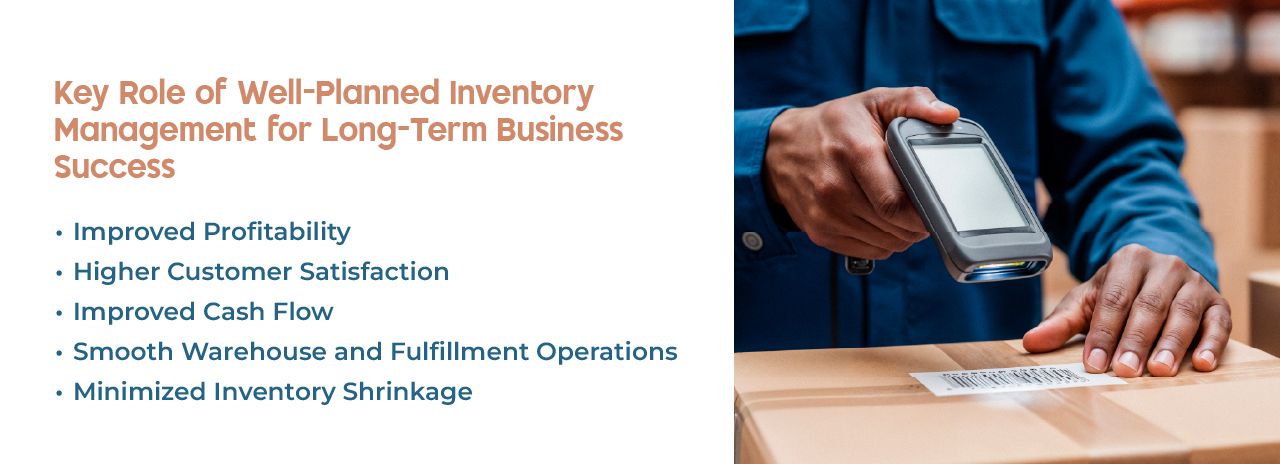
Maintaining the right quantity of inventory at the right time is essential for efficient warehouse and fulfillment operations. Well-planned inventory management influences business performance in several important areas.
Improved Profitability
Reducing stockouts, excess inventory, storage costs, and inventory write-offs can improve overall margins.
Higher Customer Satisfaction
Maintaining product availability helps businesses meet customer demand, reduce fulfillment delays, and support repeat purchases.
Improved Cash Flow
Optimized inventory levels prevent excessive capital from being tied up in slow-moving or unnecessary stock.
Smoother Warehouse and Fulfillment Operations
In warehouse and 3PL environments, effective inventory management supports faster picking, accurate packing, and uninterrupted order fulfillment trends across multiple clients.
Reduced Inventory Shrinkage
Accurate tracking and regular inventory checks help reduce losses caused by damage, theft, misplacement, and recording errors.
When these areas are managed effectively, inventory management becomes a strategic business function rather than a basic administrative task.
Effective Inventory Management Techniques and Their Benefits
Understanding proven inventory management methods helps businesses maintain stock accuracy, control costs, and support scalable operations.
Just-in-Time Inventory Management
What is Just-in-Time inventory management?
Just-in-Time inventory management is a method in which stock is received only when it is needed for production or order fulfillment. The goal is to reduce excess inventory, storage costs, and waste.
Successful JIT execution depends on reliable suppliers, predictable demand, and accurate demand forecasting. It can work well in fulfillment environments with short replenishment lead times, but it may increase stockout risk when supply chains are unreliable.
ABC Inventory Analysis
What is ABC analysis in inventory management?
ABC analysis is an inventory classification method that groups products according to their value and operational importance.
For 3PLs managing multiple clients, ABC analysis helps teams focus control efforts on the SKUs that have the greatest financial or operational impact.
- A items: High annual consumption value and strict monitoring requirements
- B items: Moderate value and regular monitoring requirements
- C items: Lower-value inventory requiring simpler controls
This approach helps businesses allocate time and resources more effectively while maintaining control over long-tail inventory.
Economic Order Quantity
What is Economic Order Quantity?
Economic Order Quantity determines the order quantity that can minimize total ordering and inventory holding costs.
EOQ Formula
EOQ = √(2DS / H)
Where:
- D = Annual demand in units
- S = Ordering cost per order
- H = Annual holding cost per unit
EOQ is most useful when demand, ordering costs, and holding costs are relatively stable. It may be less reliable when demand or supplier conditions change frequently.
EOQ Example
Assume a business has:
- annual demand of 10,000 units
- an ordering cost of $50 per order
- an annual holding cost of $2 per unit
EOQ = √((2 × 10,000 × 50) ÷ 2)
EOQ = approximately 707 units
This means the business could order around 707 units at a time to balance ordering and holding costs, assuming demand and costs remain stable.
Safety Stock
What is safety stock in inventory management?
Safety stock is additional inventory held to protect against unexpected demand increases, supplier delays, and other supply chain disruptions.
Safety Stock = (Maximum Daily Demand × Maximum Lead Time) − (Average Daily Demand × Average Lead Time)
Safety stock is especially important for warehouses and 3PLs managing variable order volumes, seasonal demand, or long supplier lead times.
Cycle Counting
What is cycle counting in inventory management?
Cycle counting is a continuous inventory-auditing method in which smaller inventory groups are counted regularly instead of conducting a complete physical inventory count at one time.
This method is particularly useful in high-volume warehouses and 3PL operations because it improves accuracy without significantly interrupting daily activity. It also helps teams identify inventory discrepancies earlier.
Reorder Point Planning
What is a reorder point in inventory management?
A reorder point is the inventory level at which a replenishment order should be placed to prevent a stockout.
Reorder Point = Average Demand During Lead Time + Safety Stock
For example, if a warehouse ships 40 units per day, supplier lead time is 7 days, and safety stock is 80 units:
Reorder Point = (40 × 7) + 80 Reorder Point = 360 units
The warehouse should place a replenishment order when available inventory reaches 360 units.
FIFO and FEFO Inventory Management
What is FIFO inventory management?
First In, First Out ensures that the oldest inventory is picked and shipped before newer stock. It is commonly used for perishable goods and products that may become obsolete over time.
What is FEFO inventory management?
First Expired, First Out prioritizes inventory based on expiration date rather than receiving date. It is especially important for food, pharmaceutical, healthcare, and other expiry-controlled products.
Inventory Management Methods Comparison
| Inventory Method | Best For | Main Benefit | Main Limitation |
|---|---|---|---|
| Just-in-Time (JIT) | Businesses with predictable demand and reliable suppliers | Reduces storage and inventory carrying costs | Can increase stockout risk during supply disruptions |
| ABC Analysis | Warehouses with large or complex SKU catalogs | Prioritizes high-value and operationally important inventory | Requires regular review and reclassification |
| Economic Order Quantity (EOQ) | Businesses with stable demand and predictable costs | Balances ordering costs and inventory holding costs | Less effective when demand or supplier conditions change frequently |
| Safety Stock | Operations with variable demand or uncertain lead times | Protects against stockouts and supply chain disruptions | Increases inventory carrying costs |
| Cycle Counting | High-volume warehouses and 3PL operations | Improves inventory accuracy without a full warehouse shutdown | Requires consistent scheduling and discrepancy investigation |
| Reorder Point | Businesses with repeat replenishment workflows | Helps prevent stockouts by triggering replenishment at the right time | Depends on accurate demand, lead-time, and safety-stock data |
| FIFO | Perishable, seasonal, or aging inventory | Reduces spoilage, waste, and product obsolescence | Requires accurate receiving dates and disciplined stock rotation |
| FEFO | Food, pharmaceutical, healthcare, and expiry-controlled products | Ensures products with the earliest expiration dates are shipped first | Requires reliable expiration-date tracking |
| Perpetual Inventory Management | Multi-location warehouses and 3PL providers | Provides near real-time inventory visibility and stock updates | Depends on accurate scanning, integrations, and warehouse processes |
How to Choose the Right Inventory Management Method
The right inventory management method depends on the type of products being stored, demand patterns, supplier performance, operational scale, and supply chain complexity.
Important factors to consider include:
- product type, shelf life, and expiry risk
- sales volume and demand variability
- supplier reliability and replenishment lead times
- inventory value and carrying costs
- number of SKUs, clients, and warehouse locations
- lot, batch, serial-number, or expiration-date requirements
- business goals such as reducing costs, improving availability, or supporting growth
- availability of real-time inventory data and reporting
In many cases, businesses achieve better results by combining several inventory management techniques. For example, ABC analysis can help prioritize high-value inventory, reorder points can trigger replenishment, cycle counting can maintain stock accuracy, and safety stock can protect against demand or supply uncertainty.
Just-in-Time inventory may also be useful when demand is predictable, suppliers are reliable, and replenishment lead times are short. However, it may increase stockout risk in volatile supply chains.
For 3PL providers and multi-warehouse businesses, the selected methods should also support client-level inventory separation, location-level tracking, stock-status control, and consistent reporting across facilities.
How Fulfillor Supports Inventory Management
Fulfillor is a cloud-based 3PL warehouse management system designed for 3PL providers, warehouses, and multi-location fulfillment operations.
It supports inventory management through capabilities such as:
- real-time inventory visibility across warehouses and storage locations
- SKU-level inventory tracking
- client-specific inventory control
- multi-warehouse inventory synchronization
- inventory movement and stock-status visibility
- integration with marketplaces, carriers, and other operational systems
These capabilities help warehouse teams apply inventory management methods such as cycle counting, reorder-point planning, stock classification, and multi-location inventory control using current operational data.
By combining proven inventory management techniques with Fulfillor’s 3PL WMS, warehouses and 3PL providers can improve inventory accuracy, reduce manual work, and maintain better control as order volumes and client requirements increase.
Frequently Asked Questions About Inventory Management Techniques
What is the best inventory management technique?
There is no single best technique for every business. The right approach depends on product type, demand patterns, supplier reliability, inventory value, and operational complexity. Many businesses combine methods such as ABC analysis, safety stock, cycle counting, and reorder-point planning.
Can businesses use more than one inventory management method?
Yes. Most warehouses and fulfillment operations use a combination of methods. For example, ABC analysis may be used to prioritize inventory, while safety stock and reorder points help maintain product availability.
Which inventory management methods are useful for 3PL warehouses?
3PL warehouses often use cycle counting, ABC analysis, reorder points, safety stock, lot or serial tracking, and perpetual inventory management. The exact combination depends on client requirements and the types of products being stored.
Can automated inventory management software reduce human error?
Yes. Inventory management software can reduce errors such as incorrect counts, misplaced stock, duplicate records, and manual data-entry mistakes by using real-time tracking and system-guided workflows.
How do inventory tools improve warehouse operations?
Inventory tools improve warehouse operations by increasing stock accuracy, supporting faster order processing, reducing unnecessary carrying costs, and providing better visibility into inventory by SKU, location, warehouse, and client.
What is the difference between inventory management and warehouse management?
Inventory management focuses on stock quantities, availability, replenishment, and control. Warehouse management covers a broader range of activities, including receiving, putaway, storage, picking, packing, labor, and shipping.