
Predictive analytics in warehouse management uses historical activity, current operational data, and forecasting models to estimate what is likely to happen next inside a warehouse.
Instead of relying only on reports that show yesterday's orders, inventory movements, or labor performance, warehouse teams can use predictive analytics to prepare for expected demand, SKU movement, inbound volume, replenishment requirements, and changes in workload.
This is particularly useful for 3PL warehouses, where demand may vary significantly between clients, sales channels, SKUs, and seasons.
Predictive analytics is one part of the broader use of artificial intelligence in warehouse management. While AI can support several warehouse functions, this guide focuses specifically on forecasting and the operational decisions that can be made from forward-looking warehouse data.
What Is Predictive Analytics in Warehouse Management?
Predictive analytics looks for patterns in warehouse and order data and uses those patterns to estimate future activity.
A warehouse management system already records large amounts of operational information, including orders, receipts, inventory movements, locations, picking activity, returns, and shipment history. When that information is structured and reliable, forecasting models can use it to identify patterns that may not be obvious from a daily report.
For example, historical data may show that demand for a particular SKU increases every Friday, that one client experiences significantly higher order volume during promotional periods, or that receiving activity regularly peaks during certain weeks of the month.
The purpose is not to predict warehouse activity with perfect accuracy. Warehouses are affected by promotions, supply delays, customer behavior, new products, carrier issues, and plenty of other variables humans have helpfully made unpredictable.
The value comes from having a more informed estimate of what is likely to happen before the workload actually reaches the warehouse.
How Predictive Analytics Works in a Warehouse
Predictive warehouse planning usually begins with operational data already being created by the business.
Order history can show how demand changes by SKU, client, channel, location, or time period. Inventory records provide information about stock levels and movement. Receiving data shows when goods normally arrive and how much inbound volume the warehouse handles. Promotions, seasonal events, and lead times can add more context.
The forecasting process can be understood in four stages.
First, the system collects relevant data. This may include order history, inventory movement, inbound receipts, product velocity, lead times, returns, and other operational events.
Second, patterns are identified. The model looks for relationships such as recurring seasonal demand, changes in SKU velocity, or predictable increases in order volume.
Third, future activity is estimated. Depending on the use case, the result might be expected order volume, likely SKU demand, predicted inbound workload, or a forecast of how much warehouse capacity may be required.
Finally, warehouse teams use the forecast to prepare. That could mean adjusting replenishment, reviewing storage locations, preparing labor capacity, or planning receiving activity before demand reaches the floor.
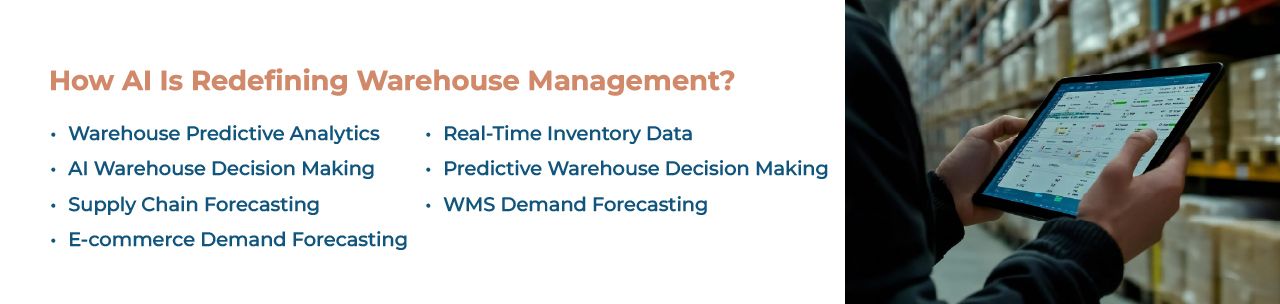
A forecast becomes useful only when it leads to an operational decision. Producing another dashboard nobody acts on merely gives the warehouse a more technologically advanced way to ignore a problem.
What Warehouse Data Can Be Used for Predictive Analytics?
The quality of predictive analytics depends heavily on the information available to the model.
Historical order volume is one of the most useful inputs because it shows how demand has changed over time. SKU-level order history can reveal which products are gaining or losing velocity, while client-level data helps a 3PL identify different demand patterns across customer accounts.
Other useful inputs can include receiving history, current inventory, replenishment activity, product lead times, returns, promotions, sales channels, and warehouse location data.
For forecasting models that rely on current stock positions, reliable real-time inventory synchronization is particularly important. A model may calculate future demand correctly and still produce poor recommendations if the inventory position it starts with is inaccurate.
Data quality therefore matters before model complexity.
A warehouse with unreliable SKU records, incomplete order history, incorrect stock balances, or inconsistent client data does not automatically become better at planning because machine learning has been placed on top of it.
Predictive Demand Forecasting for Warehouse Operations
Demand forecasting is one of the most practical uses of predictive analytics in warehouse management.
The objective is to estimate how much inventory or order activity the warehouse may need to handle during a future period.
Consider an ecommerce fulfillment operation preparing for a major promotion. Historical orders may show which products typically experience the largest increase, how long the demand increase lasts, and whether the change occurs equally across every SKU.
That information can help the warehouse prepare inventory before the promotion rather than discovering the demand shift after a pick face has already emptied.
Forecasting can also operate at different levels.
A warehouse may estimate overall daily order volume to understand expected workload. It may forecast demand for individual SKUs to support replenishment decisions. A multi-location operation may compare expected regional demand when deciding how inventory should be positioned.
The useful level depends on the decision being made.
Predicting that total orders will increase by 20 percent is useful for capacity planning. It is less useful to a replenishment team that needs to know which 15 SKUs are likely to create the pressure.
Predictive Analytics for Multi-Client 3PL Warehouses
Forecasting becomes more complicated in a 3PL because several businesses may be creating demand inside the same facility.
One client may experience strong volume around Black Friday. Another may have steady B2B orders throughout the year. A subscription business may create predictable monthly peaks, while another ecommerce client may generate irregular demand based on promotions.
Looking only at total warehouse volume can hide those differences.
Predictive analytics can help separate expected demand by client, SKU, sales channel, or warehouse. This gives operations teams a better view of where capacity may be required rather than treating every account as if it follows the same demand pattern.
Suppose a 3PL manages eight clients and expects total order volume to increase next week. The warehouse still needs to know which accounts are driving the increase.
If most of the additional volume belongs to one client with a small number of high-velocity SKUs, the warehouse response may involve replenishment and storage changes in a specific zone.
If the increase is spread across hundreds of SKUs from several clients, the capacity problem may look very different.
That client-level forecasting is one reason predictive analytics can be particularly useful in multi-client fulfillment environments.
What Decisions Can Predictive Analytics Support?
Predictive analytics should support specific warehouse decisions rather than become a separate layer of reporting.
| What Is Forecast | Warehouse Decision It Can Support |
|---|---|
| Expected SKU demand | Replenishment quantities and inventory positioning |
| Expected order volume | Capacity and workload planning |
| Expected SKU velocity | Reviewing which storage locations may need to change |
| Expected inbound volume | Receiving capacity and dock planning |
| Expected client demand | Allocating capacity across multi-client operations |
| Expected seasonal volume | Preparing inventory and fulfillment capacity before a peak period |
Not every forecast needs to trigger an automatic change.
In many operations, the most useful role of predictive analytics is to identify something that deserves attention early enough for a warehouse manager to act.
Predictive Analytics and Inventory Planning
Inventory is closely connected to warehouse forecasting, but predictive analytics and inventory management are not the same thing.
Predictive analytics estimates what demand or inventory movement may occur. Inventory management determines how the business responds to that information.
For example, a forecast may indicate that demand for a SKU is likely to increase over the next three weeks. That forecast can inform reorder quantities, safety stock decisions, replenishment schedules, or inventory positioning.
The operational decision still depends on factors such as lead time, available stock, storage capacity, purchasing rules, and the consequences of running out.
This distinction is important for 3PLs because the warehouse may not control purchasing decisions for every client. The 3PL may provide inventory visibility and demand information while the client retains responsibility for procurement.
For a broader look at how AI affects stock planning, replenishment, and inventory control, AI-driven inventory management for 3PLs covers that part of the process separately.
Using Forecasts for Warehouse Capacity Planning
Demand forecasts are also useful when the constraint is warehouse capacity rather than inventory.
A forecast showing increased order volume can help operations teams identify periods when receiving, picking, packing, or shipping activity may come under pressure.
For instance, expected order-line volume can provide a better indication of picking workload than order count alone. Five thousand single-line orders create a different warehouse workload from five thousand orders containing eight lines each.
Inbound forecasting can be treated similarly.
If historical patterns and scheduled receipts suggest unusually high inbound volume, the warehouse may need to prepare dock space, receiving capacity, staging areas, or putaway resources.
Predictive analytics does not perform those warehouse activities. It provides earlier warning that capacity may become constrained.
Detailed workforce allocation belongs to warehouse labor management rather than this forecasting process, although predicted volume can provide an important input into AI-driven warehouse labor optimization.
Predictive Analytics and Warehouse Slotting
Expected SKU velocity can also influence storage decisions.
If demand data indicates that a previously slow-moving product is becoming more active, keeping it in a distant or inconvenient location may increase unnecessary travel during picking.
Forecasting can identify the change early enough for warehouse teams to review whether that SKU still belongs in its current location.
The predictive system is therefore providing an input to slotting rather than replacing the slotting process itself.
Other factors such as product dimensions, weight, storage type, picking method, SKU affinity, replenishment requirements, and warehouse layout still determine whether moving the product actually makes sense.
This separation matters because demand is only one variable in warehouse slotting.
Where AI Fits Into Predictive Warehouse Analytics
Predictive analytics is often discussed together with artificial intelligence because machine learning models can analyze larger and more complex operational datasets than simple fixed rules. Predictive analytics can use traditional statistical forecasting methods or machine learning. It does not always require AI.
AI can help identify relationships between variables, adjust forecasts as new data becomes available, and detect patterns that may change over time.
However, predictive analytics is only one application of AI inside warehouse operations.
AI can also be applied to exception detection, inventory management, warehouse automation, workflow prioritization, and other operational processes. Those broader applications are covered in more detail in AI in warehouse management.
Keeping the distinction clear helps prevent every warehouse technology conversation from becoming a vague discussion about "AI-powered efficiency," a phrase that has now been asked to perform more work than most warehouse employees.
For predictive analytics, the question is more specific:
What is likely to happen next, and can the warehouse prepare for it?
What Predictive Analytics Cannot Fix
Predictive analytics can improve planning, but it cannot compensate for every warehouse problem.
A forecast based on inaccurate inventory records is unreliable before the model even begins. Missing order history creates similar problems, particularly when historical patterns are needed to identify seasonality.
New products can also be difficult to forecast because there may be little or no sales history available.
Sudden changes present another limitation. A viral product, unexpected promotion, supplier disruption, weather event, or large client order can change demand faster than historical patterns suggest.
Forecast quality can also deteriorate when customer behavior changes.
A pattern that held for the previous two years does not automatically remain valid forever. Forecasting models need to be monitored against actual outcomes and adjusted as operating conditions change.
Predictive analytics should therefore be treated as decision support rather than certainty.
How to Prepare Warehouse Data for Predictive Analytics
Warehouses do not need to begin with the most complicated forecasting model available.
A better starting point is to make sure the operational data required for forecasting can actually be trusted.
SKU identifiers should be consistent. Inventory movements should be recorded correctly. Order history needs usable dates and quantities. Client ownership must remain clear in a multi-client facility. Warehouse locations and receiving records should reflect what happened physically.
A connected warehouse management system provides much of this operational foundation by recording inventory, orders, locations, receiving, fulfillment, and shipping activity within the same workflow.
Once those records are reliable, warehouse teams can decide which forecast would solve a real planning problem.
A warehouse dealing with frequent stockouts may begin with SKU demand forecasting. A facility struggling with seasonal peaks may focus on expected order volume. A 3PL experiencing unpredictable workloads may need client-level forecasting.
Starting with the operational decision usually produces more value than beginning with an AI feature and then searching for somewhere to use it.
Predictive Analytics in Warehouse Management: Final Thoughts
Predictive analytics gives warehouses a way to use operational history to prepare for future activity.
Demand forecasts can help teams anticipate SKU movement. Expected order volume can support capacity planning. Client-level forecasts can help multi-client 3PLs understand where future workload is likely to originate. Predicted changes in SKU velocity can also signal when inventory positioning or slotting deserves review.
None of this removes uncertainty from warehouse operations.
The practical advantage is earlier visibility.
A warehouse that identifies a likely demand increase several days or weeks in advance has more options than one discovering the same problem when inventory is already short, receiving is congested, or orders are waiting to be picked.
For 3PLs, that planning becomes more valuable as the number of clients, SKUs, channels, and warehouse locations increases.
Fulfillor provides a connected WMS environment for managing multi-client inventory, orders, receiving, fulfillment, shipping, reporting, and warehouse activity. If your operation is building better forecasting or analytics processes, reliable warehouse data provides the foundation those systems need.
Schedule a call to discuss how Fulfillor can support your 3PL warehouse workflows.