

A simulation study published in Acta Logistica found that combining wave picking with slotting and picker workload balancing reduced average order fulfillment time by approximately 55%, from 503.74 minutes to 225.09 minutes, while using the same infrastructure and staffing. The result reflects the combined strategy rather than wave picking alone, but it shows why planned order releases work best when coordinated with warehouse layout, labor, and downstream capacity.
When orders are released without considering shipping deadlines, warehouse zones, inventory availability, or available labor, pickers may spend more time walking between locations than collecting items. Unplanned releases can also create aisle congestion, uneven workloads, and delays at packing stations.
Wave picking brings more structure to this process by holding eligible orders and releasing them in planned groups at specific times. Each wave can be organized around carrier cutoffs, order priority, storage zones, product requirements, or client service levels.
Warehouse teams can combine wave planning with batch, zone, cluster, or single-order picking depending on the order profile and facility layout.
This guide explains how wave picking works, how it differs from batch picking, where it is most useful, and what warehouses should consider before implementing it.
What Is Wave Picking in Warehousing?
Wave picking is an order-picking strategy in which selected orders are grouped and released for picking at planned times instead of being sent to the warehouse floor as soon as they are received.
Warehouses typically group orders within a wave by carrier deadline, delivery priority, storage zone, handling requirement, or client service level.
For example, a fulfillment center may release next-day orders in a morning wave, urgent same-day orders in a smaller midday wave, and standard orders later in the afternoon. This allows warehouse teams to work backward from shipping cutoffs while balancing the workload across picking, packing, and dispatch.
A warehouse management system can identify eligible orders, allocate available inventory, create picking tasks, and track shortages or other exceptions during the wave.
Orders released within the same wave do not always have to be picked in the same way. Teams complete each wave using the picking method that fits the layout and order mix, whether that is batch, cluster, zone, or single-order picking. Wave picking controls when the work is released, while these methods determine how the items are collected.
How the Wave Picking Process Works
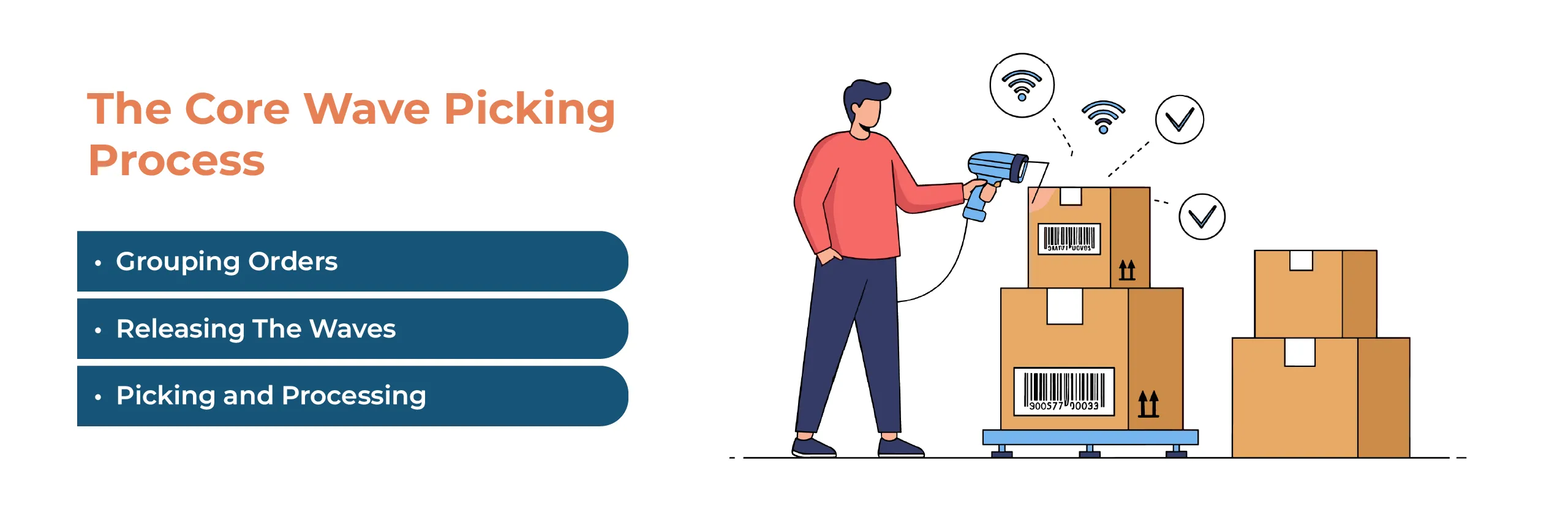
A wave starts before the first picking task appears on a handheld device. Orders must be eligible, inventory must be available, and downstream teams must have room to process the release. The process ends when completed orders are verified and moved to the correct dispatch area.
1. Build the Wave
The warehouse first identifies orders that are ready for fulfillment. Warehouses commonly build waves around carrier cutoffs, delivery priorities, storage zones, or handling requirements.
Inventory should be confirmed and allocated before the wave is released. This prevents an unavailable item from delaying several orders after picking has already started. In a multi-client warehouse, the wave must account for each client’s carrier account, packing rules, and service commitments.
2. Release the Wave
Once the orders have been grouped, the wave can be released manually by a supervisor or automatically through a warehouse management system.
The release should reflect the warehouse’s actual capacity at that time. Wave size should match the labor available on the floor. Packing capacity and the time left before dispatch then set the practical limit.
Oversized waves overwhelm packing and staging, even when picking moves quickly. Undersized waves create less congestion but may not save enough travel or task setup time to justify the extra planning.
3. Pick, Verify, and Complete the Orders
After release, the WMS assigns tasks to one or more pickers based on the selected workflow. The warehouse completes the wave through single-order, batch, zone, or cluster picking based on its layout and order profile.
RF scanners, voice-directed picking, and pick-to-light systems can guide workers to the correct locations and confirm the SKU and quantity during collection. A shortage, damaged item, or location discrepancy must trigger an exception rather than allowing the order to continue with incorrect information.
Picking is only one part of the wave. Collected items may still need to be sorted by order, consolidated from different zones, verified, packed, labeled, and moved to the appropriate carrier staging area. The wave is complete when its orders have either moved forward successfully or been assigned a clear exception status.
Wave Picking vs. Batch Picking
Wave picking and batch picking are related, but they control different parts of the fulfillment process.
Wave picking determines when a group of orders is released. Batch picking determines how items for several orders are collected during a picking route.
A warehouse can therefore release orders in a scheduled wave and use batch picking to complete them. It may also use zone, cluster, or single-order picking within that wave. The release schedule and picking method solve separate planning decisions. One controls when work begins; the other controls how items are collected.
Benefits of Wave Picking in Warehousing
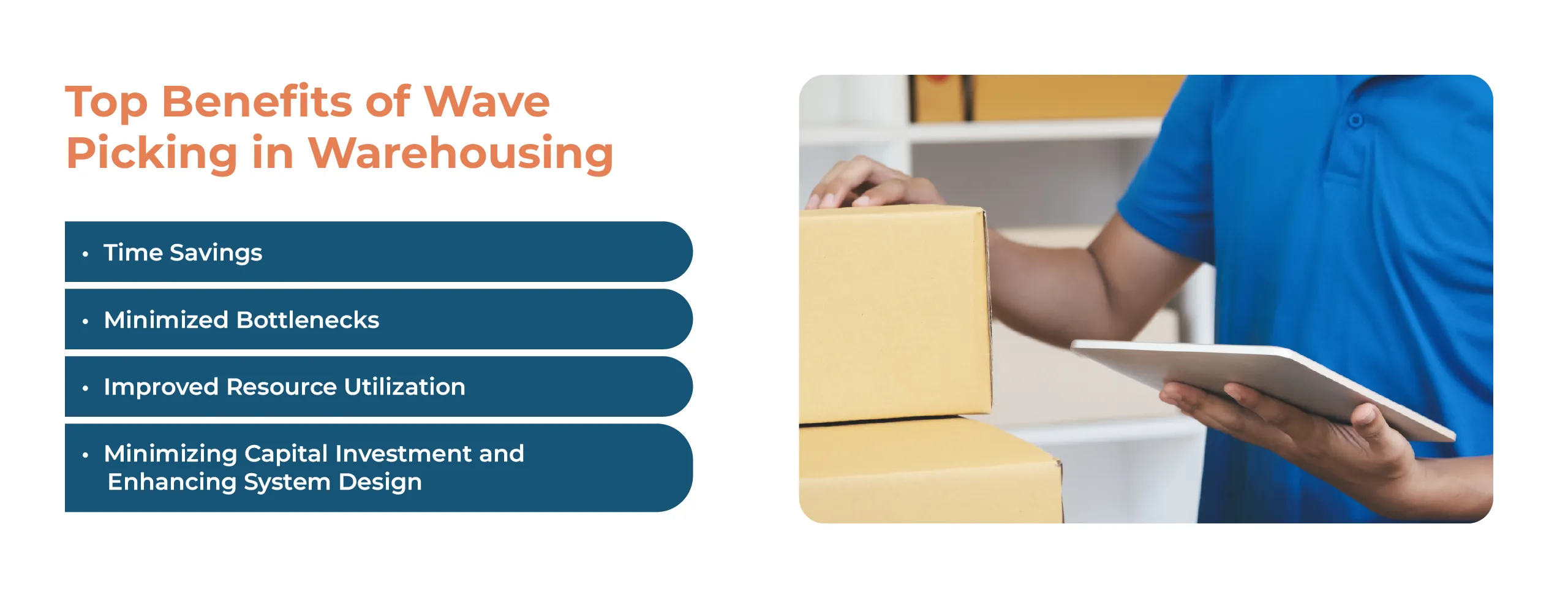
Picking delays often begin when more work reaches the warehouse floor than downstream teams can process. Well-planned waves control that flow and keep completed picks from accumulating at sorting, packing, or staging. When wave rules match the order profile and available capacity, teams can reduce unnecessary movement while keeping picking, packing, and shipping aligned.
Reduced Travel and Aisle Congestion
Grouping orders by storage area, product type, or picking route can reduce repeated trips through the same locations. Planned releases also make it easier to prevent several workers from entering the same aisle at once.
These gains depend on how the wave is configured. Poor grouping can create longer routes or move congestion from picking into sorting and packing.
Better Control Over Shipping Deadlines
Orders can be released according to carrier collection times, delivery commitments, or marketplace cutoffs. This helps the warehouse prioritize work according to when it must leave the facility rather than processing every order strictly in the sequence in which it arrived.
Urgent orders can also be placed in smaller, more frequent waves without disrupting the entire daily workload.
More Predictable Labor Planning
Scheduled waves give supervisors a clearer view of the work expected during each part of a shift. They can assign labor according to order volume, picking zones, equipment needs, and packing capacity.
Labor savings come from shorter travel, fewer task changes, and better workload timing. Poorly designed waves have the opposite effect by adding sorting work or leaving completed picks waiting for packing.
Clearer Operational Visibility
A WMS can show which waves are waiting, active, completed, or delayed. Supervisors can identify short picks, unfinished tasks, packing queues, and orders at risk of missing a cutoff before those issues affect the full dispatch schedule.
This visibility is especially useful for 3PL warehouses managing several clients with different priorities and service-level agreements.
When Wave Picking May Not Be the Right Approach
Wave picking is not necessary for every warehouse. Low-volume operations with simple orders often perform better with single-order or basic batch picking.
Wave picking is also a poor fit when most orders require immediate release, daily demand changes sharply, or packing and staging cannot absorb grouped releases. Poor inventory accuracy is another warning sign because shortages discovered during picking can delay an entire group of orders.
Before introducing scheduled waves, review the daily order profile and dispatch schedule. Then check whether picking routes and packing capacity can support timed releases. The method should solve an existing operational problem rather than add another planning layer for employees to wrestle with.
How Fulfillor Supports Wave Picking Workflows
Fulfillor supports wave, batch, zone, and single-order picking through its pick, pack, and ship software. This allows warehouse teams to choose a picking method based on order volume, product location, fulfillment priority, and warehouse layout rather than forcing every order through the same workflow.
For 3PL operations, picking rules can also reflect client requirements, carrier deadlines, and different order profiles within the same warehouse.
Schedule a call to discuss how Fulfillor can support your current picking, packing, and shipping workflows.
Frequently Asked Questions About Wave Picking
How large should a picking wave be?
Wave size should match what the warehouse can pick, pack, and stage before the relevant carrier cutoff. If completed orders spend too long waiting for packing, the wave is too large for the downstream capacity.
How often should a warehouse release picking waves?
Release frequency depends on the dispatch schedule and order profile. Some warehouses use two or three larger waves during a shift, while operations handling urgent or same-day orders release smaller waves more frequently.
What happens when an item is unavailable during a wave?
The picker records a short pick or inventory exception. The affected order then moves to recounting, substitution, partial fulfillment, or a later wave according to the warehouse’s rules. Other orders in the wave should continue without waiting for the unresolved item.
Can wave picking be combined with zone picking?
Wave picking and zone picking often work together. The wave controls when orders enter the fulfillment process, while zone picking divides the collection work by warehouse area. Items picked in separate zones are consolidated before packing.
Can smaller warehouses use wave picking?
A smaller warehouse rarely needs complex wave scheduling. Two simple releases, such as priority orders before lunch and standard orders before the final carrier collection, may provide enough control without adding unnecessary planning.
When should a warehouse avoid wave picking?
Wave picking is a poor fit when most orders require immediate release, daily demand changes sharply, or packing and staging cannot absorb grouped order releases. In those situations, single-order or basic batch picking is often easier to manage.
A simulation study published in Acta Logistica found that combining wave picking with slotting and picker workload balancing reduced average order fulfillment time by approximately 55%, from 503.74 minutes to 225.09 minutes, while using the same infrastructure and staffing. The result reflects the combined strategy rather than wave picking alone, but it shows why planned order releases work best when coordinated with warehouse layout, labor, and downstream capacity.
When orders are released without considering shipping deadlines, warehouse zones, inventory availability, or available labor, pickers may spend more time walking between locations than collecting items. Unplanned releases can also create aisle congestion, uneven workloads, and delays at packing stations.
Wave picking brings more structure to this process by holding eligible orders and releasing them in planned groups at specific times. Each wave can be organized around carrier cutoffs, order priority, storage zones, product requirements, or client service levels.
Warehouse teams can combine wave planning with batch, zone, cluster, or single-order picking depending on the order profile and facility layout.
This guide explains how wave picking works, how it differs from batch picking, where it is most useful, and what warehouses should consider before implementing it.
What Is Wave Picking in Warehousing?
Wave picking is an order-picking strategy in which selected orders are grouped and released for picking at planned times instead of being sent to the warehouse floor as soon as they are received.
Warehouses typically group orders within a wave by carrier deadline, delivery priority, storage zone, handling requirement, or client service level.
For example, a fulfillment center may release next-day orders in a morning wave, urgent same-day orders in a smaller midday wave, and standard orders later in the afternoon. This allows warehouse teams to work backward from shipping cutoffs while balancing the workload across picking, packing, and dispatch.
A warehouse management system can identify eligible orders, allocate available inventory, create picking tasks, and track shortages or other exceptions during the wave.
Orders released within the same wave do not always have to be picked in the same way. Teams complete each wave using the picking method that fits the layout and order mix, whether that is batch, cluster, zone, or single-order picking. Wave picking controls when the work is released, while these methods determine how the items are collected.
How the Wave Picking Process Works
A wave starts before the first picking task appears on a handheld device. Orders must be eligible, inventory must be available, and downstream teams must have room to process the release. The process ends when completed orders are verified and moved to the correct dispatch area.
1. Build the Wave
The warehouse first identifies orders that are ready for fulfillment. Warehouses commonly build waves around carrier cutoffs, delivery priorities, storage zones, or handling requirements.
Inventory should be confirmed and allocated before the wave is released. This prevents an unavailable item from delaying several orders after picking has already started. In a multi-client warehouse, the wave must account for each client’s carrier account, packing rules, and service commitments.
2. Release the Wave
Once the orders have been grouped, the wave can be released manually by a supervisor or automatically through a warehouse management system.
The release should reflect the warehouse’s actual capacity at that time. Wave size should match the labor available on the floor. Packing capacity and the time left before dispatch then set the practical limit.
Oversized waves overwhelm packing and staging, even when picking moves quickly. Undersized waves create less congestion but may not save enough travel or task setup time to justify the extra planning.
3. Pick, Verify, and Complete the Orders
After release, the WMS assigns tasks to one or more pickers based on the selected workflow. The warehouse completes the wave through single-order, batch, zone, or cluster picking based on its layout and order profile.
RF scanners, voice-directed picking, and pick-to-light systems can guide workers to the correct locations and confirm the SKU and quantity during collection. A shortage, damaged item, or location discrepancy must trigger an exception rather than allowing the order to continue with incorrect information.
Picking is only one part of the wave. Collected items may still need to be sorted by order, consolidated from different zones, verified, packed, labeled, and moved to the appropriate carrier staging area. The wave is complete when its orders have either moved forward successfully or been assigned a clear exception status.
Wave Picking vs. Batch Picking
Wave picking and batch picking are related, but they control different parts of the fulfillment process.
Wave picking determines when a group of orders is released. Batch picking determines how items for several orders are collected during a picking route.
A warehouse can therefore release orders in a scheduled wave and use batch picking to complete them. It may also use zone, cluster, or single-order picking within that wave. The release schedule and picking method solve separate planning decisions. One controls when work begins; the other controls how items are collected.
Benefits of Wave Picking in Warehousing
Picking delays often begin when more work reaches the warehouse floor than downstream teams can process. Well-planned waves control that flow and keep completed picks from accumulating at sorting, packing, or staging. When wave rules match the order profile and available capacity, teams can reduce unnecessary movement while keeping picking, packing, and shipping aligned.
Reduced Travel and Aisle Congestion
Grouping orders by storage area, product type, or picking route can reduce repeated trips through the same locations. Planned releases also make it easier to prevent several workers from entering the same aisle at once.
These gains depend on how the wave is configured. Poor grouping can create longer routes or move congestion from picking into sorting and packing.
Better Control Over Shipping Deadlines
Orders can be released according to carrier collection times, delivery commitments, or marketplace cutoffs. This helps the warehouse prioritize work according to when it must leave the facility rather than processing every order strictly in the sequence in which it arrived.
Urgent orders can also be placed in smaller, more frequent waves without disrupting the entire daily workload.
More Predictable Labor Planning
Scheduled waves give supervisors a clearer view of the work expected during each part of a shift. They can assign labor according to order volume, picking zones, equipment needs, and packing capacity.
Labor savings come from shorter travel, fewer task changes, and better workload timing. Poorly designed waves have the opposite effect by adding sorting work or leaving completed picks waiting for packing.
Clearer Operational Visibility
A WMS can show which waves are waiting, active, completed, or delayed. Supervisors can identify short picks, unfinished tasks, packing queues, and orders at risk of missing a cutoff before those issues affect the full dispatch schedule.
This visibility is especially useful for 3PL warehouses managing several clients with different priorities and service-level agreements.
When Wave Picking May Not Be the Right Approach
Wave picking is not necessary for every warehouse. Low-volume operations with simple orders often perform better with single-order or basic batch picking.
Wave picking is also a poor fit when most orders require immediate release, daily demand changes sharply, or packing and staging cannot absorb grouped releases. Poor inventory accuracy is another warning sign because shortages discovered during picking can delay an entire group of orders.
Before introducing scheduled waves, review the daily order profile and dispatch schedule. Then check whether picking routes and packing capacity can support timed releases. The method should solve an existing operational problem rather than add another planning layer for employees to wrestle with.
How Fulfillor Supports Wave Picking Workflows
Fulfillor supports wave, batch, zone, and single-order picking through its pick, pack, and ship software. This allows warehouse teams to choose a picking method based on order volume, product location, fulfillment priority, and warehouse layout rather than forcing every order through the same workflow.
For 3PL operations, picking rules can also reflect client requirements, carrier deadlines, and different order profiles within the same warehouse.
Schedule a call to discuss how Fulfillor can support your current picking, packing, and shipping workflows.
Frequently Asked Questions About Wave Picking
How often should a warehouse release picking waves?
Release frequency depends on the dispatch schedule and order profile. Some warehouses use two or three larger waves during a shift, while operations handling urgent or same-day orders release smaller waves more frequently.
What happens when an item is unavailable during a wave?
The picker records a short pick or inventory exception. The affected order then moves to recounting, substitution, partial fulfillment, or a later wave according to the warehouse’s rules. Other orders in the wave should continue without waiting for the unresolved item.
Can smaller warehouses use wave picking?
A smaller warehouse rarely needs complex wave scheduling. Two simple releases, such as priority orders before lunch and standard orders before the final carrier collection, may provide enough control without adding unnecessary planning.