
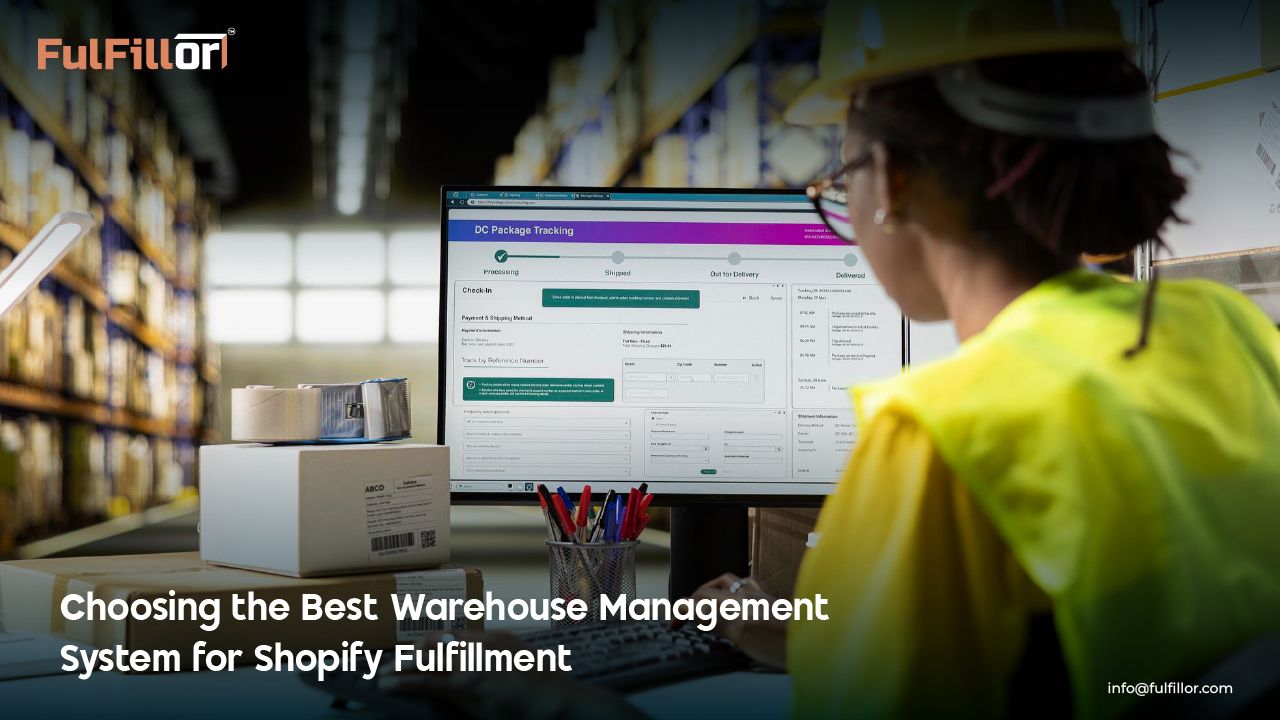
A WMS for Shopify helps teams manage receiving, storage, picking, packing, and fulfillment alongside their online store. Shopify provides inventory and order management tools, but some operations need more detailed control over warehouse tasks, bin locations, client ownership, and fulfillment exceptions. The decision depends on your workflows. A small store with straightforward fulfillment may manage with its existing tools, while a 3PL handling multiple clients may need dedicated warehouse software.
This guide explains how to compare WMS and inventory tools for Shopify, understand their differences, and evaluate them against your warehouse workflows.
Shopify vs WMS: What Changes as You Scale
Shopify is built to manage the commercial side of e-commerce, including storefront operations, product listings, orders, payments, and customer checkout.
For small Shopify businesses shipping from one location with simple SKUs and moderate order volume, Shopify’s built-in inventory tracking may be enough.
A dedicated WMS becomes worth evaluating when teams need more detailed bin-level control, guided picking, client-specific workflows, task management, or exception handling than their current setup provides. Multiple locations or barcode scanning alone do not establish that need.
Shopify creates and manages the order. A WMS manages what happens inside the warehouse after that order is ready to be fulfilled.
What a WMS Does for Shopify Fulfillment
A Warehouse Management System (WMS) for Shopify manages how inventory is received, picked, packed, moved, adjusted, and returned inside the warehouse.
A WMS records warehouse activity through scans, transactions, and connected workflows. Inventory accuracy and update timing depend on how those processes and integrations are configured.
A typical WMS for Shopify fulfillment manages:
- Inventory updates driven by warehouse activity
- Receiving, picking, packing, and returns
- Barcode-based warehouse workflows
- Task sequencing across the warehouse floor
- Exceptions such as damaged items, partial orders, and inventory mismatches
- Inventory visibility across multiple warehouse locations
Types of Warehouse Management Systems That Integrate With Shopify
Not all systems marketed as “WMS for Shopify” serve the same purpose. Some focus on extending Shopify’s inventory capabilities, while others are designed to control warehouse execution directly.
As fulfillment complexity increases across multiple channels, locations, and clients, systems that do not manage warehouse execution often become operational bottlenecks.
Understanding this difference is critical when choosing a system that can handle fulfillment as complexity increases.
| WMS | Potential Fit | Type | Key Strength |
|---|---|---|---|
| Fulfillor | 3PLs and multi-client warehouses | Full WMS | Execution control and client-level data separation |
| ShipHero | High-volume Shopify brands | WMS and fulfillment platform | Optimized picking workflows and warehouse efficiency |
| ShipBob | Brands evaluating in-house or outsourced fulfillment | WMS and outsourced fulfillment services | Warehouse software for owned operations, with outsourced fulfillment options |
| Cin7 Core | Businesses needing connected inventory and warehouse workflows | Inventory platform with WMS capabilities | Inventory control with receiving, putaway, picking, and packing workflows |
| Zoho Inventory | Small to mid-sized businesses | Inventory tool | Simple setup and cost-effective inventory management |
Best WMS for Shopify Based on Business Type
Different Shopify businesses require different types of warehouse management systems.
Shopify-Centric Fulfillment and Inventory Tools
Shopify-centric tools extend Shopify’s built-in capabilities and are suitable for early-stage operations with low complexity. They are usually easy to set up, but they tend to become limited as order volume, warehouse locations, and operational requirements grow.
These tools are usually a better fit for small Shopify stores that need simple stock tracking rather than full warehouse execution.
Inventory Management Platforms With Shopify Integrations
Inventory management platforms improve inventory visibility across multiple sales channels and warehouses. They support planning, stock control, and reporting well, but they may not fully control day-to-day warehouse execution.
These platforms may suit businesses that need connected purchasing, inventory, and fulfillment workflows. Check the specific product’s warehouse capabilities rather than assuming an inventory platform cannot support warehouse execution.
Dedicated WMS Platforms for Complex Fulfillment
Full warehouse execution systems manage fulfillment operations directly, including receiving, picking, packing, inventory movement, and returns. They control how orders are processed and integrate Shopify as the order source.
These systems are usually the best fit for high-volume Shopify brands, multi-location warehouses, and 3PL providers managing multiple Shopify clients.
How to Evaluate a Warehouse Management System for Shopify
When evaluating a warehouse management system for Shopify, the way a WMS behaves during daily operations matters more than its feature list.
What actually matters during evaluation:
- What happens when inventory does not match during picking?
- How are exceptions like damaged items or partial shipments handled?
- Can multiple brands or 3PL clients operate without data overlap?
- Does the system support barcode-based picking and packing?
- Can inventory be tracked across multiple warehouses or locations?
- Does the system hold up during peak order volume?
- How much manual reconciliation is required daily?
The key factor is whether the system can consistently manage warehouse execution as fulfillment complexity increases.
Ask the vendor to demonstrate order imports, inventory availability updates, partial fulfillments, cancellations, and returns. Confirm which system controls each record, how quickly updates are exchanged, and what happens when a connection fails. Test these workflows using your own products, locations, and order scenarios.
How Fulfillor Supports Shopify Fulfillment at Scale
Fulfillor is a warehouse management system designed for Shopify fulfillment in multi-client and 3PL warehouse environments.
Shopify acts as the order source, with orders, updates, and cancellations flowing into the system automatically. Fulfillment operations such as picking, packing, returns, and inventory updates are managed within the warehouse system.
This setup is typically used by 3PL providers and fulfillment teams managing multiple Shopify stores within shared warehouse operations, where inventory accuracy and execution consistency are required to keep orders moving reliably.
Unlike basic inventory tools, Fulfillor manages warehouse execution directly, including how orders are processed, picked, packed, and fulfilled across clients and locations.
Signs a Shopify Business Has Outgrown Native Inventory Tools
Businesses typically begin evaluating a WMS when they experience:
- Repeated inventory discrepancies
- Increasing fulfillment-related support tickets
- Manual reconciliation between Shopify and warehouse records
- Difficulty managing multiple warehouse locations
- Limited visibility into warehouse performance
- Frequent picking, packing, or stock transfer errors
- Delays caused by manual inventory checks
When these issues become common, Shopify inventory tools may no longer be enough to support accurate fulfillment.
How to Choose a WMS for Shopify in 2026
The right WMS for Shopify depends on how your fulfillment operation works today and how much complexity it needs to handle as order volume grows.
Before choosing a system, look at your warehouse setup, order volume, number of SKUs, return volume, picking process, and whether you manage one brand or multiple clients. A basic inventory tool may be enough for a small Shopify store, but multi-location warehouses, high-volume brands, and 3PL providers usually need a full warehouse execution system.
A modern Shopify WMS should help teams manage:
- Real-time inventory updates
- Receiving, picking, packing, and returns
- Barcode-based warehouse workflows
- Multi-location inventory visibility
- Order and fulfillment status syncing with Shopify
- Exceptions such as damaged items, partial orders, and inventory mismatches
- Multi-client or 3PL warehouse operations, when needed
If your team still depends on spreadsheets, manual stock checks, or delayed inventory updates, it is usually a sign that Shopify alone is no longer enough to manage fulfillment accurately.
For 3PL providers and fulfillment teams managing multiple Shopify stores, Fulfillor helps centralize warehouse execution, inventory movement, and order fulfillment across clients and locations. You can schedule a Fulfillor demo to see how it supports Shopify fulfillment workflows.
This article is based on real-world 3PL warehouse operations and Shopify fulfillment workflows.