
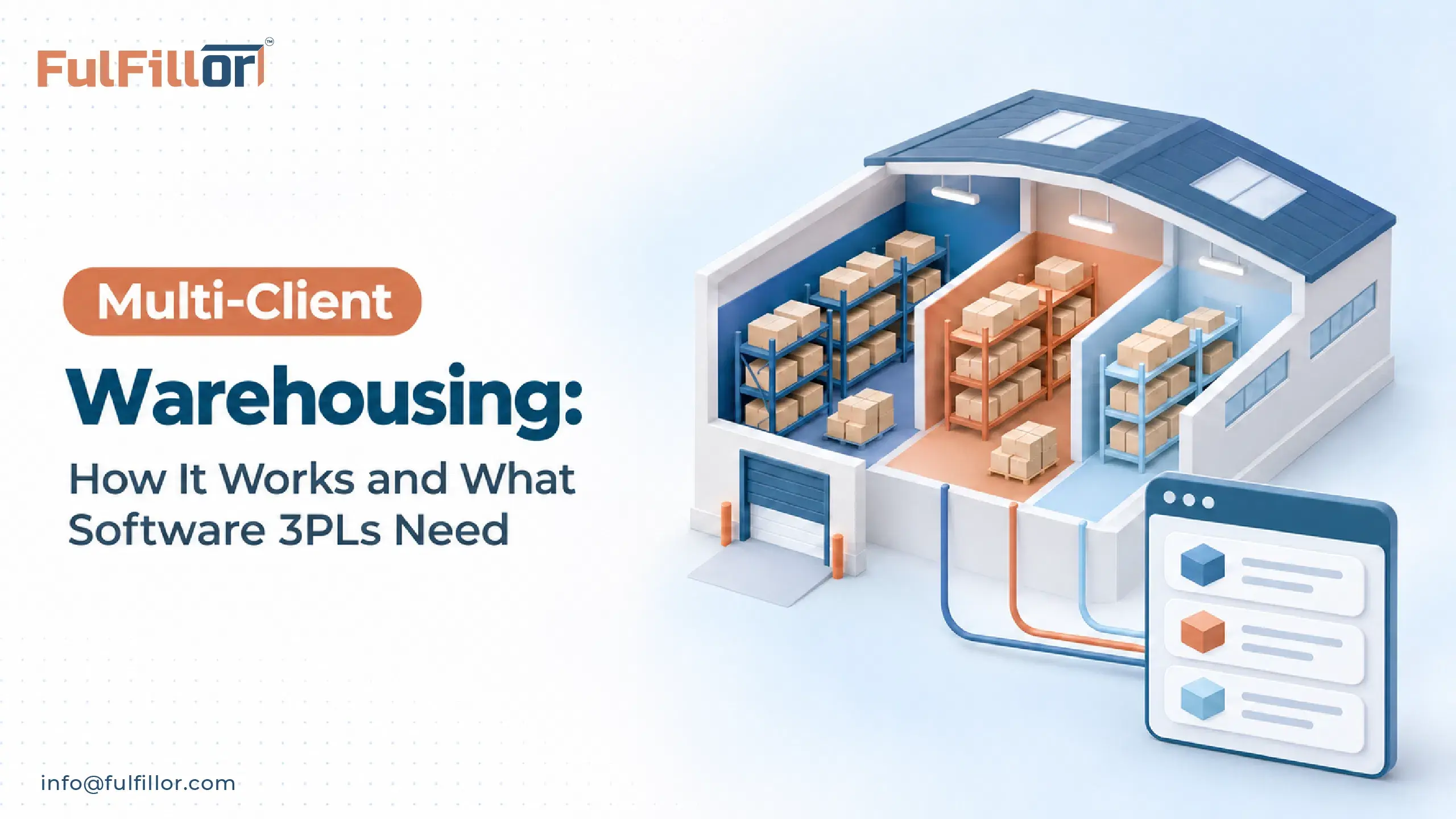
What Is Multi-Client Warehousing?
Multi-client warehousing is an arrangement in which a third-party logistics provider (3PL) stores goods and ships orders for several businesses from one building. In a multi-client warehouse, one receiving crew might unload for three brands before lunch. Every pallet still needs a client account, and every order needs that client's shipping instructions. The work of getting those orders out the door is called multi-client fulfillment.
Picture a warehouse in New Jersey. At the same packing bench, a Shopify apparel order gets a branded insert and a UPS label. The next order, for a home goods seller on Amazon, ships on that client's FedEx account. The packer needs the right instructions for whichever order is on the bench. The inventory record and any handling charge also have to go to the right account.
Multi-Client vs. Dedicated Warehousing
In a dedicated warehouse, one client reserves the building or a defined part of it. In a shared warehouse, the 3PL assigns open rack space and crew time as clients need them. For a prospective client that ships half as many orders in February as in November, show which charges fall with volume and what the client pays year-round to reserve capacity.
| Factor | Multi-client warehousing | Dedicated warehousing |
|---|---|---|
| Cost | The 3PL spreads facility and staffing costs across clients. The client's bill may include storage, handling, and a monthly minimum. | The client pays for capacity set aside for its operation. Steady volume makes that cost easier to justify. |
| Flexibility | A 3PL can offer extra space or labor for a busy period when the site has room. | The client has reserved capacity. Expanding it may require more staff, racks, or equipment. |
| Control | The warehouse uses common procedures and applies each client's handling rules. | The layout, equipment, and day-to-day procedures can be designed around one client's needs. |
| Best fit | Seasonal brands, regional launches, and businesses that can use common warehouse procedures. | High-volume operations with steady demand or products that need specialized space, equipment, or handling. |
A brand may keep its year-round inventory in a dedicated warehouse and turn to your shared site for a regional launch. Quote against the client's projected storage and order volumes, with receiving minimums and pick fees visible alongside the storage rate.
Why Brands Choose Multi-Client Warehousing
For a first shipment of 30 pallets, a brand may know exactly how much space it needs on day one and have very little idea what it will need in six weeks. Your shared site can take the initial 30 pallets. The client will want to know when the space is available, what overflow will cost, and how much notice you need before another truck shows up.
McKinsey's analysis of multi-client ecommerce fulfillment estimated that 3PLs could save 7% to 9% on fulfillment costs compared with dedicated operations. McKinsey attributes the potential savings to steadier demand across clients, economies of scale at the warehouse, automation, and lower final-mile costs. The rate a brand pays still depends on the services and terms in its contract.
A shared warehouse can move crews between clients more easily when their busiest weeks fall at different times. From Black Friday through Cyber Monday, several brands may need the same dock slots, packing stations, and carrier pickups. Suppose a client normally ships 2,000 orders a month and forecasts 5,000 for a promotion. Price both volumes and plan the dock and packing coverage for the busiest week.
Include inbound loads in the forecast. Extra packers can't do much while the stock is still on a trailer.
How 3PLs Run a Multi-Client Warehouse
Separate Inventory at Receiving
Two clients may sell the same product under the same barcode. Before posting a receipt, the receiver confirms which client owns the stock, how many units arrived, and which bin they went into. Lot or serial numbers need to follow the stock when it's moved or counted.
Separate bins work for some items. Others need their own zone or a controlled hold area. If nobody can identify a carton's owner, put it on hold until it can be matched to the correct receipt.
Show Client Instructions at the Bench
A cosmetics client may require an expiration-date check at receiving. An apparel client may want an insert in every parcel. Both instructions can sit in an onboarding spreadsheet, but the receiver and packer need to see them while they're doing the job.
Use the 3PL client onboarding checklist to record those rules. Have the warehouse crew test the picking and packing steps on a sample order, then get the client's sign-off before go-live.
Track Service Commitments by Client
At 1:45 p.m. ET, a parcel order comes in for a brand with a 2 p.m. same-day shipping cutoff. At the next station, a crew is finishing a wholesale shipment with a fixed retailer appointment. Both deadlines inform where the supervisor sends extra help.
A carton can have a label at noon and still be sitting on the dock at five. When you set the client's shipping SLA, name the event that closes the order for reporting. If the agreement uses confirmed dispatch, printing the label won't stop the clock. Decide who calls the client if a hold or missed pickup makes that deadline doubtful.
Handle Retailer Requirements for Wholesale Clients
For a wholesale shipment to a retailer such as Walmart, use its current routing guide for carton labels, markings, and delivery appointments. A missing label or missed appointment can lead to a chargeback.
Keep those instructions tied to both the client and the retailer. Before the first shipment, have the packing and shipping teams run a sample order and confirm the labels and shipment details.
Capture Billable Work as It Happens
In multi-client billing, use the unit specified in the client's rate card. A crew unloads two pallets with 12 cartons each. That's two receiving units on a per-pallet contract or 24 on a per-carton contract. If the crew also relabels six cartons, log that work separately under the same client account.
If a client questions a storage charge, finance should be able to show the dates, the pallet positions counted, and how the fee was calculated. The same records help finance trace other charges back to the work, from receiving to relabeling.
What a Multi-Client WMS Must Keep Separate
To test whether a warehouse management system (WMS) can run a shared site, set up two client accounts and run their work through the same dock and packing bench. The supervisor should see both clients' work. Each client should see only its own records.
| WMS capability | Try this with two client accounts |
|---|---|
| Client portal and permissions | Sign in as an operations contact and then as a finance contact. Compare access to stock, orders, invoices, and exports across the two roles. |
| Activity-based billing | Receive a pallet, put it away, and record a relabeling job. Find the charges and see how finance would review one that looks wrong. |
| Client-specific workflows | Pack one order for each client at the same bench. See whether the correct instructions and carrier options come up on each order. |
| Separate reporting | Export inventory and order performance for one client. The export should contain only that client's records. The supervisor's view should show work across the facility. |
A 3PL client portal gives clients a place to see available stock or look up a shipment. A white-label client portal puts the 3PL's brand on that experience. Before you give a client access, sign in with the permissions they'll actually have and try downloading a report.
Here's a test for your 3PL WMS feature checklist. Set up two clients with the same SKU code. Client A expects 24 cartons and receives 20. Client B expects 12 and receives all 12. Both receipts go through one dock. In the supervisor's view, find the four missing cartons on Client A's receipt. Then sign in as Client B and confirm its receipt shows 12 of 12. Finish in billing. If Client A pays per carton received, the charge should be based on 20 cartons under that client's rate card.
How Fulfillor Supports Shared Warehouse Operations
Fulfillor's cloud-based WMS ties warehouse work to the client account, from the receipt at the dock to the charges finance reviews.
Client Portal and Billing Views
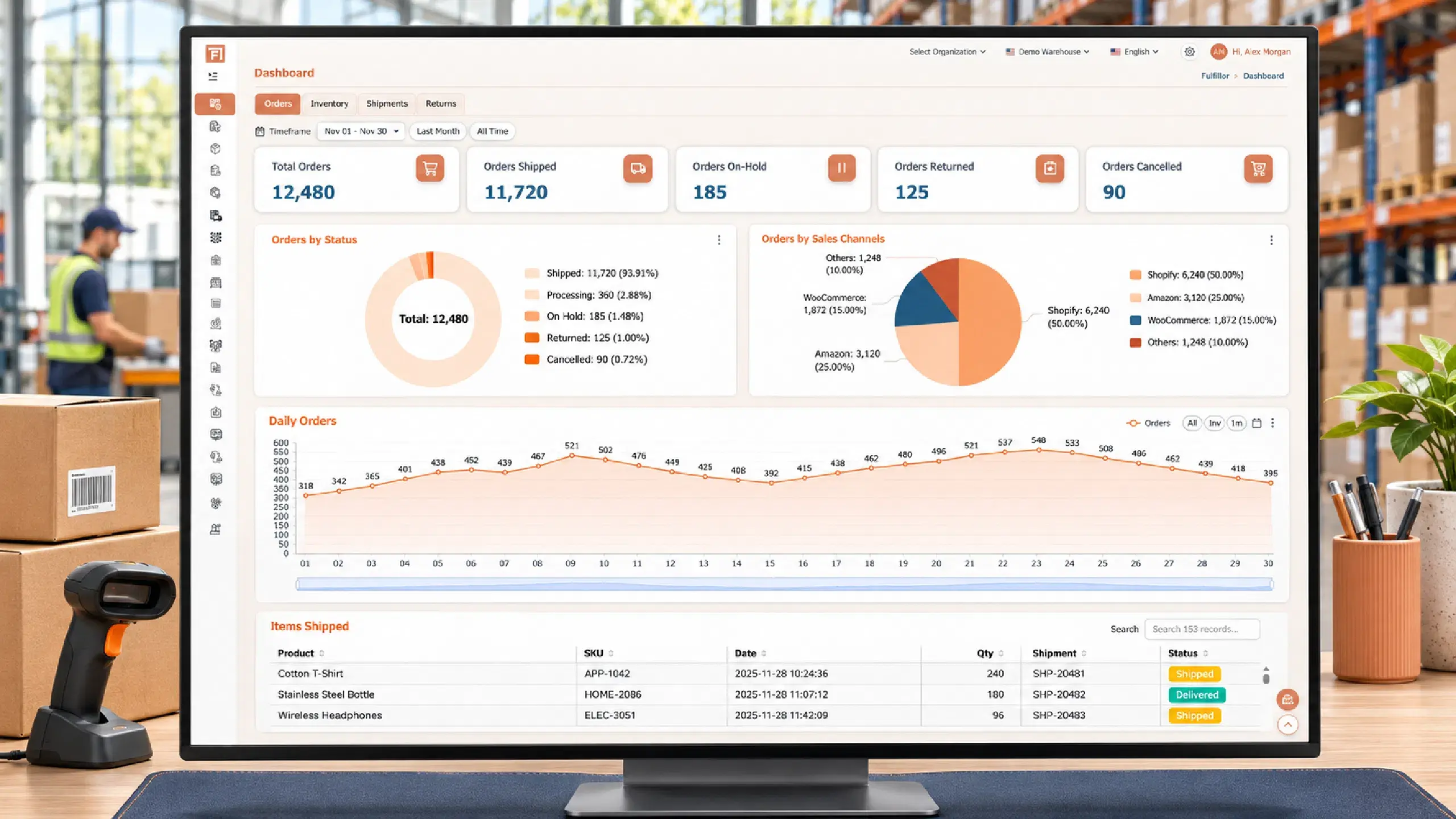
With Fulfillor's multi-client 3PL WMS, the warehouse crew can work across accounts. A client who logs into the portal sees its own inventory, orders, and reports.
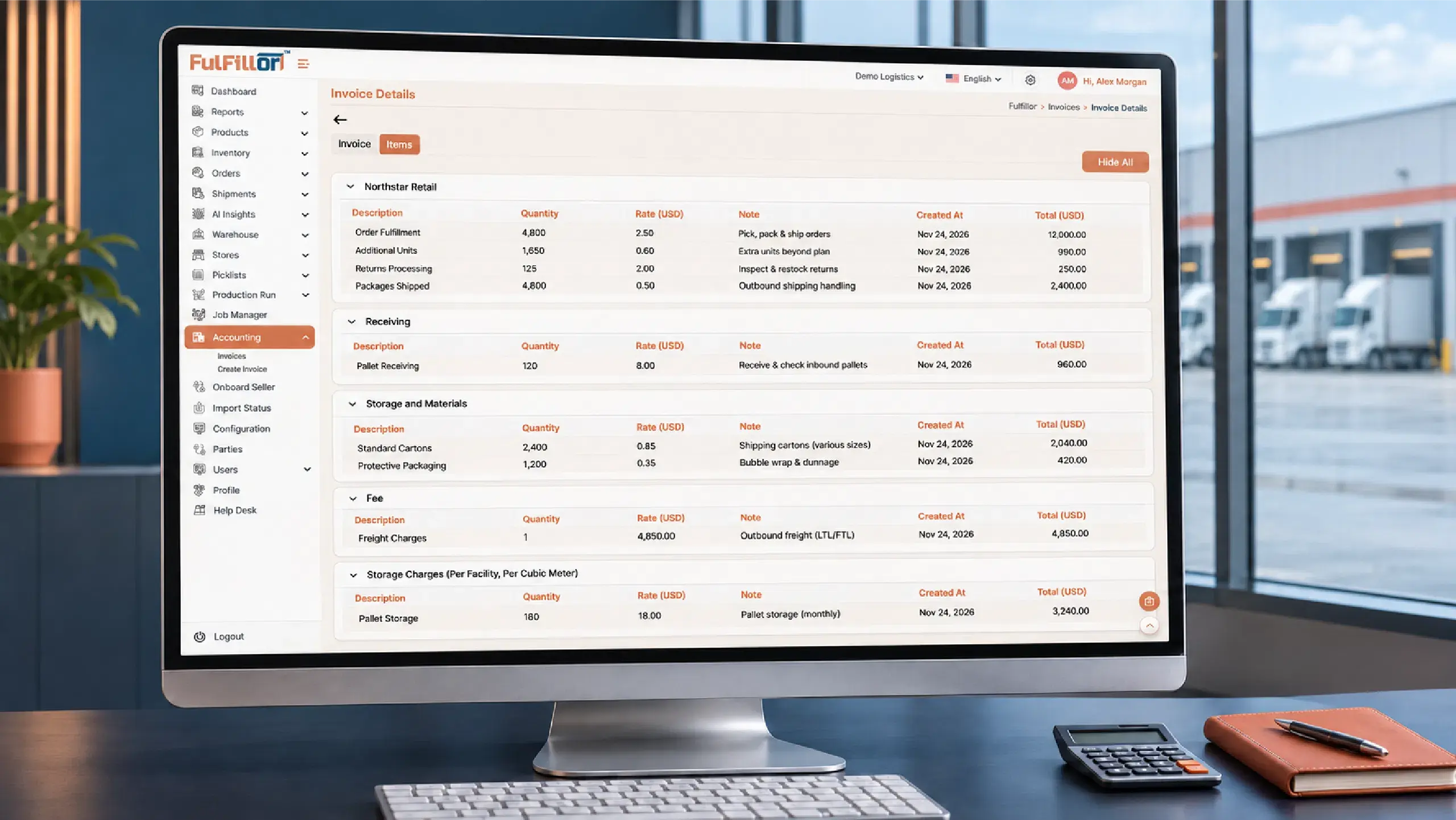
When the same crew unloads pallets for two clients, the receiving charges follow each account's rate card. Finance can trace the work behind a charge before sending the invoice.
 For a 3PL managing multiple locations, the WMS connects inventory and orders across US sites.
How a US 3PL Connects Client Onboarding and Orders
A US 3PL uses Fulfillor's order management system (OMS) and WMS under its own branding. During onboarding, the team creates the client account, connects its sales channels, and assigns warehouses. The OMS sends orders from marketplaces and client websites to Fulfillor WMS or the legacy WMS that the provider still uses.
Fulfillor OMS typically handled 30,000 to 40,000 orders a month, reaching about 48,000 orders in the month around Black Friday 2025. The US 3PL case study explains how the provider connected onboarding and order intake while keeping its existing WMS in service.
Frequently Asked Questions
Is inventory mixed in a shared warehouse?
Not in the records. The WMS tracks stock separately for each client. Different clients can store goods in the same aisle, with labels or location records that identify who owns each pallet, container, or bin. The warehouse system should still show the owner when someone moves, counts, picks, or returns those units.
Is a multi-client warehouse the same as a multi-warehouse operation?
A multi-client warehouse serves several businesses, while a multi-warehouse operation uses several sites. A 3PL can do both, in which case it needs to report stock by client and by site.
A client may ask whether stocking products at your East and West Coast sites would shorten ground shipping times. Confirm two- or three-day coverage using the carrier's transit map and the client's destination ZIP codes. From there, the 3PL needs to track stock and allocate orders across warehouses.
How do 3PLs charge for shared warehousing?
A shared-warehouse bill typically combines storage fees and service charges. A 3PL may bill monthly for each pallet position and charge separately for receiving, picking, packing, shipping, or returns. Say a quote uses $20 per pallet position per month. Fifteen positions would put $300 on the storage line before the warehouse receives or ships anything. Share sample invoices for a regular month and a peak month so clients can see which minimums and surcharges apply.
When is dedicated warehousing a better fit?
Dedicated warehousing is a better fit for a client that can keep reserved space and staff busy year-round or needs a site set up around its equipment. If only one product line needs special handling, your shared facility may be able to reserve a zone for it.
What happens when several clients peak at the same time?
When several clients peak at once, the 3PL schedules work around reserved capacity and its rules for prioritizing orders. Orders above forecast may take longer if the warehouse runs out of space or labor. Set a forecast deadline before the promotion and name the person who will contact the client if orders are likely to miss the shipping cutoff.
What should I look for in a 3PL WMS for multi-client warehouses?
Look for client-level inventory and order records, client-specific workflows, role-based portal access, separate reports, and billing tied to each client's rate card. In the demo, run two clients through the same receiving dock and packing bench. Each order should pick up the right packing rules and charges, and each client should see only its own records.