

3PL Inventory Management: Smart Systems and Best Practices
Smart inventory management helps 3PL warehouses maintain accurate stock records across clients, channels, and locations. A modern 3PL inventory management system provides real-time inventory visibility, supports replenishment planning, and reduces errors caused by spreadsheets or disconnected warehouse processes.
Overstocking and stockouts can tie up working capital, reduce product availability, and disrupt fulfillment operations. These problems become harder to control as SKU counts, client requirements, and warehouse locations increase.
This guide explains how smart inventory management uses real-time data, automation, and connected warehouse systems to improve inventory control and support more efficient 3PL operations.
What Is Smart Inventory Management?
Smart inventory management uses connected warehouse software, real-time data, automation, and forecasting tools to track stock and support inventory decisions. In a 3PL environment, the system must also separate inventory by client, warehouse, ownership, status, lot, and sales channel.
Challenges 3PLs Face with Traditional Inventory Processes
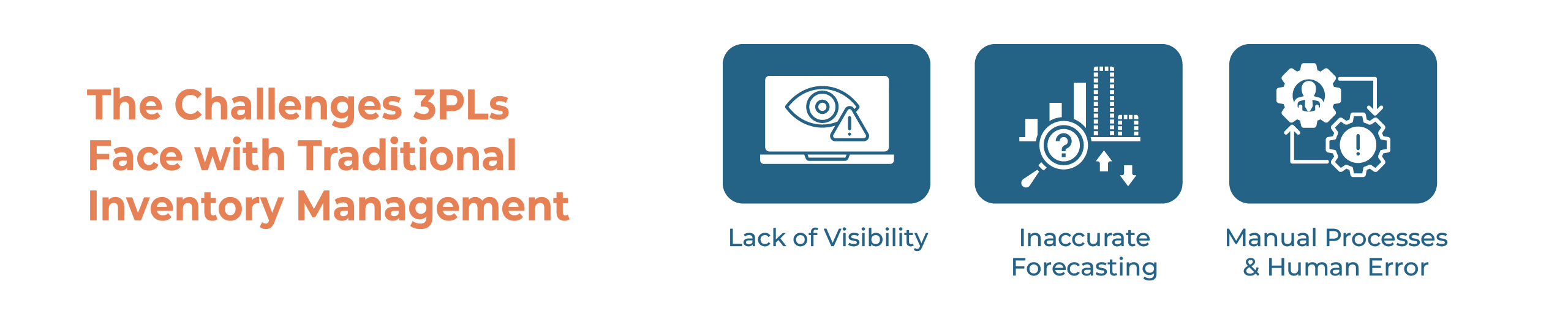
Traditional inventory processes often depend on spreadsheets, manual updates, disconnected systems, and delayed reporting. As 3PL operations grow, these methods make it harder to maintain accurate inventory records across clients, warehouses, and sales channels.
-
Limited inventory visibility: Without real-time inventory data, warehouse teams may struggle to confirm stock quantities, storage locations, allocation status, and inventory ownership across facilities.
-
Inaccurate forecasting and replenishment: Outdated or incomplete data can make it difficult to anticipate demand, plan replenishment, and prevent excess inventory or stockouts.
-
Manual processes and human error: Repetitive data entry and siloed systems can create incorrect counts, duplicate records, misplaced stock, and slower inventory reconciliation.
-
Multi-client inventory complexity: 3PL providers must separate inventory by client, SKU, location, and stock status. Weak inventory controls increase the risk of incorrect allocation, reporting discrepancies, and fulfillment delays.
-
Limited scalability: Processes that work for one warehouse or a small number of clients often become difficult to manage as order volumes, SKU counts, and operational requirements increase.
Why Smart Inventory Management Matters
Smart inventory management uses real-time data, automation, scanning workflows, analytics, and system integrations to improve how inventory is tracked, controlled, and replenished.
For 3PL providers, this means maintaining accurate visibility into inventory by client, SKU, warehouse, storage location, and stock status. It can also support faster inventory updates, more reliable reporting, and better replenishment decisions across multi-client operations.
For 3PL providers, smart inventory management means maintaining current visibility into inventory by client, SKU, warehouse, storage location, and stock status. It can also support faster inventory updates, more reliable reporting, and better replenishment decisions across multi-client operations.
These capabilities usually depend on connected warehouse workflows, barcode scanning, inventory analytics, and integrations that keep stock records updated as warehouse activity occurs.
How Smart Inventory Management Supports 3PL Growth
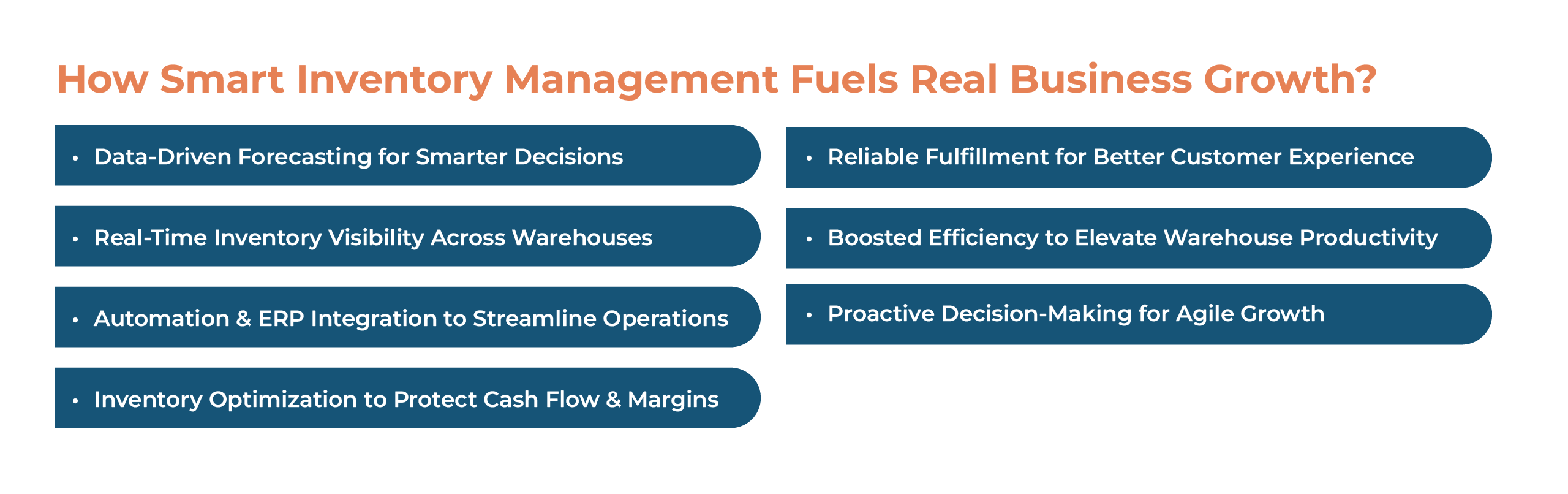
1. Demand Forecasting and Replenishment Planning
Smart inventory management systems can analyze historical orders, stock movement, seasonal demand, and replenishment patterns to support more informed planning. This gives 3PL teams and their clients stronger data for allocation, replenishment, and purchasing decisions, depending on how responsibilities are divided between the provider and the inventory owner.
2. Real-Time Inventory Visibility Across Warehouses
Real-time inventory visibility allows warehouse teams to monitor stock quantities, storage locations, allocation status, and movement across facilities. This makes it easier to respond to demand changes, investigate discrepancies, and manage multi-location stock with fewer manual checks.
3. Automation and ERP Integration
Automation and ERP integration connect warehouse data with sales, finance, purchasing, and fulfillment workflows. This can reduce duplicate data entry, improve consistency across systems, and provide more current operational information.
4. Inventory Utilization and Working Capital Control
More accurate planning can reduce unnecessary overstocking, slow-moving stock, and avoidable storage costs. For 3PL providers, stronger inventory control can also improve warehouse space utilization and simplify the management of client stock across locations.
5. More Reliable Fulfillment Operations
Accurate stock records support faster order allocation, fewer picking errors, and more consistent fulfillment. Automated updates, SKU-level tracking, and warehouse optimization practices can also reduce manual reconciliation and improve workflow consistency.
6. Earlier Identification of Inventory Issues
Inventory analytics and exception reports can highlight unusual stock movement, count discrepancies, low-stock risks, and replenishment delays. This allows warehouse managers to investigate problems before they affect client reporting or order fulfillment.
Example of Smart Inventory Management in a Multi-Client 3PL
Consider a mid-sized 3PL managing ecommerce inventory for several brands across multiple warehouse locations. The operation relies on spreadsheets and delayed updates, making it difficult to identify discrepancies, low-stock risks, and excess inventory.
By introducing barcode-supported workflows, real-time tracking, and client-level stock visibility, the 3PL could reduce manual reconciliation, identify problems earlier, and make more informed replenishment decisions.
Results would depend on factors such as inventory volume, data quality, warehouse processes, staff adoption, supplier performance, and system configuration.
How to Implement Smart Inventory Management
Implementing smart inventory management requires more than installing new software. 3PL providers should review existing workflows, prepare accurate data, configure the system carefully, train warehouse teams, and measure results after implementation.
1. Review Current Inventory Processes
Map how stock moves through receiving, putaway, storage, transfers, picking, returns, adjustments, and cycle counting. Identify where spreadsheets, delayed updates, or duplicate data entry create errors or slow down operations.
2. Establish an Inventory Baseline
Measure current inventory accuracy, stockout frequency, adjustment volume, cycle count variance, and the time required to reconcile stock. These figures provide a baseline for measuring improvements after implementation.
3. Define Operational Requirements
Document requirements for:
- client-level inventory separation
- multi-warehouse visibility
- lot, batch, serial number, and expiration date tracking
- inventory statuses such as available, allocated, damaged, held, and returned
- marketplace, ERP, accounting, and carrier integrations
- reporting, user permissions, and audit trails
4. Select the Right 3PL WMS
Choose a 3PL WMS that supports real-time inventory tracking, barcode workflows, multi-client operations, role-based access, integrations, reporting, and controls that match your warehouse processes.
5. Clean and Prepare Inventory Data
Standardize SKU names, units of measure, client ownership, warehouse locations, product identifiers, and stock statuses before migration. Poor data quality can create new discrepancies even after the system is implemented.
6. Configure and Test Workflows
Configure receiving, putaway, transfers, allocation, picking, returns, cycle counts, and inventory adjustments before full deployment. Test exception scenarios such as damaged stock, missing inventory, incorrect allocations, and failed scans.
7. Run a Pilot
Test the system with one warehouse, client, or inventory category before expanding it across the operation. A pilot helps teams identify workflow gaps, data issues, and training needs before full rollout.
8. Train Warehouse Teams
Train users on scanning requirements, stock adjustments, discrepancy handling, exception workflows, and reporting procedures. Clear process ownership is essential for maintaining accurate records.
9. Monitor and Improve
Track inventory accuracy, cycle count variance, stockout rate, shrinkage, order fill rate, adjustment volume, and reconciliation time. Review these metrics regularly and update workflows where problems continue.
Smart Inventory Management vs. Traditional Inventory Management
Traditional inventory management often relies on periodic stock updates, spreadsheets, and manual reconciliation. Smart inventory management uses connected warehouse workflows, barcode scanning, automation, integrations, and analytics to keep inventory records current as warehouse activity occurs.
The main difference is not simply the use of software. It is the ability to capture inventory changes during receiving, movement, picking, counting, and shipping, then make that information available across clients, warehouses, locations, and connected systems.
| Area | Traditional Inventory Management | Smart Inventory Management |
|---|---|---|
| Inventory updates | Entered manually or updated at scheduled intervals | Updated through scanning, integrations, and warehouse transactions |
| Inventory visibility | Limited, delayed, or spread across separate systems | Centralized visibility by client, SKU, warehouse, location, and stock status |
| Data entry | Often spreadsheet-based, repetitive, and prone to errors | Reduced through barcode scanning, system integrations, and automated workflows |
| Issue detection | Problems are often identified after a discrepancy or stockout occurs | Alerts, reports, and exception monitoring help teams identify issues earlier |
| Inventory accuracy | Depends heavily on manual updates and periodic reconciliation | Supported by real-time transactions, cycle counting, and controlled inventory movements |
| Multi-client operations | Becomes difficult to manage across clients, warehouses, and sales channels | Supports structured inventory separation across clients, locations, and facilities |
How Fulfillor Supports Smart Inventory Management
Fulfillor is a cloud-based 3PL warehouse management system built for multi-client and multi-location fulfillment operations.
It supports inventory management through features including:
- inventory visibility by client, SKU, warehouse, and storage location
- SKU-level stock tracking
- barcode-supported receiving, movement, picking, and counting workflows
- inventory status and stock movement tracking
- multi-warehouse inventory management
- inventory reports for warehouse teams and clients
Available integrations, automation rules, and workflows depend on system configuration and operational requirements.
Whether a 3PL manages one warehouse or multiple facilities, Fulfillor 3PL WMS can help improve inventory accuracy, reduce manual updates, and provide clearer visibility across fulfillment operations.
Schedule a call to discuss your warehouse requirements.
Frequently Asked Questions
What is a smart inventory management system?
A smart inventory management system uses real-time inventory data, barcode or mobile scanning, automation, integrations, and analytics to improve how stock is tracked, controlled, and replenished.
What is 3PL inventory management?
3PL inventory management involves tracking and controlling inventory on behalf of multiple clients. It includes inventory visibility by client, SKU, warehouse, location, ownership, lot, and stock status.
How does smart inventory management help 3PL providers?
Smart inventory management helps 3PL providers track inventory across clients, SKUs, locations, warehouses, and stock statuses. It can reduce manual updates, improve inventory accuracy, and provide more reliable client reporting.
What is the difference between smart inventory management and a WMS?
Smart inventory management refers to the processes and technologies used to improve inventory control. A warehouse management system supports these processes while also managing receiving, putaway, picking, packing, labor, and shipping workflows.
Can smart inventory management reduce stockouts?
Smart inventory management can help teams identify low-stock risks earlier through real-time visibility, inventory alerts, and replenishment data. Results also depend on demand forecasting, supplier performance, purchasing decisions, and workflow execution.
What inventory KPIs should a 3PL track?
Important 3PL inventory KPIs include inventory accuracy, cycle-count variance, stockout rate, shrinkage, order fill rate, inventory turnover, adjustment rate, and inventory reconciliation time.
Can a 3PL inventory management system support multiple warehouses?
Yes. A suitable 3PL inventory management system can centralize stock visibility across multiple warehouses while keeping inventory separated by client, SKU, location, ownership, and stock status.