
Ecommerce fulfillment has become harder to manage as customers expect faster delivery, accurate order updates, and a smoother post-purchase experience. For 3PLs, that pressure grows even more when they are managing multiple clients, sales channels, SKUs, carriers, and return workflows at the same time.
Adding more labor can help for a while, but it does not solve the deeper operational issues. Growing 3PLs need the right technology stack to improve inventory accuracy, reduce manual work, speed up fulfillment, and keep orders moving across every channel.
This guide is for 3PL fulfillment providers managing multi-client, multi-channel ecommerce operations. It explains the key technologies that help 3PLs improve warehouse visibility, automate repetitive workflows, reduce fulfillment errors, and scale ecommerce fulfillment with more control.
How 3PLs Transform Ecommerce Fulfillment With 7 Key Technologies
3PLs use a mix of warehouse software, automation, inventory tracking, analytics, robotics, returns tools, and ecommerce integrations to manage faster order cycles and higher client expectations. These technologies help fulfillment teams reduce manual work, improve accuracy, and keep orders moving across multiple sales channels. These technologies are not necessarily seven separate purchases. Inventory tracking, returns workflows, and automation may be included in a WMS, while robotics and specialized analytics may require connected systems.

1. Cloud-Based Warehouse Management System for Multi-Client 3PL Operations
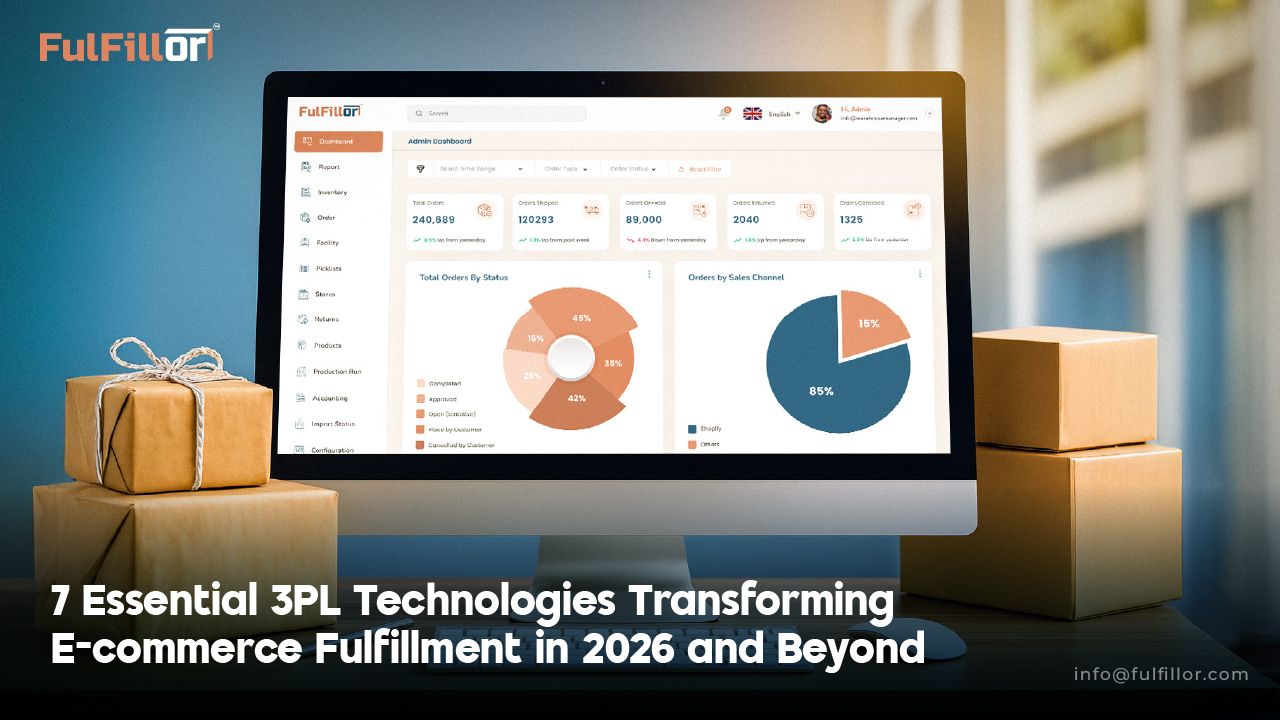
A cloud-based warehouse management system is often the foundation of a modern 3PL technology stack. It helps fulfillment teams manage inventory, orders, picking, packing, shipping, returns, billing, and client visibility from one system.
For multi-client 3PL operations, this is especially important. Each client may have different SKUs, order rules, shipping requirements, billing terms, and reporting expectations. A 3PL WMS helps keep these workflows organized without relying on scattered spreadsheets or disconnected tools.
A modern WMS should support real-time inventory visibility, barcode-based warehouse execution, ecommerce integrations, carrier workflows, returns management, and client reporting. In many warehouses, the WMS also works alongside warehouse execution systems and order management systems to coordinate fulfillment workflows from order import to dispatch.
Confirm which workflows are included, which require connected applications, and how warehouse teams handle connectivity interruptions.
2. Workflow and Handling Automation
Automation can reduce repetitive steps such as assigning orders, generating labels, applying packing rules, and routing exceptions for review. Physical handling equipment, such as conveyors and sortation systems, can support movement between workstations.
Start with a repeatable process that creates measurable delays or manual work. Define the rules, required data, and exception handling before automating it. Otherwise, incorrect records or unclear instructions can spread through the workflow faster.
For physical equipment, evaluate throughput, space, maintenance, and compatibility with warehouse systems. See our guide to conveyor and sortation systems.
3. Real-Time Inventory Tracking
Even a well-automated warehouse can struggle if inventory data is inaccurate. When stock counts are wrong, 3PLs risk overselling, delayed shipments, missed SLAs, and unhappy clients.
Real-time inventory tracking helps teams see what is available, where items are stored, and when stock needs attention. Barcode scanning, RFID tagging, cycle counts, and location-based stock updates help keep inventory data accurate across multiple warehouse zones or locations.
For ecommerce fulfillment, this visibility is critical. Clients need to know what they can sell, warehouse teams need to know what they can ship, and customer support teams need reliable order and stock information. Warehouse updates and sales-channel updates may run at different intervals. Confirm how reserved, damaged, quarantined, and available stock are represented before relying on channel availability.
4. AI and Predictive Analytics
AI and predictive analytics help 3PLs understand patterns in order volume, inventory movement, fulfillment performance, and warehouse bottlenecks.
Instead of only reacting after delays or stock issues happen, teams can use analytics to forecast demand, identify slow-moving SKUs, review picking performance, improve replenishment planning, and spot workflow issues before they affect service levels.
For ecommerce fulfillment, this becomes useful during seasonal spikes, promotional campaigns, and fast-changing SKU demand. Better data helps 3PL teams plan labor, stock placement, and fulfillment priorities with more confidence. Forecasting depends on reliable historical data and relevant inputs, such as promotions and seasonal demand. Review predictions against actual results. Routine reporting and rule-based alerts do not necessarily require AI.
5. Returns Management Technology
The customer journey does not end after delivery. Returns are a major part of ecommerce fulfillment, and poor returns handling can create inventory gaps, refund delays, and extra support work.
Returns management technology helps 3PLs track return requests, return status, received items, restocking decisions, and client updates. When returns are handled inside the same warehouse system, teams can process items faster and update inventory more accurately.
For 3PLs, this also improves reverse logistics. Returned stock can be inspected, restocked, quarantined, or reported without losing visibility across the client account.
Warehouse receipt and inspection are separate from refund approval. Confirm which system controls each step and when returned stock becomes available for sale.
6. Robotics and AMRs in Fulfillment Centers
Robotics can help warehouses address specific movement or handling bottlenecks. Suitability depends on order profiles, travel distances, facility layout, throughput, and implementation cost.
Autonomous mobile robots (AMRs) can move goods between warehouse zones, while robotic arms may support packing, sorting, or repetitive handling tasks. These tools are most useful when they solve a clear bottleneck, such as long travel paths, high picking volume, or repetitive movement between zones.
Before adoption, test the proposed workflow against representative orders and peak workloads. Confirm integration requirements, maintenance responsibilities, and how staff will continue operating when equipment is unavailable.
7. Ecommerce and Marketplace Integrations
3PLs often manage orders from Shopify, WooCommerce, Amazon, eBay, Walmart, BigCommerce, and other sales channels. Without integrations, teams may need to manually import orders, update inventory, share tracking numbers, and manage customer data across separate systems.
Ecommerce integrations connect sales channels with warehouse systems. Depending on the connector, they may exchange orders, inventory availability, tracking updates, cancellations, or return records. Confirm the supported records, update frequency, and failure-handling process for each connection.
For multi-channel ecommerce fulfillment, integrations are not just a convenience. They help 3PLs keep order flow, stock data, and shipping updates aligned across every client account.
| 3PL Technology | What It Helps With | Best For |
|---|---|---|
| Cloud-based 3PL WMS | Inventory, orders, picking, packing, shipping, returns, billing, and client visibility | Multi-client warehouse management |
| Workflow and handling automation | Reducing manual work across sorting, labeling, packing, and order routing | Faster order processing during peak demand |
| Real-time inventory tracking | Stock visibility, location tracking, and identifying availability discrepancies | Inventory accuracy across multiple clients and locations |
| AI and predictive analytics | Demand patterns, workflow bottlenecks, labor planning, and replenishment decisions | Smarter fulfillment planning |
| Returns management technology | Return status, restocking, reverse logistics, and client updates | Faster and clearer returns processing |
| Robotics and AMRs | Reducing walking time, repetitive movement, and manual handling | High-volume picking and warehouse movement |
| Ecommerce integrations | Order sync, inventory sync, tracking updates, and return data across sales channels | Multi-channel ecommerce fulfillment |
Which Technology Should Your 3PL Implement First?
Start with the operational problem and the records needed to resolve it.
- If client stock is mixed or difficult to trace, prioritize inventory ownership, location records, and WMS controls.
- If staff repeatedly enter orders or tracking updates manually, evaluate the relevant ecommerce and carrier connections.
- If picking errors are frequent, improve labels, scan validation, and exception handling before adding robotics.
- If returned goods remain unprocessed, establish receiving, inspection, disposition, and client-update workflows.
- If travel or handling limits throughput, measure the bottleneck before evaluating conveyors or robots.
- If planning is unreliable despite accurate operational records, evaluate forecasting and analytics.
Set a baseline, test one change, and compare results before expanding the technology stack.
Building a Connected 3PL Technology Stack
Choose technologies that address a defined operational problem and work with your existing systems. Reliable inventory records, clear workflows, and controlled exceptions provide the foundation for automation and more advanced tools.
Fulfillor helps 3PL warehouses manage inventory, ecommerce orders, shipping workflows, returns, reporting, and client visibility. Schedule a demo to discuss your workflows and required connections.