AI-Enabled Inventory Management: Importance, Benefits, and Key Features
In today’s rapidly evolving, data-driven world, effective inventory management plays a significant role in achieving smooth and successful business operations. Advanced inventory management software is equipped with powerful tools and features essential for achieving quicker and more reliable order fulfillment.
From AI-powered automation and robust analytics to real-time inventory visibility, Fulfillor offers features that help brands gain a competitive advantage. Modern AI inventory management platforms provide real-time supply chain visibility, predictive analytics, and automated inventory optimization to reduce errors and improve fulfillment speed.
What is AI-enabled inventory management?
AI-enabled inventory management is the use of artificial intelligence and machine learning algorithms to forecast demand, optimize stock levels, automate replenishment, and provide real-time visibility across the supply chain.
Unlike traditional inventory systems that rely on static rules, spreadsheets, and manual updates, AI-enabled inventory management continuously learns from real-time and historical data to improve forecasting accuracy and inventory decisions over time.
Why Businesses Need AI-Powered Inventory Management Software
Businesses across industries are constantly struggling to simplify inventory functions, reduce manual errors, make valuable decisions, and lower costs. These issues are often difficult to address with a traditional inventory management system that essentially depends on spreadsheets or paper records to track inventory, lacks real-time decision-making, and is prone to making more mistakes. Modern AI demand forecasting models also support SKU-level forecasting, stockout prevention, and automated replenishment by constantly analyzing market patterns and historical trends.
Other issues that businesses experience involve frequently changing demands, diverse product portfolios, and the need for informed decision-making. Here, the AI-driven IMS platform can be your savior, as it provides some interesting features like AI-enabled automation, analyzing real-time data, accurate demand forecasting, informed decision making, automated replenishment, and advanced analytics that eventually help in reducing overall operational costs and ensuring reliable and timely customer fulfillment.
In this blog, we’ll walk through the crucial aspects you should know and assess before investing in AI inventory management software development:
What are the benefits of AI-driven inventory management software?
Investing in an AI-driven inventory management tool is a great way to achieve operational excellence through its numerous features and benefits. Below are some top reasons why you don’t need to think before investing in an AI-powered software:
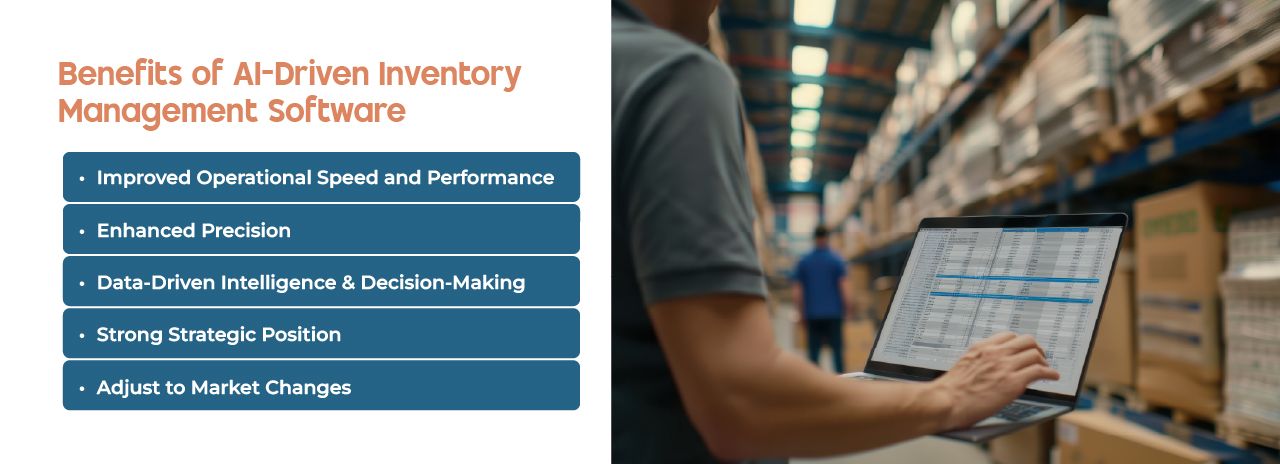
1. Improved Operational Speed and Performance
AI-driven inventory systems are tailored to automate time-consuming, complex tasks, including data entry, demand forecasting, and restocking. Through automation of these tasks, your team can focus on more important and strategic tasks, driving efficiency and profitability. With automation handling replenishment triggers and inventory planning tasks, businesses can reduce lead time variability and optimize safety stock levels more accurately.
2. Enhanced Precision
Utilizing AI algorithms, processing large volumes of data becomes easier and efficient, ensuring exceptional speed and accuracy. This leads to more accurate demand forecasts, smarter inventory management, and minimizes errors. Eventually, this will reduce the risks of stock shortages or surplus stock by ensuring you have the optimal stock levels. AI inventory optimization automatically adjusts reorder quantities and identifies fast-moving vs. slow-moving SKUs to minimize working capital tied up in excess stock.
3. Data-Driven Intelligence & Decision-Making
AI-enabled inventory management software like Fulfillor provides clear, transparent inventory updates, demand patterns, and supplier performance, letting businesses make strategic, real-time decisions. Whether it’s procurement, production planning, or distribution, data-driven intelligence helps identify cost-saving opportunities, respond responsibly to market changes, and strategize resource allocation effectively. These insights enable intelligent order routing, improved service levels, and real-time alerts whenever inventory health metrics fall below optimal thresholds.
4. Strong Strategic Position
By investing in smart inventory management software, brands can operate with greater agility, deliver more efficiently and accurately, and respond quickly to shifting customer demands. This will not only improve customer satisfaction but also boost trust and help you outperform competitors.
5. Adjust to Market Changes
Business environments are evolving fast, and your inventory management processes must embrace change. AI-powered inventory management software analyzes trends and customer behaviors in real time, allowing quick adjustments to inventory management strategies. This flexibility allows your business to stay competitive, resilient, and responsive, and to grab new opportunities.
Q: What businesses benefit most from AI-driven inventory management? AI-driven inventory management is especially valuable for retail, eCommerce, 3PL, and manufacturing businesses that manage large SKU volumes, multiple locations, variable demand, or complex supply chains.
Key Factors to Consider When Choosing an AI-Driven Inventory Management Solution
Selecting the right AI-powered inventory management system begins with understanding your business goals and aligning them with the software’s capabilities:
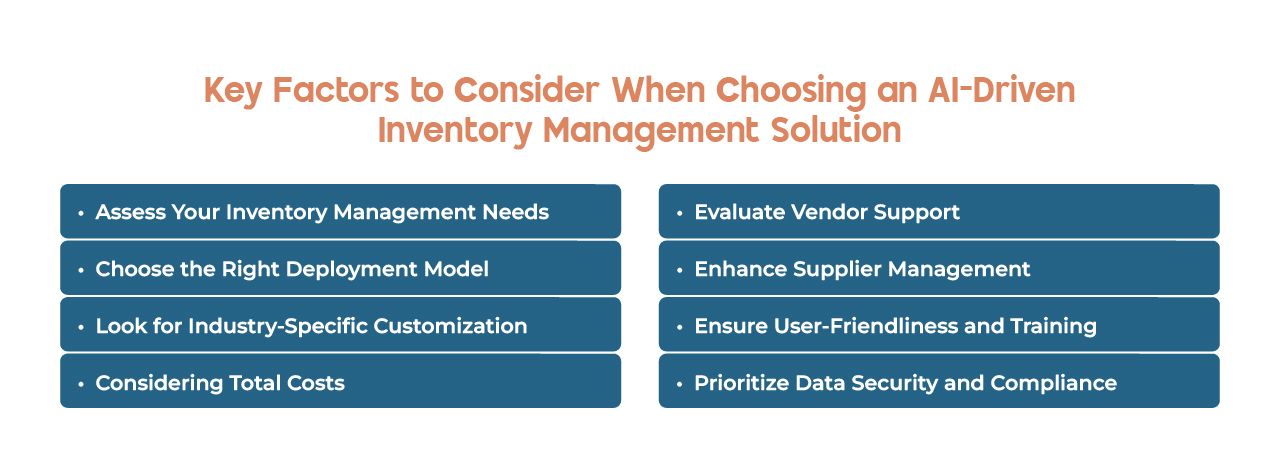
1. Assess Your Inventory Management Needs
Understanding the inventory challenges your business faces is crucial, as they vary based on company size, growth stage, and industry requirements.
-
Small businesses Choose affordable, easy-to-use inventory management solutions that require minimal integrations while maintaining accurate stock levels and basic inventory visibility.
-
Large enterprises They need advanced inventory management solutions with capabilities such as AI demand forecasting, multi-location inventory visibility, robust automation, and deep analytics to manage complex supply chains and large product portfolios.
-
Growth Choose a scalable inventory management system that can evolve with your business, support higher order volumes, and adapt without requiring costly upgrades as operations expand.
-
Industry Type Ensure the software supports your specific industry needs. For example, seasonal retailers may require trend forecasting and demand planning, while businesses handling perishable goods may need expiration date tracking and lot or batch management.
2. Choose the Right Deployment Model
You can basically choose from two model types, whichever align with your business needs, budget, and goals:
-
On-premises systems: These systems provide full control over data and infrastructure, ideal for companies that prioritize security and local management.
-
Cloud-based solutions: These software solutions are widely popular for their flexibility, accessibility, and strong backup support, making them ideal for fast-growing or e-commerce-driven operations. Cloud-based inventory management platforms also simplify ERP and API-driven integrations while supporting multi-location inventory tracking.
3. Look for Industry-Specific Customization
Select an IMS solution that can be tailored to your unique industry needs. Features like seasonal trend analysis or expiration date tracking tools ensure the system aligns closely with your business needs and improves business performance.
4. Considering Total Costs
Evaluate the costs involved, such as implementation, maintenance, licensing, and potential updates. Compare these costs with expected savings from improved productivity, fewer stockouts, and reduced carrying costs, to calculate ROI.
5. Evaluate Vendor Support
Dedicated vendor support allows smooth system adoption and ensures great performance. Consider the software solution providers that stay updated on technologies, innovation, troubleshooting, and reliable customer service to help you solve issues on time and ensure the system's efficient performance.
6. Enhance Supplier Management
AI-enabled systems can monitor supplier performance metrics such as delivery speed, pricing, and quality of service. These insights help businesses choose stronger partners and build long-term relationships by negotiating more favorable terms.
7. Ensure User-Friendliness and Training
You must choose an intuitive platform that offers training resources to ensure smooth adoption of the system. The vendor must also provide onboarding assistance and user support to maximize the benefits of AI.
8. Prioritize Data Security and Compliance
With the sensitive nature of inventory and sales data, it’s essential to choose a solution that prioritizes security and data compliance, ensuring the safety of the business and customers’ information.
Whether you operate in retail, eCommerce, 3PL, or manufacturing, AI-powered inventory optimization ensures accurate planning and omnichannel fulfillment.
Q: How does AI-powered inventory management reduce stockouts? AI-powered inventory management reduces stockouts by analyzing real-time demand signals, historical sales data, and supplier lead times to trigger automated replenishment before inventory levels fall below optimal thresholds.
Real-World Example: How Fulfillor Transformed Inventory Management
A mid-sized retail brand reduced surplus inventory by 30% within six months using Fulfillor’s AI-driven demand forecasting and automated replenishment. Fulfillor is an AI-driven inventory management and 3PL WMS platform. It helped the client navigate complexities, including inefficiencies, excess stock, redundancies, and recurring stockouts. By leveraging Fulfillor’s AI-driven inventory management software's demand forecasting feature, they achieved precise predictions.
Ultimately, this approach helped the retailer achieve a 30% reduction in surplus inventory, which significantly reduced carrying costs and waste, thereby supporting both financial and sustainability goals. AI in supply chain led to shorter lead times, improved supplier collaboration, and data-driven decision-making.
Summary: Why AI-powered inventory management matters
AI-powered inventory management helps businesses reduce stockouts, optimize inventory levels, automate replenishment, and make data-driven decisions using real-time insights and predictive analytics. Platforms like Fulfillor combine these capabilities into a unified system designed for modern retail, eCommerce, manufacturing, and 3PL operations.
Fulfillor is an AI-driven inventory management and 3PL WMS platform, built for modern logistics teams, helping 3PLs streamline fulfillment, boost accuracy, and optimize inventory operations end to end. Trusted by logistics and fulfillment teams across the US, UK, Europe, and the Middle East, Fulfillor empowers brands with real-time visibility and intelligent automation to scale effortlessly.